
A travel insurance foreign medical bill translation claim can stall when the hospital provides one unfamiliar invoice, a handwritten receipt, or documents in several languages. The solution is not to replace the originals with an English summary. Build a traceable packet that preserves the source documents and explains the patient, provider, dates, services, diagnosis, currency, payment, and translation.
Requirements vary by travel policy and by any health plan that must process the expense first. Ask each payer what it needs, who may translate, whether certification is required, how files should be transmitted, and which exchange-rate method applies. A well-organized packet reduces questions without guaranteeing coverage.
Key takeaways
- Keep every original-language invoice, receipt, medical record, and discharge document.
- Request an itemized bill; a card slip or total-only receipt is usually insufficient.
- Ask the insurer whether it translates documents or requires a certified or independent translation.
- Record original currency, payment date, card conversion, fees, and any refund separately.
- Protect claim deadlines while waiting for a provider correction or translation.
Start at the hospital before discharge
Request records while the patient is still near the facility. Foreign hospitals can be difficult to reach after the traveler returns home, time zones can slow corrections, and online portals may require a local telephone number. Ask the billing office and medical-records office separately; they may issue different documents.
Obtain the provider’s legal name, physical address, telephone, email, tax or registration identifier when available, and bank or receipt details. Record the treating physician and department. Confirm how the facility will handle later insurer inquiries.
What an itemized foreign medical bill should contain
- patient’s full name and, if used locally, passport or patient number;
- provider and facility identity;
- admission, discharge, and individual service dates;
- each consultation, procedure, medication, test, supply, and room charge;
- diagnosis, reason for treatment, or corresponding clinical record;
- original currency and amount for every line;
- taxes, discounts, deposits, refunds, and outstanding balance;
- invoice number, issue date, and payment status; and
- provider signature or stamp if customary and requested.
A credit-card receipt proves a transaction but does not explain the care. A discharge summary explains treatment but may omit charges. A total-only invoice lacks the detail an adjuster needs to evaluate eligible expenses. Submit the records together.
Original documents remain the source of truth
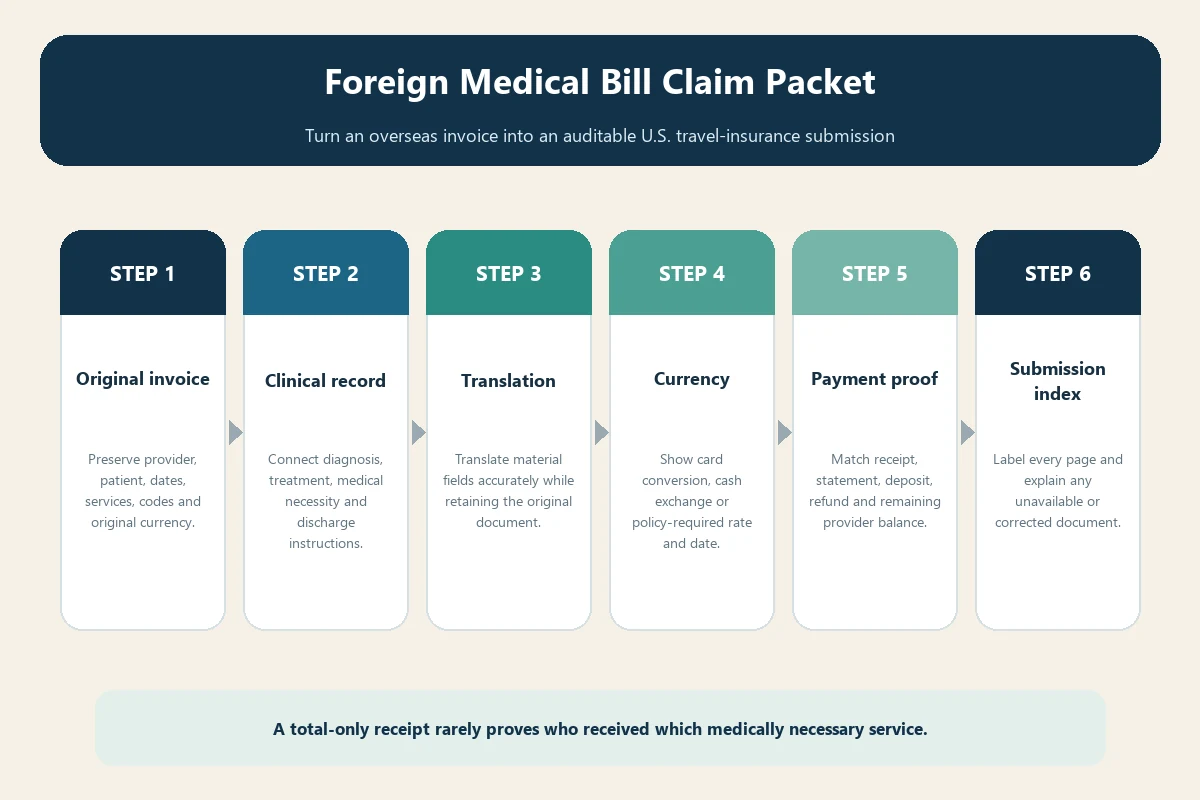
Never discard or overwrite the original-language file. A translation is a companion document. Give the source and translated file matching names, page numbers, and an index entry. If the provider corrects an invoice, retain both versions and explain the correction.
Do not alter a scanned invoice to insert English text, convert currency, remove a balance, or combine unrelated patients. Add a separate translation and reconciliation sheet. This preserves authenticity and makes later review possible.
Ask who is responsible for translation
There is no universal travel-insurance rule that the traveler must always obtain a certified translation or that the insurer must always translate. The certificate, claim instructions, language, document complexity, amount, and administrator process matter. Ask in writing:
- Will the insurer accept and translate the original documents?
- If not, must the translation be certified, notarized, independent, or professional?
- Can the treating provider issue an English version?
- Must every page be translated or only specified sections?
- Is translation cost potentially reimbursable, and under which benefit?
- How should personal health information be transferred securely?
Do not incur a large translation expense based only on an online forum. Obtain the claim handler’s requirements and preserve the answer.
What a useful translation should show
The translation should mirror page order and identify the source language, patient, provider, dates, service lines, diagnosis terms, currency, totals, stamps, handwritten notes, and illegible text. It should not “improve” the medical content or silently convert codes. Translator notes should be clearly distinguished from the source.
When certification is required, follow the insurer’s stated form. The translator may need to attest to competence and completeness, sign, date, and provide contact details. Notarization verifies a signature under the applicable process; it does not itself prove medical accuracy.
Machine translation: useful index, risky evidence
Automated translation can help a traveler identify which pages are bills, discharge notes, prescriptions, or laboratory results. It can also mistranslate abbreviations, decimals, drug names, negation, and handwritten text. Do not represent an unreviewed machine output as a certified translation.
If the insurer permits an informal translation for a small claim, label the method honestly and retain the original. For a large, complex, disputed, or medically sensitive claim, use the standard the adjuster requests and consider a qualified human translator.
Clinical records support medical necessity
A bill alone may not show why care was needed. Request the emergency note, admission history, physician assessment, diagnostic results, treatment record, operative note if relevant, medication list, and discharge summary. Ask for a fit-to-fly or trip-interruption recommendation when it was actually made.
Do not ask the clinician to decide insurance coverage. The clinician documents medical facts; the carrier applies the policy. If the traveler was moved, add transfer records and assistance-company communications.
Separate each provider
A single episode can create hospital, physician, radiology, laboratory, pharmacy, ground ambulance, and lodging charges. Build one folder and reconciliation row per provider. Match each invoice to its receipt and clinical support. If the hospital collected money for an outside physician, obtain a ledger showing that allocation.
This prevents one receipt from being counted twice and helps the insurer identify which expense lacks proof. It also supports later refunds or provider adjustments.
Prove payment and identify who paid
Provide a stamped paid invoice, official receipt, provider ledger, card statement, bank record, or cash receipt consistent with the claim instructions. Show whether the traveler, companion, family member, tour operator, or assistance company paid. Explain deposits and split payments.
Redact unrelated account activity only as permitted, while keeping the traveler name, last account digits, transaction, date, merchant, amount, currency, and final posting visible. A pending card authorization may differ from the settled charge.
Keep original currency separate from conversion
Record the amount and currency printed on the foreign bill. Add the actual U.S.-dollar card posting and foreign transaction fee when applicable. If cash was used, preserve the withdrawal, exchange receipt, or other evidence. Do not rewrite the provider invoice in dollars.
The policy or administrator may use the transaction date, service date, payment date, statement conversion, or another source. The foreign medical direct-billing guide explains why provider payment and later reimbursement use different records. Never assume the travel insurer must reimburse a card fee unless the certificate includes it.
Other insurance and the EOB
If travel medical coverage is secondary, the U.S. health plan may need to process the foreign expense first. Follow its member-claim instructions and obtain a complete EOB or formal noncoverage decision. Use our travel insurance EOB guide to distinguish the payer decision from the bill and receipt.
Original Medicare generally excludes most foreign care, subject to narrow exceptions. Medicare Advantage plans can have different worldwide emergency provisions. Our Medicare coordination guide covers the sequence.
Patient privacy and authorization
Medical records contain sensitive information. Use the insurer’s secure portal, verify any recipient, and understand the scope of a requested authorization. U.S. HIPAA rights can help patients obtain records from covered U.S. providers, but a foreign hospital is governed by its local system and may require its own form, identity proof, or fee.
For a companion or family member to act, the provider or insurer may require written authority. A travel policy’s claim authorization is not automatically accepted by a foreign hospital.
Protect the deadline while records are pending
Foreign providers can take weeks to issue final records. Give notice promptly, submit the available claim form and invoices, list missing items, and provide the request date. Ask whether the file can be supplemented. Follow our notice and proof-of-loss deadline guide.
If the provider refuses or cannot produce a document, describe the attempts and provide alternative evidence. Do not fabricate an itemization. Ask the adjuster what substitute it will consider.
Claim packet structure
- One-page chronology and claim index.
- Policy, itinerary, passport travel evidence, and claim form.
- Provider identity and original itemized invoice.
- Page-matched translation with required certification.
- Clinical records supporting the event and treatment.
- Proof of payment and currency evidence.
- First-payer EOB or denial when required.
- Refunds, corrected bills, and line-by-line reconciliation.
Use the file-naming and indexing practices in our travel claim documentation guide. For a denial based on missing or unclear foreign records, use our travel insurance appeal workflow.
Common mistakes
- sending only a card slip or total-only invoice;
- submitting a translation without the original;
- combining two patients or providers;
- converting currency directly on the source invoice;
- omitting later refunds or health-plan payments;
- using unsecured email without checking the recipient; and
- waiting for perfect records before opening the claim.
FAQ
Must every foreign medical bill have a certified translation?
Not universally. Ask the insurer what standard it requires for the language, document, and claim.
Will the insurer translate the records?
Some administrators may, while others require the claimant to provide a translation. Obtain written instructions.
Can the hospital issue an English bill?
Many international facilities can, but verify that it remains itemized and matches the original totals and dates.
What if I paid cash?
Request an official paid receipt and ledger, and preserve withdrawal or exchange evidence when available.
Bottom line
A foreign medical claim becomes easier to audit when the original bill, translation, clinical record, payment evidence, currency data, and first-payer decision stay separate but linked. Ask the insurer’s translation standard early, preserve the source documents, and protect deadlines while corrections or records are pending.
Sources
- U.S. Department of State — Insurance Coverage Overseas
- CMS — Patient’s Request for Medical Payment
- Medicare — Coverage Outside the United States
- HHS — Your Medical Records Rights
- NAIC — What to Know About Travel Insurance
- New York DFS — Travel Insurance
Reviewed August 16, 2026. This article provides general educational information and does not replace policy terms, medical advice, translation instructions, privacy law, or an insurer’s claim decision.