
A travel insurance claim recorded statement interview is formal evidence, not an ordinary customer-service call. An adjuster, investigator, attorney, or vendor may ask the claimant to describe the purchase, trip, event, medical history, expenses, refunds, documents, and prior statements while audio or video is preserved.
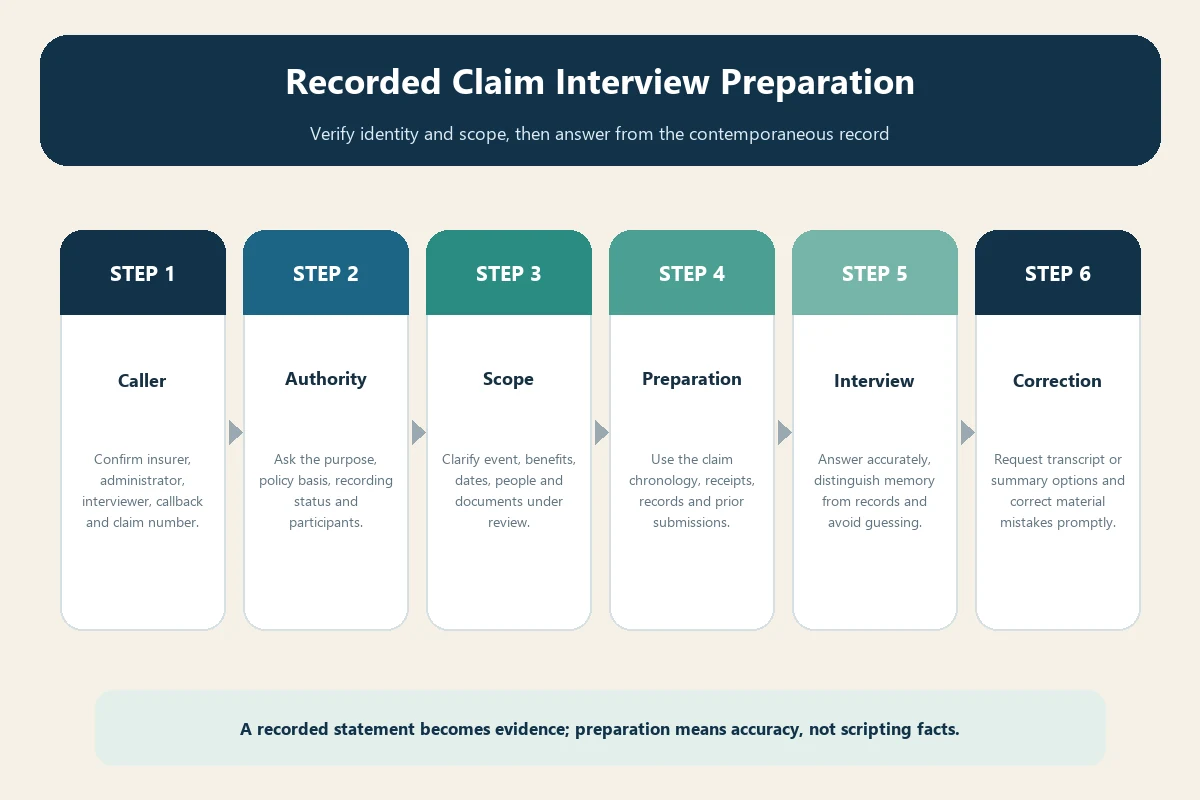
Do not panic or improvise. Verify the caller, ask why the interview is requested, review the policy duty to cooperate, understand recording law and process, prepare a factual timeline from authentic records, and obtain advice when the claim is large, legally sensitive, or potentially disputed.
Key takeaways
- Confirm the interviewer, insurer, vendor, claim number, and recording method independently.
- Ask for the subject areas, estimated length, participants, and policy basis.
- Answer truthfully from memory and records; say when you do not know.
- Do not guess dates, diagnoses, causes, values, or legal conclusions.
- Ask how to obtain or correct the statement and preserve every deadline.
Why an insurer may request an interview
A statement can clarify inconsistent dates, missing documents, a complex medical event, trip-cost changes, supplier refunds, baggage ownership, another insurer, assistance calls, or who paid an expense. It can also be part of routine verification or a more formal investigation.
The request alone does not prove fraud or denial. Ask which benefit and issue the interviewer needs to understand. A focused request is easier to prepare for than an undefined examination of the entire trip.
Verify the request
Do not use only the phone number or link in an unexpected message. Contact the insurer or administrator through the certificate, official website, or authenticated portal. Confirm the interviewer’s name, company, role, claim number, email domain, and authority.
Ask whether a third-party investigation vendor is involved and what information it will receive. Never send passport, bank, medical, or login details to an unverified contact.
Ask about the format
- Will the interview be audio, video, or transcribed?
- Who will attend and ask questions?
- How long is it expected to take?
- Which benefits, dates, and subjects are in scope?
- May the claimant review documents during the interview?
- Is an interpreter or accessibility accommodation available?
- Can a lawyer or representative attend?
- How can the claimant request a copy or transcript?
Get logistical answers in writing. Do not secretly record without understanding applicable consent law and the insurer’s procedure.
Review the policy duties
Travel policies can require cooperation, information, records, authorizations, examinations, or statements. Read the exact certificate, endorsements, claim form, and request letter. Ask the administrator to identify the provision if it is not clear.
Do not assume a duty means every question or authorization is unlimited. Conversely, refusing without review can affect the claim. Obtain legal advice for a contested demand, broad rights request, or approaching deadline.
Build a factual chronology
Prepare a date table for policy purchase, first trip payment, booking changes, onset of circumstances, treatment, cancellation or interruption, assistance contact, expenses, supplier requests, claim notice, documents submitted, refunds, and decisions. Link each date to a source.
Use the chronology as a memory aid if permitted. Do not memorize a script or make the story sound smoother than the records. Legitimate uncertainty is better than a confident guess.
Separate personal knowledge from documents
State what you personally saw, did, paid, or heard. Identify information learned from a doctor, airline, companion, or document. If asked for a diagnosis or carrier cause outside your knowledge, refer to the official record rather than interpreting it.
Do not speculate about what another person intended or why a system changed a status. Offer to provide the relevant record.
Review prior submissions
Read the claim form, emails, portal entries, physician statements, supplier records, EOBs, and earlier calls. Note any mistake or ambiguity before the interview and prepare a transparent correction.
Our claim documentation guide explains how to index the file. Use the supplement and correction workflow if a record needs updating.
Trip purchase and cost questions
Expect questions about who booked, who paid, the first trip payment, total insured cost, additions, cancellations, refunds, credits, and whether another person or program reimbursed anything. Bring the declarations, invoices, and payment reconciliation.
Do not treat a booking authorization as a final charge or a voucher as cash. Identify each financial event accurately.
Medical questions
The interviewer may ask when symptoms began, when care was sought, what a clinician advised, prior treatment, medication changes, and how the event affected travel. Use medical records for dates and avoid self-diagnosing or paraphrasing technical findings beyond your understanding.
Review the scope of any medical records authorization. A statement does not replace itemized bills, clinical records, or an EOB.
Assistance and evacuation questions
Prepare assistance case numbers, calls, messages, treating-facility information, transport decisions, and reasons prior coordination was impossible if applicable. Distinguish advice from authorization and a request from an approved arrangement.
Do not say “the insurer approved everything” unless a written guarantee or authorization says that. Provide the exact document.
Baggage and property questions
Be ready to identify ownership, purchase date, original cost, condition, last possession, carrier or police reports, recovery, and replacement. Describe evidence honestly when receipts are missing. Our alternative proof guide gives the evidence ladder.
Do not use current replacement price as original purchase price or combine two similar items.
Supplier refund and chargeback questions
Disclose refund requests, pending credits, vouchers, card disputes, goodwill payments, and later recoveries. Bring the final supplier statement and card status. A provisional credit should be labeled provisional.
Use the supplier refund statement guide and preserve later changes.
When documents conflict
Prepare a discrepancy table before the interview. List the field, each version, likely source, and verified correction. Common conflicts include local versus U.S. dates, booking versus posting dates, maiden versus married names, time-zone differences, estimated symptom onset, and a supplier status that changed after the first submission.
Do not choose the version that helps the claim most. Explain why the records differ and identify which issuer can correct them. If the answer remains unknown, say that. A documented uncertainty is more credible than an unsupported exact answer.
Companions and witnesses
A traveling companion can have relevant personal knowledge, but one claimant should not rehearse or supply another person’s memory. Ask whether the insurer wants a separate statement. Identify shared expenses, who made calls, who witnessed the event, and which facts came from another traveler.
For a senior traveler with cognitive, hearing, or communication limitations, document the condition and requested support. A helper may assist with records without answering personal-knowledge questions for the insured unless authorized and accepted.
Sensitive identifiers and financial data
Ask whether full Social Security numbers, passport numbers, bank credentials, or unrelated account data are necessary during the recording. Use the approved secure channel for documents and verify how the recording will be stored and shared. Do not read passwords, one-time codes, or complete card credentials aloud.
If payment details must be updated after the interview, use the authenticated portal or verified payment team. Treat an unexpected request to move the conversation to a messaging app or send money as a separate fraud warning.
During the interview
Listen to the complete question and answer only what was asked, while providing necessary context. Ask for clarification when a term is unclear. Take reasonable breaks. Do not let silence pressure you into guessing.
Use “I do not remember,” “I need to check the record,” or “I do not understand the question” when true. Correct a mistaken answer immediately. Distinguish approximate dates from exact ones.
Interpreters and accessibility
Ask for a qualified interpreter when language could affect accuracy. Confirm whether the interpreter is independent, how the recording identifies each speaker, and whether translated documents are available. A family member can have conflicts or lack technical vocabulary.
Request reasonable accessibility support for hearing, vision, cognition, speech, or medical needs. Put the request in writing before the session.
Representatives and counsel
Ask whether a lawyer, guardian, executor, or authorized representative can attend and what documentation is required. The claimant may still need to answer personal-knowledge questions. A power of attorney, beneficiary designation, or family relationship does not automatically grant every claim authority.
For suspected fraud, serious injury or death, high-value loss, broad medical inquiry, or legal exposure, consult qualified counsel before the interview.
After the interview
Write down the date, participants, duration, subjects, promised documents, and corrections. Submit requested records with a manifest. Ask how to obtain the recording or transcript and how corrections should be made.
If you later discover a material error, notify the administrator promptly in writing, identify the question and corrected fact, attach support, and ask that it be added to the claim file. Do not alter a transcript.
Recorded statement versus examination under oath
An examination under oath can be a more formal contractual process with different procedures and consequences. Do not assume the terms are interchangeable. Ask the insurer to identify the request and governing provision, and obtain counsel for an examination under oath.
Deadline protection
Scheduling an interview does not automatically extend proof, appeal, or legal-action deadlines. Keep the clocks in our deadline guide. If the interview date falls after a deadline, submit the required document through the proper channel and state that the interview is pending.
FAQ
Does a recorded statement mean the claim will be denied?
No. It can be routine verification or focused investigation. Ask what issue and benefit are under review.
Can I refuse?
Policy duties and law matter. Do not refuse or agree blindly; review the request and obtain advice if disputed.
Can I use notes?
Ask beforehand. A chronology and authentic records can aid accuracy, but the interviewer controls the process.
What if I made a mistake?
Correct it promptly during the interview or in a documented follow-up with supporting evidence.
Bottom line
A recorded statement is formal evidence. Verify the request, define its scope, review policy duties, prepare an indexed chronology, answer from personal knowledge and records, and correct mistakes transparently. Preserve privacy and deadlines, and obtain counsel when the request or stakes warrant it.
Sources
- NAIC — Unfair Claims Settlement Practices Act
- NAIC — Travel Insurance Model Act
- NAIC — What to Know About Travel Insurance
- NAIC — State Insurance Departments
- New York DFS — Travel Insurance
- California Department of Insurance — Travel Insurance Guide
Reviewed August 16, 2026. This article is general educational information, not legal advice about recording consent, cooperation duties, or claim strategy.