

Travel insurance for Colombia from USA trips should be selected from the actual route, not from a destination label. Bogotá’s elevation, regional advisory language, rural response limits, private medical payment and separately ticketed domestic flights create different contract questions. A useful comparison starts with those facts and then tests policy wording.
Key takeaways
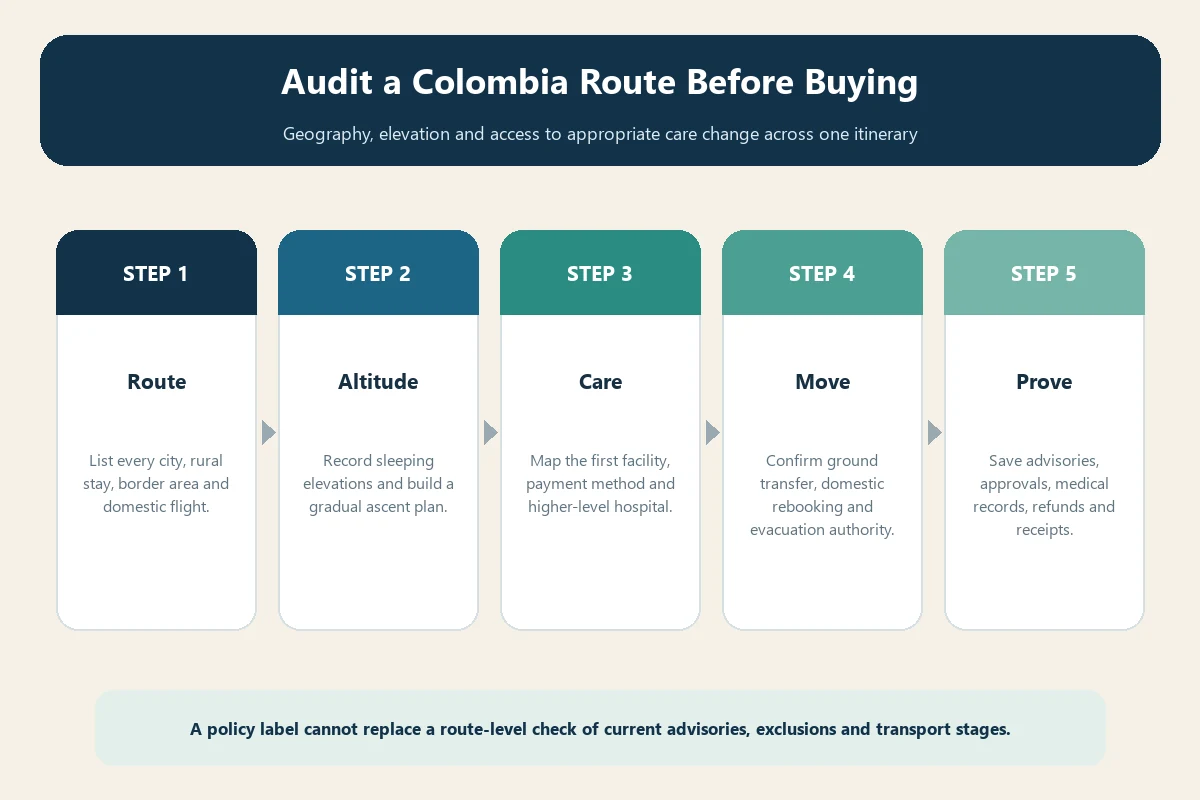
- Save the current advisory and test every overnight against its geography.
- Record sleeping elevations and allow time for gradual acclimatization.
- Confirm upfront medical payment, assistance and transfer procedures.
- Audit domestic flights and U.S. connections as separate contracts.
- Preserve dated health guidance, approvals, refunds and itemized bills.
Planning information reviewed August 16, 2026. Advisories, health measures, routes, operators and policy terms can change. Recheck every official source and supplier for the travel dates.
Start with the current route-level advisory
The current U.S. Department of State Colombia travel guidance is Level 3, Reconsider Travel. Its March 31, 2026 version identifies specific departments and the Venezuela border area as Do Not Travel. It also describes limited emergency response and medical capability outside major cities. Read the entire current page rather than relying on an undated search result.
List each airport, city, rural lodge, day trip and road corridor. Beside each, record the advisory status on the policy purchase date and the departure date. Ask the insurer whether a country, department or border exclusion applies and whether a later advisory change can trigger a named trip benefit.
The country exclusions and advisories guide explains how to test geographic wording. A national level does not automatically create cancellation coverage. The result depends on the covered-reason list, known-event language, purchase timing and exact affected place.
Build an elevation plan before comparing limits
Bogotá sits high enough for some visitors to feel the effects of elevation. A route that flies directly from a low U.S. city to Bogotá, continues higher, or adds strenuous activity should be planned differently from a coastal stay. Record the sleeping elevation for each night, not only the highest sightseeing point.
The CDC’s official high-altitude travel guidance explains that gradual ascent is protective and that fitness does not prevent altitude illness. Discuss personal risks with a clinician. Do not treat insurance as a substitute for acclimatization or medical advice.
Ask the insurer how an altitude-related illness is evaluated. Check pre-existing-condition definitions, stability or look-back rules, physician-advice exclusions and any restriction on hiking elevation. The pre-existing condition waiver guide helps audit deadlines and eligibility without assuming that a waiver covers every circumstance.
Separate medical treatment from access to treatment
The State Department reports adequate care in major cities but lower standards in many rural areas. It warns that providers often expect upfront payment and that patients may need to pay transfer costs. A high medical limit is incomplete if the traveler cannot reach an appropriate facility or meet a deposit request.
For every overnight, identify the first realistic clinic and the higher-level hospital a local clinician might use. Record travel time, hours, accepted payment and whether ambulance service is available. Do not promise yourself a specific hospital; a receiving bed and medical judgment control a real transfer.
Ask each insurer whether its assistance team can issue a guarantee of payment, contact a hospital in Spanish, arrange ground transport and coordinate a receiving facility. The assistance line versus claims guide separates live coordination from later reimbursement.
Check the U.S. health plan before choosing primary or secondary coverage
Call the U.S. health insurer with a Colombia scenario. Ask about emergency and nonemergency care, out-of-network rules, prior authorization, claim forms, currency conversion and whether it pays providers directly. Obtain the answer in writing when possible.
The health insurance abroad guide provides a structured check. Then use the primary versus secondary travel medical guide to see which plan must review first. “Primary” describes claim order; it does not guarantee direct payment in Colombia.
Carry a payment method with enough flexibility for a deposit while following personal-security guidance. Keep the authorization, itemized bill, diagnosis, proof of payment and final reconciliation. A card slip alone rarely establishes what care was provided.
Map medical transport as four separate stages
A serious case can require response to the traveler, movement to a first facility, transfer to a capable hospital and possible international evacuation. Ask who chooses the transport provider, confirms the receiving bed and certifies medical necessity at each stage.
The emergency medical evacuation guide distinguishes transport to appropriate care from a traveler’s preference to return to the United States. Check insurer control, destination language, medical escort, companion travel and return-home benefits.
Give assistance a test case: a traveler becomes ill at elevation several hours from a major city, the first clinic accepts the patient, and a physician recommends higher-level care. Ask how ground transport, hospital acceptance, payment and flight suitability would be coordinated. Record the response and the policy page supporting it.
Review official health measures without turning them into insurance promises
Colombia’s Ministry of Health maintains current traveler vaccination information, including yellow-fever risk areas and timing. Its English health recommendations for travelers advise carrying health-insurance and assistance details.
Health requirements and insurance coverage are separate. A vaccine recommendation does not create a claim benefit, and a policy does not remove a health rule. Save the official page reviewed for the exact route. If a clinician advises against vaccination or travel, ask the insurer what medical documentation and timing a cancellation claim would require.
For rural or jungle trips, add mosquito-borne illness, medication storage and access to care to the planning file. Ask a travel-health clinician about the itinerary. Avoid relying on a hotel desk or commercial insurance article for a medical decision.
Audit domestic flights and separate tickets
A Colombia itinerary may combine an international ticket with separately purchased flights to Cartagena, Medellín, the coffee region or a remote gateway. Record the legal carrier, baggage terms, minimum connection, final departure and refund rule for every segment.
Ask whether missed-connection coverage applies to the exact carriers and whether a minimum delay is required. Determine what happens when the domestic airline changes its schedule but the U.S.-bound airline operates normally. The delay, interruption and cancellation guide helps classify the loss by timing.
Do not assume an airline credit equals an insured cash loss. Preserve the original schedule, carrier notice, alternate offer, credit expiry and added expense. If the traveler voluntarily buys a replacement before asking the carrier or assistance team, reimbursement may be limited.
Test road travel and activity wording
For a rental car, confirm driver eligibility, mandatory liability, collision damage, theft, tires, glass, towing and excluded roads. Vehicle protection and medical coverage are different. The rental-car abroad guide separates damage to the car from traveler injury and unused trip arrangements.
For hiking, cycling, rafting, diving or guided wildlife trips, give the insurer the exact activity, maximum elevation, operator status, equipment and remoteness. Ask whether search, rescue and nonmedical extraction are excluded. A helicopter that retrieves an uninjured traveler is not automatically a medical evacuation.
Review operator cancellation and safety terms. Preserve registration, waiver, route, guide contact and emergency plan. If weather or an advisory changes, ask the operator for its written decision before making a voluntary cancellation.
Compare policies with one Colombia scenario
Use identical traveler ages, dates and prepaid costs. Include two nights in Bogotá, a domestic flight, a rural stay, a guided activity, an upfront hospital deposit, a ground transfer and a possible missed U.S. connection.
- Which itinerary areas or advisory events are excluded?
- How are altitude illness and the exact activity treated?
- Can assistance guarantee payment and coordinate in Spanish?
- Who authorizes ground transfer and international evacuation?
- Do separate domestic tickets qualify for connection benefits?
- Which deadlines and records control reimbursement?
Compare the actual certificate and endorsements, not only a quote table. Record the page number for every answer. If an agent gives a broader answer than the contract, request written clarification before purchase.
Build a claim file that explains the chronology
Keep the purchase receipt, certificate, itinerary, dated advisory, clinician note, case number, authorization, transport record, itemized bill, proof of payment, carrier notice, refund and replacement receipt. Record the original currency and actual card conversion.
The travel insurance claim guide provides a sequence for coordinating suppliers, the U.S. health plan and travel insurer. Disclose every refund and claim only the eligible unreimbursed amount.
If the traveler changes route for safety, preserve the official information, supplier options and assistance instructions available at that moment. A later news report cannot replace the contemporaneous reason, and concern alone may not be a covered event.
Give a companion a Colombia response card
Create one secure, offline page with passport details, allergies, medications, policy number, assistance number, U.S. health-plan contact and emergency consent. Add the Spanish names of key conditions and the addresses of the planned first facilities. A companion should know where the file is stored and which payment method can be used.
Define roles before departure. One person communicates with clinicians and assistance while another records estimates, approvals and receipts. If a domestic flight must change, a third contact at home can review supplier rules without delaying care.
Ask the insurer whether interpretation, companion lodging, dependent return or bedside travel requires medical certification. These benefits may have separate limits and do not automatically follow approval of the patient’s transport. Save the representative’s name, time, instruction and case number after every call.
Bottom line
The best Colombia plan is route-specific. It connects elevation, advisory geography, payment access, appropriate care, transport authority and separate flight contracts. Verify those operational facts before comparing headline limits, then keep the evidence needed to use the coverage.