
Travel insurance flight crew shortage coverage is not automatic when a departure board says “awaiting crew.” The airline may owe rebooking and amenities because staffing is within its control, while the policy may cover the delay, cover only a different underlying cause, or omit crew shortage entirely.
This U.S. guide explains how to classify the crew event, protect carrier remedies, test insurance wording, and calculate the remaining loss. It is educational, not legal, aviation, labor, or insurance advice.
“Crew shortage” can describe several events
A flight may lack a pilot, first officer, required flight attendant, reserve crewmember, or qualified person for a particular aircraft. A crew can also be delayed on another flight, exceed a duty limit, report fatigue or illness, miss a positioning segment, or become unavailable after a schedule change.
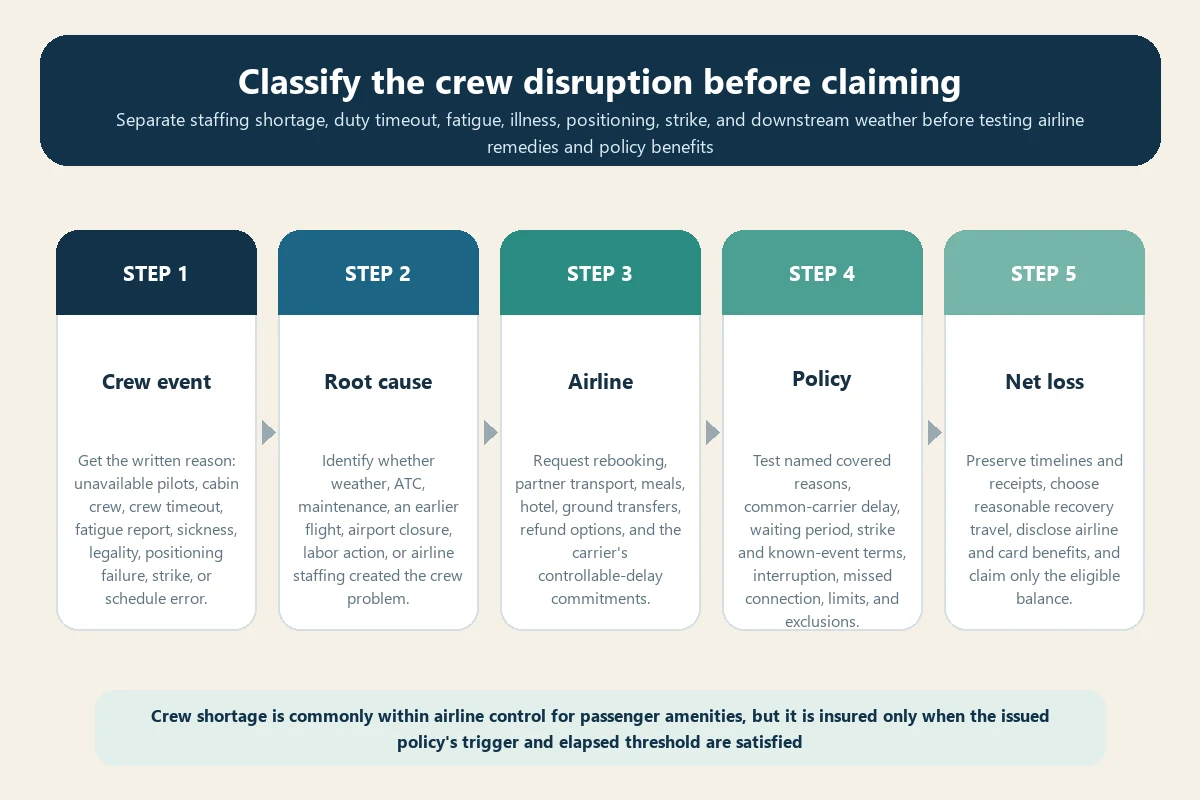
Insurance and airline remedies can turn on the exact event. Ask the operating carrier for the written reason rather than treating every staffing problem as one category.
Crew shortage differs from crew timeout
A shortage means the airline does not have the required available personnel. A timeout generally means assigned crewmembers can no longer complete the planned operation within applicable flight, duty, or rest limits. The two can overlap when no legal replacement crew is available.
The FAA’s crewmember duty and rest FAQ explains that commercial requirements vary with the type of operation and applicable regulation. Do not estimate legality from passenger-visible hours alone.
Safety limits are not optional delays
FAA rules restrict duty and require rest because fatigue affects safe performance. The agency’s aviation workforce safety guidance notes that pilot duty is limited and airlines must maintain fatigue-awareness and risk-management systems.
A passenger should not pressure crew or agents to operate beyond safety limits. The claim question is not whether the flight should have departed anyway; it is who provides the travel remedy and whether the documented disruption meets the policy.
Get a flight-specific reason in writing
Request a delay or cancellation statement naming the flight, date, scheduled time, operational reason, and duration. Save app notices, texts, emails, gate displays, announcements, original boarding pass, revised itinerary, and final arrival.
If the notice says only “operational reasons,” ask whether it was staffing, crew legality, illness, positioning, maintenance, weather, ATC, airport, or another event. Report the answer accurately even when another label appears more favorable.
Find the root cause behind a missing crew
A crew may be out of position because its earlier flight encountered weather, an air traffic restriction, maintenance, diversion, or airport closure. The airline may code the final cancellation as crew, while the insurer asks for the initiating event.
Build a causal chain without speculation: prior flight, disruption, crew arrival, remaining duty, replacement search, cancellation decision, and passenger rebooking. Preserve both airline messages if the code changes.
Ordinary staffing is commonly airline-controlled
The U.S. Department of Transportation has described mechanical or staffing issues as examples of disruptions within an airline’s control. Its Airline Customer Service Dashboard compares carrier commitments for significant controllable delays and cancellations.
Commitments vary by airline and conditions. Check same-airline or partner rebooking, meals, hotel, ground transportation, credits, or other listed services. Save the dashboard and carrier plan applicable on the event date.
Request rebooking before buying replacement travel
Ask for the earliest confirmed itinerary, including partner carriers where the airline has committed to use them. Compare final arrival, airports, connections, baggage transfer, seat accessibility, and protected onward segments.
If the airline offers only standby or an unreasonable delay, document the offer and live alternatives before purchasing. A self-booked premium ticket may exceed policy reasonableness or authorization requirements.
Record whether the substitute seat is confirmed, which cabin and airport it uses, and whether accepting it protects checked baggage and every remaining segment. A vague promise of later travel is weaker than a ticketed itinerary.
Refund rights are separate from amenities
When an airline cancels or significantly changes a flight and the traveler rejects the offered alternative, federal refund rules may require repayment of the fare and eligible ancillary fees. Taking the replacement flight generally changes the refund analysis.
Use our flight-change coverage guide to compare refund, rebooking, and insurance decisions. A meal or hotel commitment is not the same as a ticket refund.
Insurance coverage depends on named reasons
Some policies cover any documented common-carrier delay after a waiting period. Others list only severe weather, mechanical breakdown, strike, accident, or another narrow set. Crew shortage or operational staffing may not appear.
Quote the exact covered reason and definition. Do not convert a staffing shortage into mechanical failure or weather without carrier evidence connecting the events.
Test the waiting period independently
A covered crew event may still need to delay travel for a specified number of consecutive hours or force an overnight stay. The policy can measure from scheduled departure, the start of the disruption, or final arrival.
Record every scheduled, revised, and actual time. Use our flight-delay coverage guide to test the clock, daily expense limit, and total maximum.
Crew illness may be treated differently
A sudden illness can remove a crewmember shortly before departure, but a policy’s traveler-illness provision may apply only to the insured, companion, family member, or host—not an airline employee. A general common-carrier delay provision may be more relevant.
Ask the airline to state that a required crew member became unavailable without requesting private medical details. The operational fact is usually sufficient; passenger claims do not require the employee’s diagnosis.
A fatigue report is not automatically a shortage
A crewmember may report unfit due to fatigue even before reaching a numerical limit. FAA fitness-for-duty principles prevent assignment or acceptance when a flightcrew member is too fatigued to operate safely.
Document the carrier’s resulting delay reason and replacement effort. Avoid alleging misconduct. Insurance turns on the verified common-carrier event, policy terms, elapsed time, and expense—not blame directed at an individual employee.
Strike and labor action form a separate branch
A strike, sickout, work stoppage, or industrial action may have its own policy definition, announcement date, waiting period, and known-event exclusion. Routine scheduling shortage should not be relabeled as a strike.
Preserve union, carrier, and government notices when relevant. Check whether the labor action was known when coverage was purchased and whether the policy requires an unannounced strike.
ATC staffing is not airline crew shortage
Air traffic controllers manage the airspace and are not the airline’s flight or cabin crew. An ATC staffing restriction can delay many carriers and is generally outside the airline’s ordinary staffing control.
Use our air traffic control delay guide to identify the FAA initiative and underlying cause. Keep the two staffing systems separate in the claim.
Measure downstream connections and reservations
A crew-related departure delay can cause an onward misconnection, missed cruise embarkation, lost hotel night, tour absence, or rental change. Record the protected ticket, minimum connection, carrier rebooking, supplier no-show terms, and refunds.
Use our missed-connection insurance guide when another segment is lost. Trip delay, missed connection, and interruption can have different triggers and should not reimburse the same cost twice.
Claim reasonable additional expenses
Potential costs include meals, hotel, ground transportation, communications, and reasonable replacement travel, subject to the policy. Expenses the airline provides or promises are not an outstanding traveler loss.
Keep itemized receipts and payment proof. Separate ordinary planned spending from additional cost. Alcohol, entertainment, upgrades, luxury lodging, speculative reservations, and unsupported cash purchases may be excluded.
Reconcile airline and card benefits
List airline refunds, vouchers, rebooking, meals, lodging, transport, credit-card trip-delay payments, and other insurance. Match each recovery to the expense it addresses and disclose disputed vouchers.
Follow our supplier-refund and subrogation guide to calculate net loss. Being eligible to seek two benefits does not permit payment twice for one receipt.
Build the evidence packet
Include the original itinerary, ticket receipt, boarding pass, flight-status history, written crew reason, scheduled and actual times, airline offers, dashboard commitment, revised itinerary, final arrival, affected prepaid reservations, receipts, refunds, vouchers, and insurer communications.
Create a chronology from first notice through arrival. If the root cause began on an earlier flight, mark which facts came from the carrier and which are inference. File through our travel-insurance claim guide before all notice and proof deadlines.
Crew-shortage checklist
- Get the operating carrier’s exact written reason.
- Distinguish shortage, timeout, fatigue, illness, positioning, and strike.
- Identify any documented earlier weather, ATC, or maintenance cause.
- Preserve scheduled, revised, departure, and final-arrival times.
- Request controllable-delay amenities and confirmed rebooking.
- Compare refund rights before accepting an alternative.
- Test the policy’s named reason and waiting period.
- Document missed connections and unused prepaid arrangements.
- Keep reasonable itemized receipts and proof of payment.
- Disclose every airline, card, and insurance recovery.
Bottom line
Travel insurance flight crew shortage coverage requires a precise classification. Protect airline-controlled disruption remedies first, establish whether the event is shortage, timeout, fatigue, illness, positioning, or labor action, and then apply the issued policy.
A documented chronology, reasonable mitigation, and complete recovery ledger produce the strongest claim for the eligible loss that remains.
A jet-fuel shortage needs a supplier-first and timing-specific analysis. Use this travel insurance fuel shortage coverage guide to preserve airline refunds, identify the underlying event and known-date cutoff, test policy wording, and calculate net loss.
