
Travel insurance fuel shortage coverage is usually more limited than travelers expect. An airline still has refund and rebooking responsibilities when it cancels, but a standard policy may not list jet-fuel scarcity as a covered reason and may exclude war, government action, or a shortage already known when coverage was bought.
This U.S. guide explains how to preserve supplier remedies, identify the underlying event, test purchase timing, and claim only the remaining eligible loss. It is educational, not legal, aviation, energy, financial, or insurance advice.
Fuel shortage is not one event
“Fuel shortage” can describe physical scarcity at an airport, refinery or pipeline failure, rationing, delivery interruption, sanctions, conflict, strike, infrastructure damage, supplier insolvency, carrier procurement failure, or fuel that is available but too expensive for the planned operation.
These causes can receive different insurance treatment. Ask the operating carrier for its exact written reason and identify the upstream event without relying on a social-media label.
The airline refund comes before insurance
The U.S. Department of Transportation’s Refunds guide says a consumer is entitled to a refund when an airline cancels a flight, regardless of the reason, if the consumer chooses not to travel or accept the offered alternative compensation.
Request the airfare and eligible ancillary-service fees in the original form of payment when due. Do not claim a refundable ticket as an insurance loss while leaving the airline refund unrequested.
Rebooking and refund are different choices
If the airline offers confirmed alternative travel, compare the route, final arrival, airports, connections, cabin, baggage, accessibility, and onward protection. Accepting rebooking generally means the transportation service continues and changes the refund analysis.
If the alternative is unusable, document why before rejecting it. Preserve the exact offer, response deadline, availability, and price of reasonable alternatives at that moment.
Federal refund rights do not guarantee every expense
A ticket refund does not automatically pay a missed hotel, cruise, tour, rental, meal, or replacement flight. Those items depend on supplier contracts, credit-card benefits, and travel-insurance provisions.
DOT’s Cancellation and Delay Dashboard compares voluntary airline commitments for controllable disruptions. Whether a fuel shortage is considered controllable may depend on whether it arose from carrier procurement or a broader external supply event.
Physical scarcity differs from high fuel prices
An airport can lack enough aviation fuel to support planned operations. Separately, an airline may reduce service because fuel prices make a route uneconomic. Insurance forms may treat a supplier’s financial or commercial decision differently from an unavoidable supply interruption.
Ask whether fuel was unavailable, allocated, delayed, prohibited, or merely more expensive. Preserve the carrier notice and any airport, supplier, or government announcement supporting that description.
Operational fuel rules do not create insurance coverage
Aircraft must depart with required trip, alternate, reserve, and other fuel under applicable operating rules. FAA materials on fuel supply requirements illustrate that operators must plan fuel appropriate to the operation and known delays.
A carrier appropriately refusing to dispatch without required fuel is a safety decision. The policy question remains whether the shortage’s verified cause and resulting travel consequence meet a covered provision.
Look for an expressly named covered reason
Policies often list severe weather, mechanical breakdown, strike, natural disaster, common-carrier delay, or another finite set of triggers. “Fuel shortage” may be absent. A broad benefit title does not replace the named-reason language.
Quote the actual reason and definition. If the fuel interruption resulted from a refinery fire, strike, natural disaster, or airport closure, test that event independently without pretending every downstream loss is automatically covered.
The causal chain matters
A conflict can disrupt shipping, a sanction can prevent purchase, a storm can close a terminal, or a pipeline outage can constrain an airport. The airline then may cancel only certain routes or frequencies.
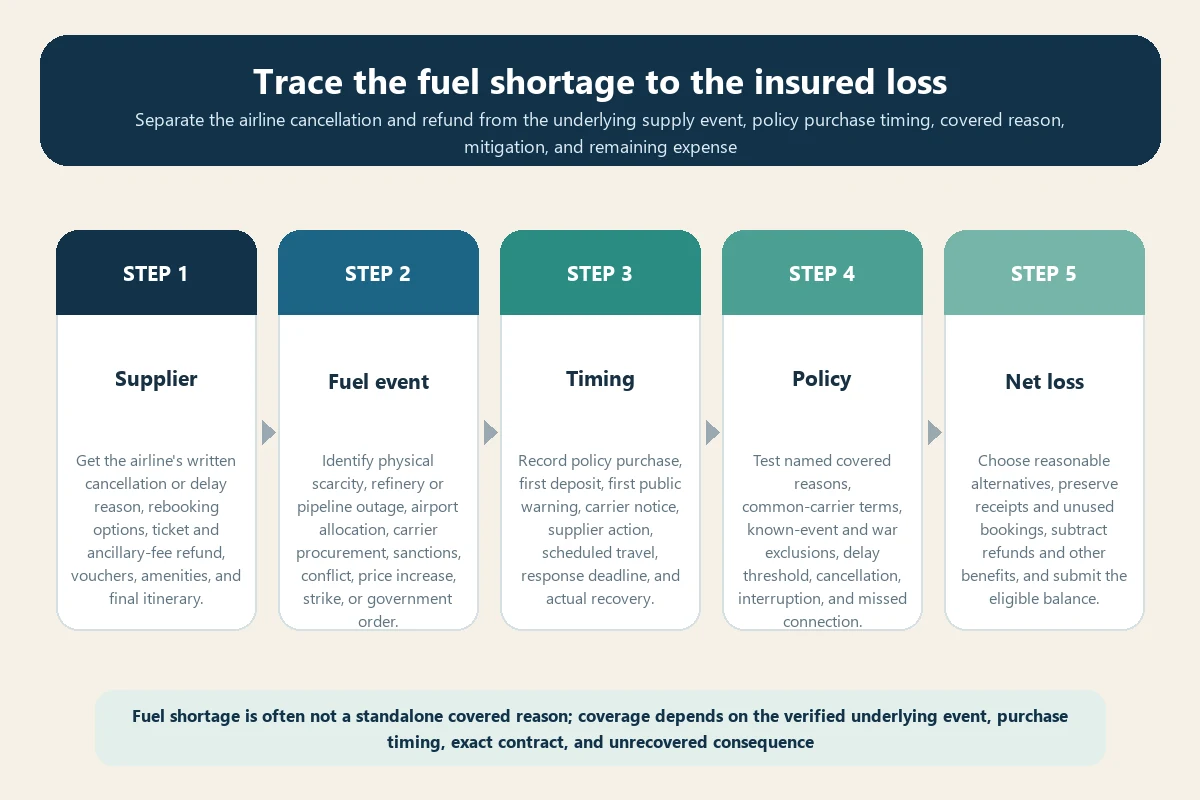
Build the chain from verified event to fuel availability, carrier decision, booked flight, itinerary consequence, expense, and recovery. A broad news article about scarcity does not prove the traveler’s flight was canceled for that reason.
War and sanctions require separate review
When conflict or sanctions create the shortage, a policy’s war, hostilities, military action, government action, sanctions, or indirect-causation language may apply. A terrorism benefit does not necessarily override a war exclusion.
Use our travel-insurance war exclusion guide to map event, causation, exceptions, geography, timing, and access. Do not rely on the phrase “fuel shortage” to erase an upstream excluded cause.
Known-event timing can decide the claim
Travel insurance protects uncertain future events. Once an insurer, government, airline, airport, or widely available source identifies a specific shortage affecting the route, later purchases may not cover losses arising from it.
Record policy quote, purchase, effective date, first trip deposit, first public warning, insurer notice, airline schedule change, and travel date. Avoid asserting one universal known-event date; it can vary by company, product, route, and evidence.
A preexisting policy is not automatically sufficient
Buying before the event became known can avoid one timing objection, but the policy still needs a coverage grant that reaches the actual cause and benefit. Purchase timing cannot insert fuel shortage into a named-peril list.
Likewise, an insurer’s later public advisory may explain claim treatment but cannot be read apart from the issued certificate, endorsements, state form, and purchase date.
Trip delay may cover expenses after a qualifying hold
If the flight operates later, a trip-delay benefit may reimburse reasonable meals, lodging, local transport, or communications after the waiting period—only when the underlying cause is covered.
Record scheduled departure, each update, actual departure, scheduled arrival, and actual arrival. Use our flight-delay coverage guide to test named reasons, clock, daily cap, total maximum, and receipts.
Cancellation and interruption protect different stages
Before departure, trip cancellation may address prepaid nonrefundable arrangements lost because a covered reason stops the trip. After travel begins, interruption may address unused arrangements and reasonable additional transport under different terms.
Use our delay, interruption, and cancellation comparison before choosing a claim section. The airline’s canceled flight does not automatically mean the entire insured trip qualifies as trip cancellation.
Missed connections need their own proof
A fuel-related hold or cancellation may break an onward flight, cruise, rail segment, or tour. Preserve whether the itinerary was on one ticket, the minimum connection, carrier rebooking, supplier no-show rule, catch-up option, and final arrival.
Our missed-connection insurance guide explains benefit-specific waiting periods and catch-up costs. Avoid presenting one replacement expense under multiple benefits.
Carrier insolvency is a different risk
If an airline claims fuel shortage because it cannot pay suppliers, the underlying issue may be financial default or bankruptcy. Policies often define supplier default separately and can impose waiting periods, covered-supplier lists, or exclusions.
Use our airline bankruptcy coverage guide to preserve cessation, insolvency, refund, chargeback, and policy evidence. Do not classify ordinary fuel allocation as insolvency without proof.
Choose reasonable alternative travel
Determine whether the shortage affects one airline, one airport, a country, or an entire region. A replacement ticket may face the same constraint. Check confirmed availability, fuel-related advisories, transit requirements, baggage, accessibility, and refundability.
Contact the insurer’s assistance service before a major purchase when practical. Save screenshots showing price and availability at the decision time and explain why the chosen route was proportionate.
Protect downstream bookings
Contact hotels, cruises, tours, rental companies, and other suppliers promptly. Ask for refunds, date changes, credits, late-arrival protection, or waiver of no-show penalties. Keep every response.
Failure to mitigate can enlarge the loss unnecessarily. Insurance generally addresses eligible unrecovered cost, not an amount a supplier remained willing to refund or move.
Build a recovery ledger
List airfare and fee refunds, alternative transport, vouchers, hotel changes, airline amenities, credit-card payments, chargebacks, supplier refunds, and other insurance. Match each recovery to the expense it addresses.
Use our supplier-refund and subrogation guide to calculate net loss. Disclose restricted or disputed credits and ask the administrator for its written valuation.
Assemble the evidence packet
Include the policy and purchase proof, original itinerary, ticket receipt, carrier cancellation or delay statement, fuel event evidence, public-warning timeline, rebooking offers, refund notices, revised itinerary, final arrival, affected reservations, mitigation contacts, receipts, and recoveries.
Separate verified facts from inference. File through our travel-insurance claim guide and meet notice and proof deadlines even while airline or supplier refunds remain pending.
Fuel-shortage checklist
- Obtain the airline’s exact written operational reason.
- Request rebooking and every applicable ticket or fee refund.
- Identify physical scarcity, cost, procurement, infrastructure, conflict, or sanction.
- Record policy purchase and the first route-specific warning.
- Test named covered reasons and known-event exclusions.
- Separate delay, cancellation, interruption, and missed connection.
- Check whether the shortage affects the proposed alternative.
- Ask downstream suppliers to refund or move reservations.
- Keep itemized receipts and contemporaneous availability evidence.
- Subtract all recoveries and claim only the eligible balance.
Bottom line
Travel insurance fuel shortage coverage requires more than proof that fuel became scarce. Protect airline refund rights first, identify the verified upstream cause and known-event timeline, and then apply the exact policy benefit and exclusion.
A supplier-first recovery strategy and documented net-loss ledger prevent duplicate claims and reveal which expense, if any, remains insured.
A conflict-related flight cancellation requires a supplier-first recovery and clause-by-clause coverage review. Use this travel insurance flight cancellation due to war guide to preserve airline refunds, test exclusions and known-event timing, compare safe reroutes, and calculate net loss.
