
Travel insurance wind shear flight cancellation coverage depends on the booked flight’s final outcome, not simply on a wind-shear or microburst alert. An alert may lead to a delayed takeoff, rejected approach, go-around, holding, runway change, diversion, or cancellation. Insurance coverage then depends on policy wording, timing, thresholds, airline remedies, and documented net loss.
This U.S. guide explains how to connect runway-area detection to the flight maneuver and financial consequence without turning a safety alert into an automatic coverage claim. It is educational, not meteorological, aviation, safety, legal, mechanical, or insurance advice.
Wind shear cancellation coverage at a glance
- Save the alert type, runway, location, wind change, source, and timestamp.
- Preserve the flight maneuver: hold, go-around, runway change, or diversion.
- Get the airline’s final delay or cancellation reason and every remedy.
- Compare the first known hazard with policy purchase and effective times.
- Apply delay, diversion, connection, interruption, or cancellation correctly.
- Subtract airline and supplier recovery before claiming net expense.
Reviewed August 17, 2026.
What is wind shear?
Wind shear is a rapid change in wind speed or direction over a short distance. Near the ground, it can affect aircraft during takeoff and landing. A microburst is a powerful localized downdraft that can produce hazardous changes in wind around an airport.
The FAA’s Terminal Doppler Weather Radar overview explains that TDWR detects hazardous wind shear, microbursts, gust fronts, wind shifts, and precipitation near approach and departure corridors. Detection helps crews avoid the hazard; it does not mean every airport operation stops.
How airport wind-shear detection works
The FAA maintains ground-based Wind Shear Detection Services at many commercial airports. Systems can include Low Level Wind Shear Alert System sensors, Terminal Doppler Weather Radar, and weather-processing tools.
These systems provide real-time alerts to air traffic controllers, who relay them to flight crews. Coverage and capability vary by airport and system. Preserve which source generated the alert instead of assuming every airport observes the same area in the same way.
Read the alert as runway-specific evidence
The FAA’s Air Traffic Control manual requires controllers to issue detected or reported wind-shear and microburst advisories to arriving and departing aircraft. Alerts can identify a runway, arrival or departure path, windspeed gain or loss, and location relative to the runway.
For example, an alert may concern a microburst three miles from final approach. That is operationally more precise than a regional thunderstorm warning. Save the runway, direction, gain or loss, distance, time, ATIS reference, pilot report, and later clearance of the alert when available.
An alert is not a cancellation order
A controller relays hazard information, while the flight crew applies procedures and makes safety decisions. The response can depend on the alert, aircraft position, runway, storm movement, fuel, alternate airport, and carrier procedures.
One flight may delay departure while another is already airborne. An arriving aircraft may go around and land later, use a different runway, hold, or divert. Do not label the trip canceled unless the carrier actually cancels the service.
Document a delayed or rejected departure
If the aircraft remains at the gate or on the ground, record the scheduled departure, gate closure, pushback, taxi, alert announcement, return to gate if any, and actual takeoff. Preserve whether the delay came from a runway microburst alert, broader thunderstorms, route restriction, or airport traffic-management action.
A runway-specific wind-shear alert can be brief, while the resulting backlog lasts longer. Separate the alert period from the total flight delay. Insurance waiting periods generally use the contract’s defined delay measurement, not the duration of the weather alert alone.
Document a go-around correctly
A go-around is a normal safety maneuver in which an aircraft discontinues an approach and climbs for another attempt or different plan. It is not automatically an emergency, diversion, delay benefit, or cancellation.
Preserve the scheduled arrival, first approach time, airline or crew explanation if provided, holding, runway change, later landing, gate arrival, and connection outcome. Do not rely only on a flight-tracking loop; get the carrier’s flight-specific record.
Holding and runway changes create their own timeline
An aircraft may hold while an alert clears or use another runway if conditions allow. Record holding duration, runway change, fuel stop if any, and final gate time. An extended airborne hold may break a connection even if the flight ultimately reaches the original airport.
Airport and FAA status pages provide general conditions, but they are not proof that a particular passenger’s flight was affected. Match every operational record to the flight number and schedule.
A diversion is not yet a cancellation
If the aircraft lands at an alternate airport, preserve the wind-shear alert or destination condition, diversion reason, airport, landing time, refueling, deplaning instructions, baggage status, onward flight, ground transport, and final arrival.
The carrier may continue later, bus passengers, return to origin, or cancel the remaining segment. Follow each transition. Our flight diversion coverage guide explains the correct evidence sequence.
Separate wind shear from the wider thunderstorm
Wind shear and microbursts often occur within thunderstorms that also cause lightning, hail, heavy rain, turbulence, and route congestion. The immediate flight reason may be “convective weather” rather than the runway alert itself.
If lightning stops ramp work, use the lightning flight cancellation guide. If ATC reroutes traffic around the storm, use the air traffic control delay guide. Preserve cause transitions rather than choosing the most dramatic label.
Get the airline’s final reason
Keep the original itinerary, confirmation, ticket number, flight number, boarding pass, app alerts, email, text messages, and airport display. Ask whether the final cause was wind shear, microburst, thunderstorm, holding, diversion, fuel, inbound aircraft, crew displacement, or network recovery.
Record every option: same-day continuation, later flight, alternate airport, waiver, voucher, cash refund, hotel, meals, transport, and baggage plan. The final reason and remedy determine which cost can remain for insurance.
Use the airline refund before insurance
The U.S. Department of Transportation’s current airline refund guidance says a passenger is entitled to a refund when the airline cancels and the passenger does not accept alternative transportation or compensation. Weather being outside the carrier’s control does not remove that right.
If airfare is refunded, it is not an insurance loss. If the traveler accepts continuation or rebooking, eligible delay costs, a missed connection, or unused prepaid arrangements may remain. Save the offer, response, and ticket status.
Build the known-event chronology
List the trip deposit, later nonrefundable payments, policy purchase, coverage effective time, first relevant thunderstorm forecast, wind-shear or microburst alert, departure hold, approach, go-around, diversion, carrier decision, and final arrival. Retain original timezones.
A policy bought after a forecast or disruption became known may not cover that event. A brief microburst can be unforeseen even inside a broader forecast, but the contract’s known-event language controls. Do not make that determination from a weather app alone. See when to buy travel insurance.
Read the covered reason and threshold
Search the certificate for weather, inclement weather, severe weather, common carrier, air traffic control, airport closure, cessation of service, delay, missed connection, diversion, and destination inaccessible. Read definitions, exclusions, waiting periods, duties, per-day caps, and maximums.
Answer these questions:
- Does carrier cancellation qualify, or must service stop for a stated period?
- How many consecutive hours trigger trip delay?
- Does a diversion qualify, or only its resulting delay and expense?
- Must a missed connection involve a named type of onward service?
- Does an airport need to close, or can an operational restriction qualify?
- Which replacement expenses require authorization?
Use the weather delay coverage guide for broad policy tests.
Choose the benefit by final outcome
Trip cancellation usually concerns abandoning the trip before departure for a covered reason. Trip delay can reimburse necessary costs after a qualifying wait. Missed connection addresses a late arrival breaking an onward segment. Trip interruption may apply after departure.
A go-around followed by a normal landing may create no insured loss. A diversion and overnight wait may create delay costs. A carrier cancellation may activate different rights. Use the benefit comparison guide.
Preserve missed-connection evidence
Keep the scheduled and actual gate times, original connection, missed segment, carrier reaccommodation, baggage status, and final arrival. Explain how the wind-shear response caused the late arrival. Test the minimum delay and connection type in our missed connection insurance guide.
Build the evidence file
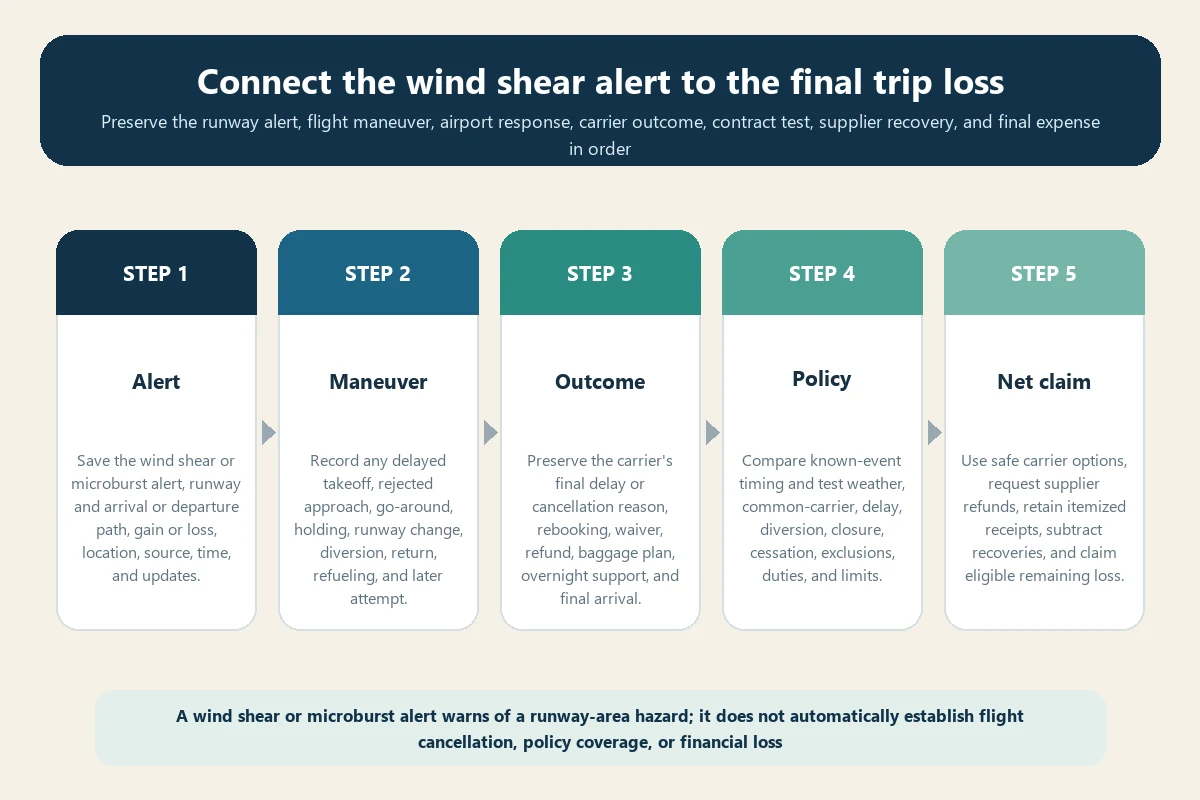
- Alert: system or pilot report, runway, arrival or departure, gain or loss, location, time, and updates.
- Maneuver: ground hold, rejected approach, go-around, holding, runway change, diversion, and later attempt.
- Outcome: carrier reason, delay or cancellation, rebooking, refund, baggage, and final arrival.
- Coverage: policy, purchase time, covered reason, threshold, exclusion, duty, and benefit limit.
- Loss: supplier terms, refund request, response, itemized receipts, credits, and remaining amount.
Write a concise chronology citing each exhibit. Show how the alert affected the flight, how the safe operational response changed the itinerary, what remedy was used, and what cost remained.
Calculate documented net loss
Create a ledger listing supplier, original charge, service date, currency, refund eligibility, refund requested, refund received, voucher, card credit, replacement expense, and amount claimed. Separate airfare, lodging, meals, transport, and unused prepaid activities.
Later refunds reduce the same loss. Update the insurer when pending credits post. The supplier refunds and insurance recovery guide explains coordination.
Common wind-shear claim mistakes
- Submitting a general storm screenshot instead of a runway-area alert.
- Treating an advisory as a cancellation order.
- Calling a go-around an emergency or flight cancellation.
- Ignoring a later landing, holding period, diversion, or continuation.
- Failing to get the final carrier reason.
- Buying coverage after the disruption became known.
- Using cancellation benefits for a delay below the threshold.
- Claiming expenses already refunded, credited, or supplied.
File and follow the claim
Notify the insurer within the deadline. Submit the policy, purchase proof, chronology, itinerary, alert and airport evidence, carrier explanation, diversion or connection record, supplier correspondence, receipts, and net-loss ledger. Keep a complete copy and claim number.
If more evidence is requested, answer the precise question. If coverage is denied, obtain the cited clause and factual basis, then compare them with the timed flight record. The claim filing guide can organize the package.
Bottom line
Wind shear can support travel insurance benefits when it causes the qualifying trip consequence described by the policy. The strongest case preserves the runway alert, safe aircraft response, final carrier outcome, purchase timing, airline remedy, and documented net loss—without treating an advisory or go-around as automatic cancellation coverage.