
Travel insurance freezing rain flight cancellation coverage depends on how ice affected the booked itinerary—not merely whether freezing rain appeared in a forecast. Ice can contaminate aircraft surfaces, reduce runway traction, slow deicing queues, interrupt ground handling, or trigger an FAA traffic-management program. The policy must then match the actual consequence, purchase timing, threshold, and unrecovered expense.
This U.S. guide explains the evidence chain from an official ice warning through aircraft and airport controls to the carrier’s flight-specific decision. It also separates airline refunds from insurance benefits. It is educational, not meteorological, aviation, safety, legal, medical, or insurance advice.
Freezing rain cancellation coverage at a glance
- Save the NWS product, ice accumulation forecast, area, and exact time window.
- Preserve airport treatment, deicing, ground-stop, and recovery records.
- Get the airline’s final flight-specific reason and every remedy offered.
- Compare the first forecast or warning with the policy purchase timestamp.
- Match cancellation, delay, missed connection, or interruption to its threshold.
- Subtract airline and supplier refunds before claiming documented net loss.
Reviewed August 17, 2026.
Freezing rain is not ordinary rain
Freezing rain is liquid precipitation that freezes when it reaches a cold surface. It can glaze roads, aircraft, ramps, taxiways, runways, trees, and power lines. The National Weather Service’s winter warning guidance distinguishes winter watches, advisories, Winter Storm Warnings, and Ice Storm Warnings.
Local criteria vary. An Ice Storm Warning often concerns substantial ice accumulation and dangerous or impossible travel, while a Winter Weather Advisory can cover lesser accumulations that still disrupt transport. Save the actual local product; do not substitute a national summary for the bulletin affecting the itinerary.
An ice warning does not prove the booked flight canceled
The warning establishes a forecast or observed hazard in a defined place and period. It does not show whether the origin, connection, destination, or alternate airport was affected at the relevant time. It also does not prove that the carrier canceled rather than delayed, deiced, rerouted, or operated normally.
Capture the issuing office, product name, affected counties or polygon, precipitation type, expected accumulation, onset, end time, temperature, impact statement, and revisions. Preserve both the first relevant forecast and the warning that followed to support the known-event timeline.
Aircraft contamination creates a specific safety problem
Ice on wings and tail surfaces can change their aerodynamic shape. The FAA’s winter operations explanation describes how even a small amount of ice can increase drag and reduce lift. That is why aircraft may need deicing and anti-icing before departure.
A traveler should document the operational consequence without speculating about aircraft safety. Useful records include announcements that the aircraft is awaiting deicing, returned for another treatment, exceeded a treatment window, changed gates, or could not depart before conditions worsened.
Deicing and anti-icing are different steps
Deicing removes frozen contamination already present. Anti-icing helps prevent new accumulation for a limited period. The FAA’s aircraft ground-deicing resources publish current program information and holdover-time material.
Holdover time is an estimated protection period under specified conditions, not a guarantee. If precipitation changes, treatment is delayed, or the aircraft cannot reach takeoff in time, another check or treatment may be required. This can create repeated queues even when the runway remains open.
Airport capacity can fall without a complete closure
Freezing rain can require runway and taxiway inspection, braking-action monitoring, ramp treatment, equipment repositioning, slower aircraft movement, and repeated deicing. The airport may remain technically open while handling far fewer departures and arrivals.
Record whether the operational response was a ground stop, ground delay program, reduced arrival rate, deicing program, runway restriction, or closure. Our air traffic control delay guide explains how to preserve traffic-management evidence without calling every restriction an airport shutdown.
Use a real operational record when available
An FAA Air Traffic Control System Command Center operations plan documented an Atlanta ground stop and noted additional initiatives were probable based on forecast freezing rain and ice. This illustrates the kind of operational bridge a claim needs.
Save the facility, event time, stated cause, scope, planned expiration, probability of extension, revisions, and cancellation message. Then establish whether the booked flight fell inside the affected airport, carrier, and time window.
Obtain the final airline reason
Keep the itinerary, confirmation, ticket number, flight number, scheduled times, boarding pass, app alerts, email, text messages, and gate displays. Ask the airline whether the outcome resulted from freezing rain, runway condition, deicing capacity, airport restriction, inbound aircraft, crew displacement, or a network recovery decision.
The explanation may change. A flight can begin with a deicing delay and later cancel because the crew times out or the inbound aircraft never arrives. Preserve each stage and the final written reason. Record all alternatives, deadlines, waivers, vouchers, refunds, hotel assistance, meals, and baggage instructions.
Claim the airline remedy before net-loss insurance
The U.S. Department of Transportation’s current airline refund guidance states that a passenger is entitled to a refund when the airline cancels and the passenger does not accept alternative transportation or compensation. The fact that freezing rain is outside the carrier’s control does not remove that refund right.
If the ticket is refunded, it is not also an insurance loss. If safe rebooking is accepted, eligible delay expenses, a missed connection, or unused prepaid land arrangements may remain. Keep the airline’s offer, the traveler’s response, and the final transaction record.
Known-event timing matters
Build a chronology with trip deposit, later nonrefundable payments, policy purchase, coverage effective time, first relevant winter forecast, watch, advisory or warning, FAA initiative, carrier alert, and final flight outcome. Keep original timezones and add a normalized comparison column.
Coverage purchased after freezing rain was forecast or already disrupting the airport may not apply to that storm. The exact known-event or foreseeability language controls; “officially named” is not a universal winter-weather rule. Review when to buy travel insurance for purchase-timing evidence.
Test weather and common-carrier wording
Search the certificate for weather, inclement weather, winter storm, natural disaster, common carrier, airport closure, cessation of service, air traffic control, delay, missed connection, and destination inaccessible. Read definitions, exclusions, duties, thresholds, daily caps, and maximums.
Answer these questions:
- Does a carrier cancellation qualify, or must service stop for a stated period?
- How many consecutive hours trigger trip delay?
- Must the airport close completely?
- Can an FAA restriction qualify without a formal closure?
- Does the missed-connection benefit cover the scheduled connection involved?
- Which replacement expenses require authorization?
The weather delay coverage guide explains general contract tests. This page adds freezing-rain evidence around contamination, treatment, and capacity.
Choose the benefit by chronology
Trip cancellation generally concerns abandoning the trip before departure for a covered reason. Trip delay may reimburse necessary costs after a qualifying wait. Missed connection concerns a late arrival that breaks an onward segment. Trip interruption can apply after departure when a covered event changes or ends the trip.
A deicing queue is not automatically trip cancellation. A flight that departs late may create delay costs. A flight that diverts after encountering destination icing follows a diversion sequence. Use the benefit comparison guide before selecting the claim form.
Document delay expenses precisely
For meals, lodging, local transportation, communication, or essential items, preserve itemized receipts, dates, locations, payment method, and reason. Confirm that the expense occurred after the policy’s waiting period and within its per-day and total limits.
Do not assume the insurer will cover luxury lodging, premium transportation, alcohol, or purchases unrelated to the wait. The trip delay reimbursement guide explains reasonableness and documentation.
Handle missed connections and diversions
For a missed connection, retain actual departure and arrival times, the original connection, the missed segment, reaccommodation, and final arrival. Test minimum delay and connection-type rules. See missed connection insurance.
For a diversion, preserve the destination conditions, diversion airport, landing time, deplaning instructions, baggage status, ground transport, and onward plan. Do not call the event a cancellation until the carrier actually cancels the remaining service. Our flight diversion guide covers that evidence.
Reroute only when conditions are safe
Freezing rain can make airport roads, bridges, parking lots, and sidewalks treacherous. Follow NWS, transportation, emergency-management, airport, and carrier instructions. Do not drive to a distant airport through an ice warning merely to reduce a claim.
If an alternate airport is proposed, confirm road treatment, transit operation, deicing capacity, baggage handling, and the airline’s acceptance. Contact the insurer’s assistance service before a costly replacement when safety and time allow. Record the case number, advice, and authorization.
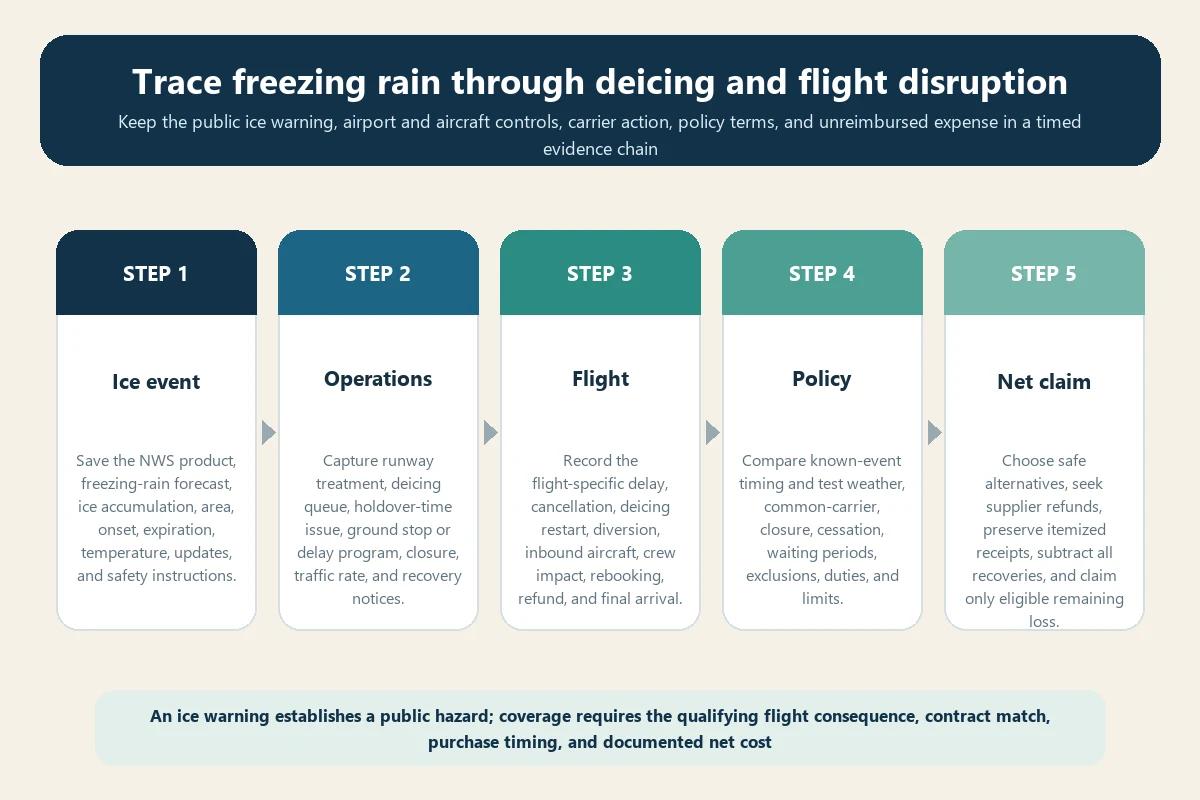
Build the evidence file in layers
- Weather: forecast, watch or warning, ice amount, area, onset, end, temperature, and updates.
- Operations: runway treatment, deicing queue, traffic program, closure, rate, and recovery.
- Flight: itinerary, carrier reasons, delay or cancellation, reroute, baggage, and final arrival.
- Coverage: policy, schedule, purchase time, covered reason, threshold, exclusion, and duty.
- Loss: supplier terms, refund requests, responses, receipts, credits, and remaining amount.
A short narrative should link these exhibits in sequence. Explain how the ice event affected safe operation or capacity, how that reached the booked flight, what remedy the traveler used, and which cost remained.
Calculate the net amount claimed
Use a ledger listing supplier, original charge, service date, currency, refund eligibility, refund requested, refund received, voucher, card credit, replacement purchase, and net claim. Separate airfare, lodging, meals, transport, and unused prepaid activities.
Later refunds reduce the same loss. Inform the insurer when a pending airline or hotel credit posts. Our guide to supplier refunds and insurance recovery explains how to avoid duplicate reimbursement.
Common freezing rain claim mistakes
- Submitting only an ice photograph without an official location and timestamp.
- Treating an Ice Storm Warning as proof the airport fully closed.
- Failing to distinguish deicing delay, runway restriction, and carrier recovery.
- Canceling voluntarily before confirming airline operations and remedies.
- Buying the policy after the relevant forecast or disruption was known.
- Using cancellation benefits for a wait that only meets delay terms.
- Claiming costs already returned, credited, or supplied by the carrier.
- Driving through dangerous icing to reach an alternate airport.
File and follow the claim
Notify the insurer within the contract deadline. Submit the policy, purchase proof, chronology, itinerary, NWS record, airport or FAA evidence, carrier explanation, supplier correspondence, itemized receipts, and net-loss ledger. Keep a complete copy and claim number.
If the examiner asks for more, respond to the precise request. If coverage is denied, obtain the cited clause and factual basis, then compare them with the timing and operational record. The travel insurance claim guide can organize the package.
Bottom line
Freezing rain can support travel insurance benefits when it creates the qualifying flight consequence named by the policy. The strongest file connects the official ice event to deicing or airport controls, proves the booked flight outcome, applies the correct timing and threshold, uses airline remedies, and claims only documented net loss.
Hailstorms add convective routing, ground-hail treatment, and aircraft-inspection evidence to a weather disruption. Use this hailstorm flight cancellation travel insurance guide to trace the warning to the booked flight, preserve airline remedies, test timing and thresholds, and claim net loss.