
Travel insurance hailstorm flight cancellation coverage depends on how the storm affected the booked itinerary—not just whether hail fell somewhere near the route. A severe thunderstorm can trigger airspace reroutes, a ramp closure, a ground stop, aircraft inspection, or a network delay. Coverage then depends on the carrier’s flight-specific action, policy terms, purchase timing, thresholds, and documented net loss.
This U.S. guide explains how to distinguish a hail warning from an operational event and how to preserve each link in the claim. It also separates airline refunds from travel insurance benefits. It is educational, not meteorological, aviation, safety, legal, mechanical, or insurance advice.
Hailstorm cancellation coverage at a glance
- Save the official warning, hail size, storm motion, polygon, and time window.
- Preserve convective reroutes, airport restrictions, ramp holds, and recovery records.
- Obtain the final reason for the booked flight’s delay or cancellation.
- Separate a storm hold from an aircraft inspection or maintenance outcome.
- Compare the first forecast with the policy purchase and waiting periods.
- Use airline remedies and claim only documented expense that remains.
Reviewed August 17, 2026.
Hail is usually part of a severe thunderstorm
The National Weather Service’s severe thunderstorm safety guidance defines a severe thunderstorm as capable of producing hail at least one inch in diameter or wind gusts above the severe threshold. A single storm may also produce lightning, heavy rain, wind, flash flooding, or a tornado.
This matters because the airline’s record may say “thunderstorms” or “convective weather” rather than “hail.” Do not force a hail label when the documented operational cause was lightning near the ramp, wind, route congestion, or another hazard in the same storm.
A watch and warning establish different facts
NWS watch and warning guidance explains that a Severe Thunderstorm Watch covers a broad area where severe storms are possible. A Severe Thunderstorm Warning is more focused and means severe weather has been reported or indicated by radar.
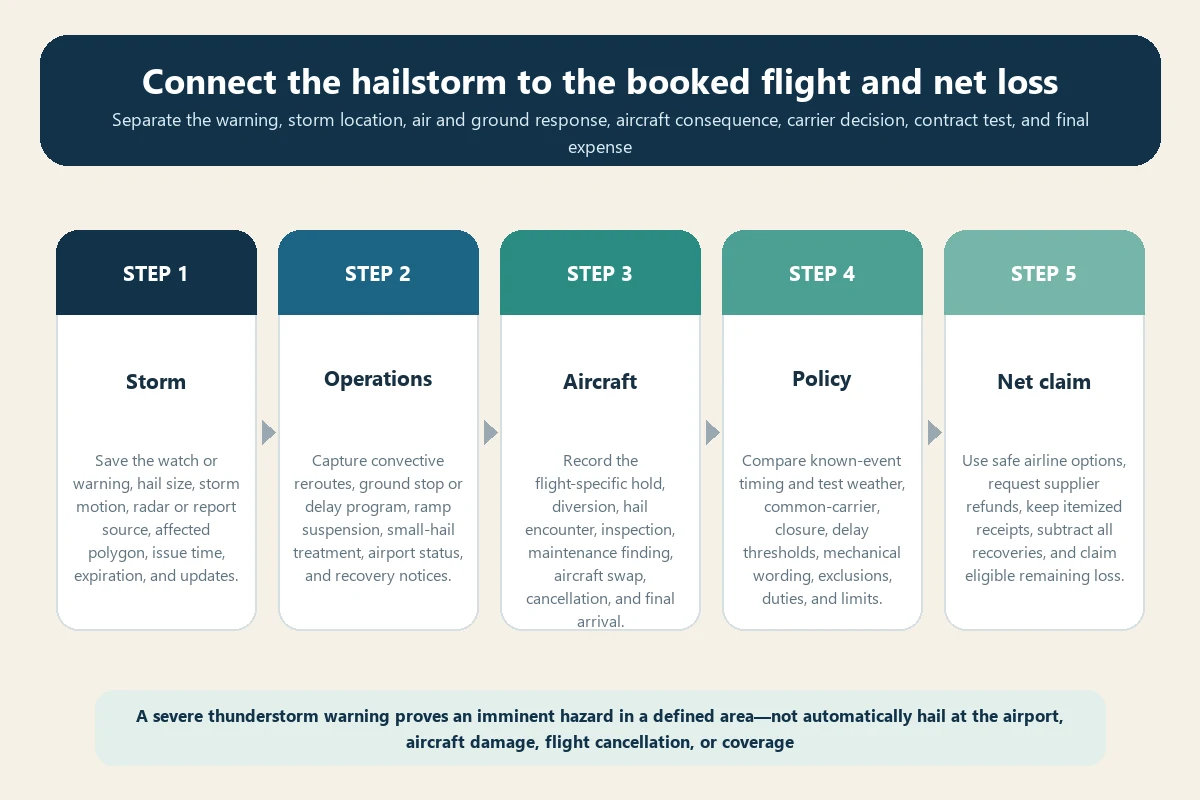
Save the product type, affected polygon, hail-size statement, storm location and motion, radar or spotter source, issue time, expiration, and updates. A watch helps establish foreseeability; a warning can establish imminent danger. Neither proves that hail struck the airport or aircraft.
Map the storm to every airport in the itinerary
Check the origin, connection, destination, and plausible alternates at the relevant time. A storm may block the departure corridor without crossing the airport. It may affect the inbound aircraft hundreds of miles away. It may pass before departure but leave a backlog.
Preserve the radar timestamp and warning polygon, then connect them to the airport or route using official records. Avoid a screenshot that lacks the legend or clock. Later reports of hail size can support what occurred, but they should not replace the real-time operational evidence.
Convective rerouting is not an airport closure
Air traffic control may reroute flights around thunderstorms, space departures, reduce arrival rates, issue a ground delay program, or temporarily stop departures to a destination. These actions manage capacity and safety while the airport remains open.
The FAA’s ground delay program guidance describes holding aircraft on the ground to manage demand and arrival capacity. Preserve the program, scope, assigned time, revisions, and cancellation. Our ATC delay coverage guide explains the claim evidence.
Ramp lightning and hail are separate operational hazards
An airport may suspend outdoor ramp work when lightning is nearby, even before hail reaches the field. Baggage loading, fueling, pushback, and ground handling can pause. If the carrier cites a ramp closure, save that message rather than assuming the aircraft was damaged by hail.
Likewise, hail may fall at one terminal or runway while operations continue elsewhere. Record airport and carrier notices with start and end times. General airport status is useful context, but the FAA repeatedly advises passengers to check with the airline for flight-specific impact.
Small hail on the ground has its own treatment rules
Small hail can behave differently from large damaging hail. The FAA’s current ground deicing program resources include operating guidance for small hail and ice-pellet conditions. Treatment and safe-departure allowances can affect when an aircraft may take off.
Preserve announcements about anti-icing, contamination checks, precipitation intensity, treatment restart, or a return to the gate. Do not interpret technical treatment limits yourself; document the carrier’s operational consequence and final reason.
An aircraft inspection changes the evidence chain
If an aircraft encounters or is exposed to hail, the carrier may inspect it before further service. The outcome could be clearance to operate, an aircraft swap, maintenance work, or cancellation. The storm initiated the sequence, but the final carrier record may identify inspection or maintenance as the immediate reason.
Save when the inspection was announced, whether damage was found, the maintenance delay code if provided, the aircraft swap, and the final disposition. Do not claim physical aircraft damage without written confirmation. A precautionary inspection is not proof of damage.
Get the flight-specific final reason
Retain the itinerary, confirmation, ticket number, flight number, scheduled times, boarding pass, app alerts, emails, text messages, and gate displays. Ask whether the cause was convective weather, hail at the airport, ramp suspension, ATC restriction, inbound aircraft, inspection, maintenance, or crew displacement.
The reason can evolve. Preserve initial and final messages, every rebooking option, response deadline, waiver, voucher, refund, hotel offer, meal assistance, baggage instruction, and actual arrival. This record determines both airline remedies and the likely insurance benefit.
Use the airline remedy before insurance
The U.S. Department of Transportation’s current airline refund guidance says a passenger is entitled to a refund when the airline cancels and the passenger does not accept alternative transportation or other compensation. Severe weather does not remove that right.
If airfare is refunded, it is not also an insurance loss. If the traveler accepts a safe reroute, eligible delay expenses, a missed connection, or unused prepaid land arrangements may remain. Record the airline offer, the traveler’s response, and the final refund or ticket status.
Build the known-event timeline
List the trip deposit, later nonrefundable payments, policy purchase, coverage effective time, first relevant convective forecast, watch, warning, FAA initiative, carrier alert, inspection notice, and final outcome. Keep original timezones and add a normalized comparison column.
A policy bought after the hail threat was forecast, warned, or already disrupting the route may not cover that event. A storm does not have to receive a personal name to become known. The policy’s foreseeable-event language controls. See when to buy travel insurance.
Test weather, carrier, and mechanical wording
Search the certificate for weather, inclement weather, severe weather, natural disaster, common carrier, airport closure, cessation of service, air traffic control, mechanical breakdown, delay, missed connection, and destination inaccessible. Read definitions, exclusions, duties, thresholds, and benefit limits.
Key questions include:
- Is carrier cancellation enough, or must service stop for a stated period?
- How many hours trigger trip delay?
- Does the airport have to close completely?
- Does a maintenance benefit require confirmed damage or breakdown?
- Can the same sequence qualify under only one benefit?
- Which replacement expenses require authorization?
The weather delay insurance guide explains general terms. This page adds the hail-specific separation between storm, operations, inspection, and final carrier action.
Choose the benefit by what happened
Trip cancellation generally concerns abandoning the trip before departure for a covered reason. Trip delay may reimburse necessary costs after a qualifying wait. Missed connection addresses a late arrival that breaks an onward segment. Trip interruption may apply after departure.
A 90-minute ramp hold is not automatically trip cancellation. A hail inspection that delays departure may fit trip delay. An aircraft diversion follows a different record. Use the benefit comparison guide before filing.
Handle a diversion or missed connection
For a diversion, save the reason, diversion airport, landing time, inspection or fuel stop, baggage status, onward flight, and final arrival. The flight diversion guide explains how a diversion can later become a delay or cancellation.
For a missed connection, keep actual segment times, the original connection, the missed service, reaccommodation, and arrival. Test the minimum delay and eligible connection type in our missed connection insurance guide.
Choose a safe reroute
Do not travel outdoors across an exposed ramp or drive into a severe thunderstorm warning to save the itinerary. Follow NWS, airport, carrier, emergency-management, and transportation instructions. Hail, lightning, wind, and flash flooding can occur in the same storm.
If an alternate airport is offered, check the storm path, road conditions, baggage plan, ground transport, and carrier acceptance. Contact the insurer’s assistance line before an expensive replacement when conditions and time allow. Preserve the case number and advice.
Build the claim file by layer
- Storm: forecast, watch or warning, hail size, motion, polygon, issue time, expiration, and updates.
- Operations: reroute, ground program, ramp hold, airport restriction, small-hail treatment, and recovery.
- Aircraft and flight: encounter, inspection, finding, swap, delay or cancellation, and final arrival.
- Coverage: policy, schedule, purchase time, covered reason, threshold, exclusion, and duty.
- Loss: supplier terms, refund requests, responses, receipts, credits, and remaining amount.
Write a short chronology that cites each exhibit. Explain which hazard reached which operation, how that affected the booked flight, what remedy was used, and what cost remained.
Calculate documented net loss
Create a ledger with supplier, original charge, service date, currency, refund eligibility, refund requested, refund received, voucher, card credit, replacement purchase, and amount claimed. Separate airfare, lodging, meals, local transport, and unused prepaid activities.
Later airline or supplier credits reduce the same loss. Inform the insurer when a pending recovery posts. Our guide to supplier refunds and insurance recovery explains coordination.
Common hailstorm claim mistakes
- Submitting a hail photo without official location, size, or timestamp.
- Treating a broad watch as proof hail reached the airport.
- Calling a convective reroute or ramp hold an airport closure.
- Claiming aircraft damage when only a precautionary inspection occurred.
- Ignoring the final cause after weather evolved into maintenance or crew delay.
- Buying coverage after the relevant storm became known.
- Using cancellation benefits for a short delay below the threshold.
- Claiming expenses already refunded, credited, or provided.
File and follow the claim
Notify the insurer within the deadline. Submit the policy, purchase proof, chronology, itinerary, NWS record, FAA or airport evidence, carrier explanation, inspection or maintenance record if available, supplier correspondence, receipts, and net-loss ledger.
If more evidence is requested, answer the exact question. If coverage is denied, request the cited clause and factual basis, then compare them with the timed records. The travel insurance claim guide can organize the submission.
Bottom line
A hailstorm can support travel insurance benefits when it causes the qualifying trip consequence described by the policy. The strongest file distinguishes the warning from air and ground operations, proves the booked flight or aircraft outcome, applies timing and thresholds, uses airline remedies, and claims only documented net loss.
Lightning can stop exposed ramp work or trigger an aircraft inspection without closing the airport. Use this lightning flight cancellation travel insurance guide to identify the operational path, preserve airline remedies, test timing and thresholds, and claim net loss.
