

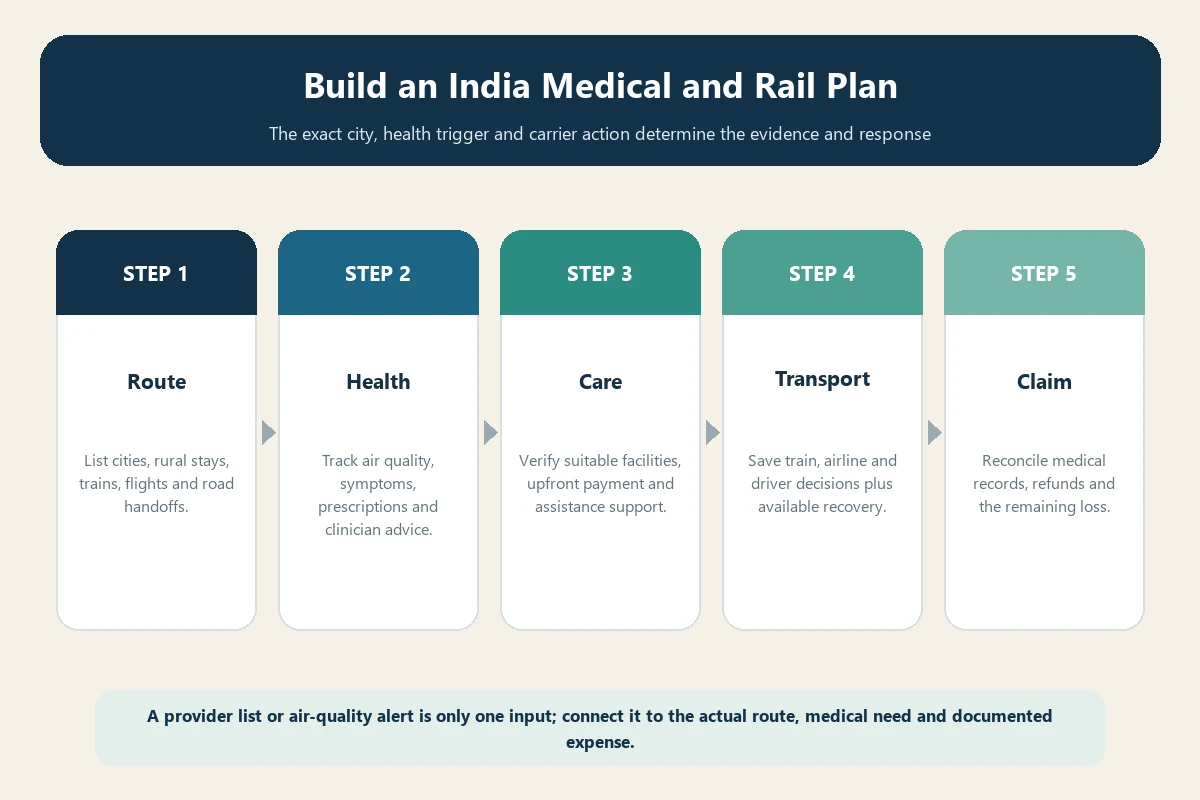
Travel insurance for India from USA trips should be selected around the actual route, upfront hospital payment, long-distance transport and the traveler’s health—not a generic countrywide price. India can combine major-city care, rural gaps, overnight trains, dense air pollution and region-specific advisories in one itinerary.
Key takeaways
- Map every city, train, driver, domestic flight and remote stay before comparing plans.
- Ask how direct payment works when a hospital wants money or insurer confirmation first.
- Keep medical treatment, rail disruption and voluntary itinerary changes in separate evidence files.
- Review air quality with a clinician if respiratory or cardiac conditions affect the traveler.
- Match official regional guidance to policy exclusions and assistance capability.
Planning information reviewed August 16, 2026. Advisories, entry rules, health guidance, transport and policy terms can change. Recheck official sources and the issued certificate for the travel dates.
Start with an India route inventory
List Delhi, Mumbai, Jaipur, Agra, Varanasi, Goa, Kerala or every other stop as separate itinerary segments. Add the airport transfer, intercity train or flight, driver, tour, hotel, family stay and any prepaid event. Note arrival times and the last practical connection.
This exposes different risks. A missed overnight train is not automatically a covered trip delay, and a clinic bill is not handled like unused hotel nights. The delay, interruption and cancellation guide helps label each loss before policy comparison.
Check official guidance by state and region
The U.S. Department of State publishes current India travel guidance with risks and restrictions that vary by location. Compare every state, border area and planned excursion with that guidance rather than relying on a single national risk label.
Ask the insurer how government-advisory, security, civil-unrest and foreseeable-event language applies. Save the guidance in force at purchase and again before departure. Insurance does not make a restricted or unsafe itinerary appropriate.
Plan for hospital payment before treatment
State Department information warns that hospitals may require advance payment or proof of insurance, and credit cards may not always be accepted. Ask the assistance team whether it can locate a suitable facility, open a case and issue a payment guarantee. Then ask what the traveler must do if the facility still requests a deposit.
Carry secure backup payment capacity without assuming reimbursement. Request an itemized bill, diagnosis, clinical notes, prescription, proof of payment and discharge instructions. The health insurance abroad guide explains the separate call to the U.S. health plan.
Do not confuse a provider list with a guarantee
A directory can show where a hospital is located, but it does not prove the hospital is appropriate, available or willing to bill the insurer. Ask whether the network is contracted, informational or simply maintained by an assistance vendor. Confirm what happens outside normal business hours.
For a chronic condition, ask the treating clinician and insurer what level of care would be necessary during a flare. A traveler with a complex cardiac, respiratory or mobility history may need a different route and limit than a healthy visitor staying only in major cities.
Separate stabilization, transfer and evacuation
Care in major cities may differ from care in smaller cities or rural areas. For each remote stay, identify how a traveler could reach a clinic, then a higher-capability hospital, and finally an international departure point if a physician recommends further treatment. This is a planning chain, not a promised destination.
Ask who determines medical necessity, selects the receiving facility and approves ground or air movement. The medical evacuation planning guide separates local transport, stabilization, evacuation and repatriation.
Compare evacuation wording, not only the limit
One certificate may pay transport to the nearest suitable facility, while another may offer a separate later transfer under narrower conditions. Ask whether the insurer, assistance company or treating physician controls the decision. Check exclusions for known conditions, high-risk regions and unapproved arrangements.
A large limit cannot create an aircraft, receiving bed, medical clearance or safe road. The evacuation-limit guide provides questions for capacity, authorization and destination wording.
Use official air-quality data as a health trigger
India’s Central Pollution Control Board operates the official National Air Quality Index portal. Use the city and date shown, not a countrywide screenshot. Save the reading that informed a medical or itinerary decision, along with the clinician’s advice.
Poor air quality alone does not guarantee cancellation benefits. Ask whether an acute illness is a covered medical reason, what documentation is required and whether a physician must advise against travel. Routine masks, air purifiers or a voluntary hotel change may be personal preparedness costs.
Review India health guidance before purchase
The CDC maintains current India traveler health guidance. Review vaccines, medicines and destination-specific risks with a clinician early enough to act. Include rural visits, animal exposure, food and water, season and the traveler’s medical history.
Preventive care and expected medication are often treated differently from an unexpected illness. Ask about prescription replacement, pre-existing conditions, acute complications and any stability or waiver requirements. Carry permitted medicines in original packaging with supporting documentation.
Audit every long-distance train segment
Record the train number, boarding station, scheduled departure, class, booking status and onward reservation. Use the official Indian Railways train enquiry service for operational information, then preserve the carrier’s record of cancellation or delay.
Ask whether a train qualifies as a common carrier, what minimum delay applies and what covered reason is required. A waitlisted ticket, missed boarding or personal decision to take a car may not equal a carrier-caused loss. The train insurance checklist offers a documentation method after India-specific wording is confirmed.
Connect trains, domestic flights and drivers
Self-built itineraries may contain separate tickets with no through-protection. For each handoff, record the scheduled buffer, baggage collection, terminal transfer and last reasonable alternative. Ask whether missed-connection benefits require a specified carrier or event.
Keep the original booking, live status, delay reason, refund response and replacement receipt. If a driver or tour operator changes the route, preserve that message separately. The final claim should show which supplier caused which unreimbursed cost.
Check road travel and vehicle roles
Record whether the traveler is a passenger, renter or driver, plus the vehicle, seat belts, license, contract and planned roads. Travel medical insurance does not automatically include vehicle damage or liability. A tour operator’s acceptance does not prove policy eligibility.
Avoid treating a long overnight drive as an automatic substitute for a canceled train. Ask assistance and the local operator whether the route is reasonable, especially during poor weather or regional disruption. Preserve why a replacement was necessary and how its cost was selected.
Match activities to the certificate
List trekking altitude, rafting grade, wildlife excursions, motorcycle use, yoga retreats with intensive activity and any equipment rental. Ask about participation, guide, licensing, protective gear, search and rescue, and medical evacuation as separate issues.
The activity-exclusions guide helps compare definitions. Legal participation and operator approval do not create insurance coverage when the certificate excludes the activity or required equipment was absent.
Compare one realistic India scenario
Use the same ages, trip dates and prepaid costs for every quote. Include two major cities, one rural stay, an overnight train, a domestic flight, a respiratory flare, an upfront hospital deposit and a possible transfer to higher care.
- Which event activates medical and delay benefits?
- Can assistance arrange or guarantee payment?
- Which hospital is considered suitable?
- How is a rail delay documented?
- Who approves transfer or evacuation?
- Which refunds reduce the claim?
Read the full certificate. A low daily price cannot answer these route-specific questions.
Use the assistance line as an operating record
Store the policy number and international contact offline. In a serious event, prioritize emergency care, then ask a companion to open a case when practical. Record the representative, time, case number, instructions and every attempted callback.
The assistance versus claims guide explains why coordination is not final claim approval. A hospital referral or case number can help without guaranteeing that every charge is covered.
Build a clean India claim file
Use separate folders for medical, rail, airline, driver and lodging records. Preserve diagnoses, itemized bills, rupee amounts, payment evidence, train status, carrier messages, refunds and replacement purchases. Translate essential documents when requested but keep the originals.
The claim documentation guide explains reconciliation. Show the original cost, supplier return, card benefit or health-plan payment and remaining request. Record the actual currency conversion method rather than estimating later.
Prepare a medicine continuity file
Before departure, list each prescription by generic name, dose, purpose and prescribing clinician. Carry enough permitted medicine for the planned trip plus a reasonable delay margin, split securely when appropriate. Ask the clinician how heat, refrigeration or time-zone changes affect storage and dosing.
Do not assume an Indian brand name or formulation is identical to the U.S. prescription. If medicine is lost or damaged, contact assistance and a qualified local clinician rather than buying an unknown substitute. Keep the police or carrier report when relevant, the new prescription, pharmacy receipt and package details. Ask the policy whether replacement medication, the medical visit and delivery costs have separate conditions or limits.
Assign roles for a traveling group
Give one companion access to policy contacts, allergies, passports, route bookings and the traveler’s consent information. Decide who accompanies a patient, who handles luggage and who contacts the next hotel or carrier. Store the plan offline in case the primary phone is unavailable.
When one person’s illness affects others, keep each traveler’s costs separate. A companion’s extra hotel, changed flight or local transport may require its own covered reason and documentation. Record why the companion remained, which alternatives were offered and what each supplier refunded.
Bottom line
A strong India plan follows the itinerary city by city, verifies payment and medical coordination, and treats trains, air quality and regional guidance as separate decision inputs. Choose wording that can operate on the real route, then preserve the evidence connecting a covered event to the final loss.