

Europe travel insurance for train travel should be chosen by reading how the policy defines a common carrier, trip delay, missed connection and baggage. A generic “travel delay” limit is not enough. The certificate must respond to the rail itinerary you actually booked, especially when tickets are separate, connections cross operators or luggage stays in your custody.
Key takeaways
- Rail passenger rights and travel insurance are separate systems.
- A through-ticket usually gives stronger connection protection than separate contracts.
- Confirm that “common carrier” includes the scheduled trains in your itinerary.
- Check waiting periods, covered causes and unreimbursed-expense rules.
- Keep the original tickets, delay proof, operator response and every receipt.
Start with the rail contract, then test the insurance
When a European train is canceled or delayed, the railway company may owe rerouting, reimbursement, assistance or compensation. Travel insurance may cover a different part of the loss, subject to its own triggers and limits. Insurance generally does not replace a refund the operator owes, and it should not pay the same expense twice.
| Loss or need | First place to check | Insurance question |
|---|---|---|
| Replacement train after a cancellation | Rail operator or ticket seller | Does delay or missed-connection cover an unreimbursed replacement? |
| Meals during a long wait | Operator assistance rights | When does the policy’s delay clock start? |
| Hotel after the last train is missed | Operator and ticket conditions | Is lodging a reasonable covered delay expense? |
| Separate onward ticket lost | Onward operator’s fare rules | Does missed-connection wording protect separate tickets? |
| Bag stolen from a train | Police and operator reporting process | Do custody and unattended-property exclusions apply? |
The European Union’s rail passenger rights guide explains current EU rights for cancellations, delays, missed connections and registered luggage. Coverage can vary because countries may exempt some services, and journeys outside the EU require separate checks. Start with the operator’s conditions for each leg rather than assuming one rule covers the entire continent.
Through-ticket or separate tickets?
This is the most important booking fact for a multi-train journey. A through-ticket covers connected services as one contract of carriage. Several tickets bought in one checkout are not necessarily a through-ticket; the seller should tell you what was issued.
Under the current EU framework, a traveler with a through-ticket who misses a connection and is expected to reach the final destination at least 60 minutes late can have rights to reimbursement or rerouting, plus assistance in qualifying circumstances. The same connection rights do not automatically apply to individual tickets. Voluntary arrangements between some operators may still help, but their terms must be checked for the specific trains.
Before paying for rail tickets, record:
- whether the itinerary is one through-ticket or several contracts;
- the ticket issuer and operating company for every leg;
- the minimum transfer time and station-change time;
- fare flexibility and change or refund rules;
- what the seller promises after a missed connection; and
- whether a commercial journey-continuation agreement applies.
A cheap pair of separate tickets can transfer the missed-connection risk to the traveler. Our guide to separate tickets and missed connections explains how to identify that gap before booking.
Which policy benefits matter on a train trip?
Trip delay
Trip delay usually reimburses necessary expenses after a covered event delays the trip for a stated minimum period. Check all four parts of the clause:
- Does the policy define a scheduled train as a common carrier?
- Is the cause of delay listed or otherwise covered?
- How long must the delay last?
- What daily and total limits apply to meals, lodging and transport?
The displayed maximum does not answer those questions. Use the trip-delay reimbursement guide to compare the trigger, waiting period and expense rules.
Missed connection
Some missed-connection benefits are narrower than their name. They may be written for a cruise departure, a tour departure or a specified form of common-carrier travel. Others require the arriving carrier to be delayed by a minimum number of hours. Look for separate-ticket language, reasonable connection-time requirements and the expenses that can be reimbursed.
Do not assume that missing a train because an earlier train was late is covered merely because both tickets appear on the same itinerary email. The missed-connection coverage guide provides a clause-by-clause test.
Trip interruption
Interruption applies after the insured trip has begun and usually requires a covered reason. A rail cancellation alone may create a delay rather than an interruption. If a covered illness forces the traveler to abandon the route and return home, interruption may address unused insured arrangements and additional transport. The definitions and benefit triggers decide the category.
Our delay versus interruption versus cancellation guide helps classify the loss before filing.
Baggage and personal property
On many trains, the traveler retains custody of ordinary luggage. That matters because carrier rules for registered baggage may not apply to a suitcase placed on an open rack, and an insurance policy may exclude unattended property. Read how the certificate treats theft from a common carrier, unattended bags, checked baggage, electronics and valuables.
The EU guide distinguishes registered luggage from hand luggage and describes rail-operator rights for qualifying registered-baggage losses. An insurance claim may still require a prompt operator report and, for theft, a police report. Review the baggage delay and loss guide before deciding where to store high-value items.
Emergency medical and evacuation
A rail itinerary does not reduce the need for medical protection. A traveler can become ill between cities or need transport from a smaller destination to appropriate care. The CDC Yellow Book recommends reviewing domestic health coverage and considering supplemental health and medical-evacuation insurance for unmet needs. It also warns that travelers may need to pay providers abroad before seeking reimbursement.
Use the site’s Europe travel medical insurance guide for US travelers to assess medical, evacuation and assistance terms separately from rail disruption benefits.
Strikes, weather and known events
A railway’s passenger obligations and an insurer’s covered-reason rules are not identical. The European Commission states that the current rail passenger rights framework is based on Regulation (EU) 2021/782, which has applied since June 7, 2023. The Commission also provides a rail-rights overview and common claim resources.
For insurance, check whether strikes, severe weather, natural disasters or mechanical breakdowns appear in the delay and missed-connection clauses. Then check the known-event exclusion. Buying after a strike is announced or after a disruption becomes foreseeable may leave the related loss outside coverage, even if the same cause would have been covered before it became known.
Rail-company staff strikes have a specific place in current EU passenger-rights rules, but that does not create insurance coverage. Treat the two systems independently and save the date and source of any disruption notice.
Build a train-by-train risk sheet
For each material rail leg, add one row to the trip sheet:
| Field | What to record |
|---|---|
| Service | Date, train number, operator, origin and destination |
| Contract | Through-ticket, separate ticket or rail pass reservation |
| Connection | Scheduled buffer, station change and last viable alternative |
| Financial exposure | Nonrefundable fare and onward bookings at risk |
| Operator remedy | Rerouting, refund, assistance and complaint route |
| Insurance response | Benefit, covered cause, waiting period and limit |
For a multi-country route, also confirm that every country and travel date falls within the policy territory. The multi-country Europe policy checklist covers transits, side trips and itinerary changes.
What to do when a train is disrupted
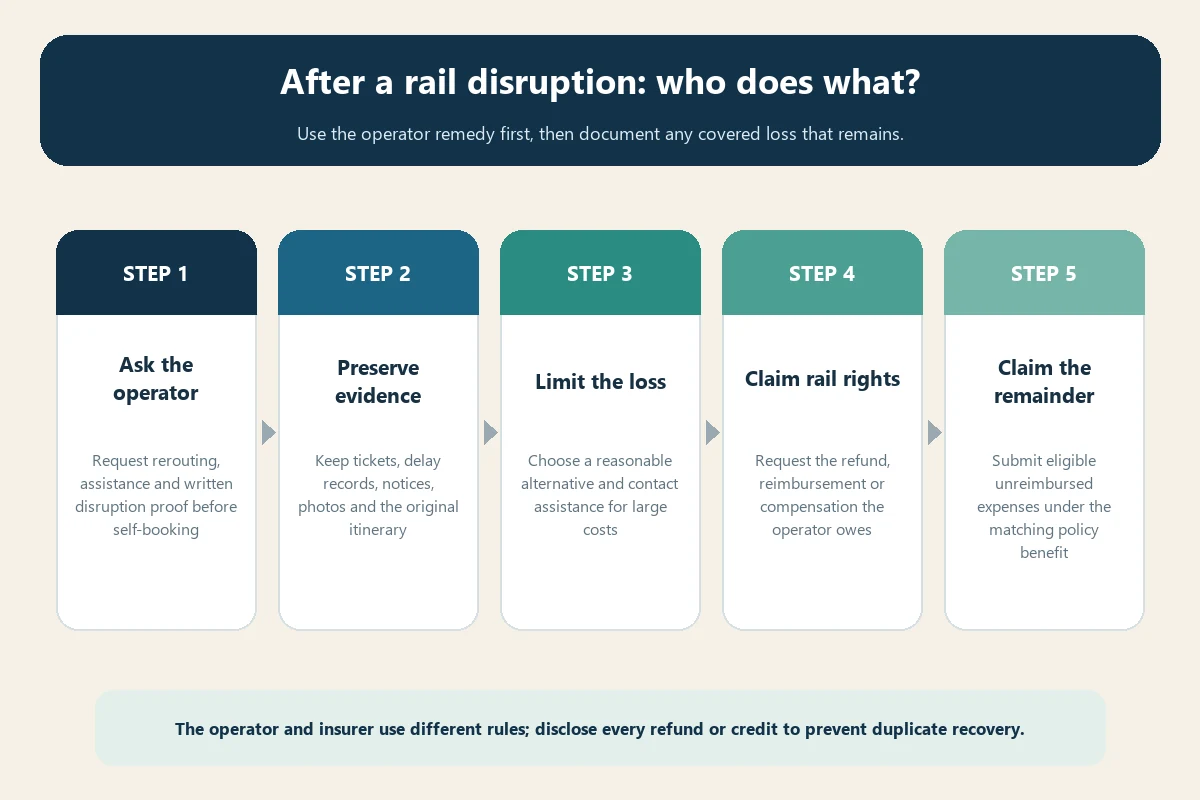
- Ask the operator before self-booking. Request rerouting, assistance and written confirmation of the disruption.
- Preserve the itinerary. Screenshot departure boards and app notices, but also obtain an official delay or cancellation record when possible.
- Contact the insurer. If costs will be significant, ask which benefit may apply and whether approval is required.
- Choose a reasonable alternative. Keep evidence that the cost and route were necessary, not merely preferable.
- Keep itemized receipts. Save tickets, hotel invoices, meal receipts and proof of every refund or credit.
The EU has a standardized form for reimbursement and compensation requests under Implementing Regulation (EU) 2024/949. The operator’s claim and the insurance claim remain separate. Tell the insurer what the operator paid or refused so that only the eligible unreimbursed loss is considered.
A pre-purchase rail insurance checklist
- □ Every scheduled rail service fits the policy’s common-carrier definition.
- □ I know which journeys are through-tickets and which are separate contracts.
- □ The delay waiting period fits my shortest critical connection.
- □ Missed-connection wording covers my kind of onward booking.
- □ I checked strike, weather, mechanical and known-event wording.
- □ Baggage exclusions reflect how luggage will be stored on trains.
- □ Medical and evacuation coverage remains adequate for the full route.
- □ Trip dates include overnight trains and the journey back home.
- □ I know whether rail-pass reservations and replacement tickets are insured costs.
- □ I saved operator conditions and the state-specific policy certificate.
Use the broader Europe trip insurance purchase checklist to finish the health, cost, document and review-period checks that apply beyond rail travel.
Frequently asked questions
Does travel insurance cover a canceled train in Europe?
It can, but only through a benefit whose covered event, common-carrier definition, waiting period and expense rules fit the cancellation. Seek the operator’s rerouting, reimbursement or assistance first, then claim eligible unreimbursed expenses.
Will insurance pay if I miss a separately ticketed train?
Not automatically. Some policies cover a missed connection only in narrow circumstances, and some require a qualifying delay of the arriving common carrier. Check separate-ticket language and minimum connection-time rules before purchase.
Are European rail passenger rights available to US tourists?
EU rail passenger rules generally attach to eligible journeys rather than nationality, but service exemptions and geographic limits exist. Check the current Your Europe guidance and the operator’s conditions for the exact route.
Does baggage insurance cover a suitcase on an open train rack?
It depends on custody and unattended-property wording. Keep valuables with you, follow operator reporting procedures immediately and obtain a police report for theft when required.
Using a European rail pass? The rail-pass travel insurance guide explains unused value, activated travel days, reservations, refunds and the evidence needed after interruption.
Flying into one European city and home from another? The open-jaw Europe travel insurance guide explains multi-city tickets, surface gaps, missed connections and return-transport claims.
Traveling in Europe during spring or fall? The shoulder-season travel insurance guide explains seasonal timetables, weather triggers, delay limits and route backups.
Planning a European Christmas market route? The holiday-market travel insurance guide covers winter rail delays, short itineraries, closures, cold illness and market purchases.
Routing through Belgium? Use the Belgium travel insurance guide for U.S. travelers to plan for medical payment, international rail delays, strikes and missed connections.
Building a Czech rail itinerary? Use the Czech Republic travel insurance guide for U.S. visitors to check medical payment, train connections, entry proof and prepaid city bookings.
Connecting trains through Lithuania? Use the Lithuania travel insurance guide for U.S. visitors to audit ticket structure, missed connections, medical payment and Baltic routes.
Using Luxembourg as a cross-border base? Read the Luxembourg travel insurance guide for U.S. visitors to align rail fares, neighboring-country care and disruption claims.
Traveling through Poland by train or car? Read the Poland travel insurance guide for U.S. visitors to check advance medical payment, rail remedies, rural access and winter disruption.
