
Travel insurance for Japan from USA trips should be selected around medical payment and a verified disruption timeline. Japan’s care is advanced, but cashless treatment is not automatic. An earthquake alert, typhoon warning, rail suspension and hotel refund are also different facts with different policy consequences.
Key takeaways
- Confirm cashless service by facility and insurer, not by policy label.
- Use Japan Meteorological Agency warnings as dated evidence.
- Record airline, rail, hotel and tour decisions separately.
- Check when a typhoon or other event became foreseeable.
- Preserve original bills, approvals, refunds and revised schedules.
Planning information reviewed August 16, 2026. Warnings, medical networks, rail operations, entry rules and policy terms can change. Recheck official and supplier information for the travel dates.
Do not assume Japan provides cashless care
Japan’s official tourism site explains travel insurance and medical payment. It says some policies offer cashless service, meaning the insurer pays the medical provider directly. Other policies require the traveler to pay upfront, and some clinics do not accept credit cards.
Ask the insurer for its Japan provider process. Give it the cities and rural stays, then ask whether cashless service is guaranteed, merely attempted or available only at named facilities after authorization. Keep secure access to funds even when assistance advertises direct payment.
The current U.S. Department of State Japan travel guidance says medical providers may ask for upfront payment and that hospitals may refuse patients without proof of funds. It also warns that unpaid medical bills can affect immigration.
Audit the U.S. plan and claim order
Ask the U.S. health plan about overseas emergency care, out-of-network rules, prior authorization, claim forms and currency conversion. Medicare and Medicaid generally do not work overseas, as the State Department notes.
The health insurance abroad guide structures the call. The primary versus secondary guide explains which plan reviews first.
Claim order is separate from local payment. Even a primary travel-medical policy may reimburse after the traveler pays. Obtain diagnosis, itemized bill, proof of payment and discharge instruction. Preserve the Japanese original and translate a copy.
Build an alert stack from official sources
The Japan Meteorological Agency provides an official tourist and resident information hub for weather, climate and earthquakes. Bookmark it and store essential instructions offline.
JMA’s multilingual disaster information covers weather, heavy rain, earthquakes, tsunami and volcanic information. Follow local evacuation and shelter instructions before dealing with bookings or claims.
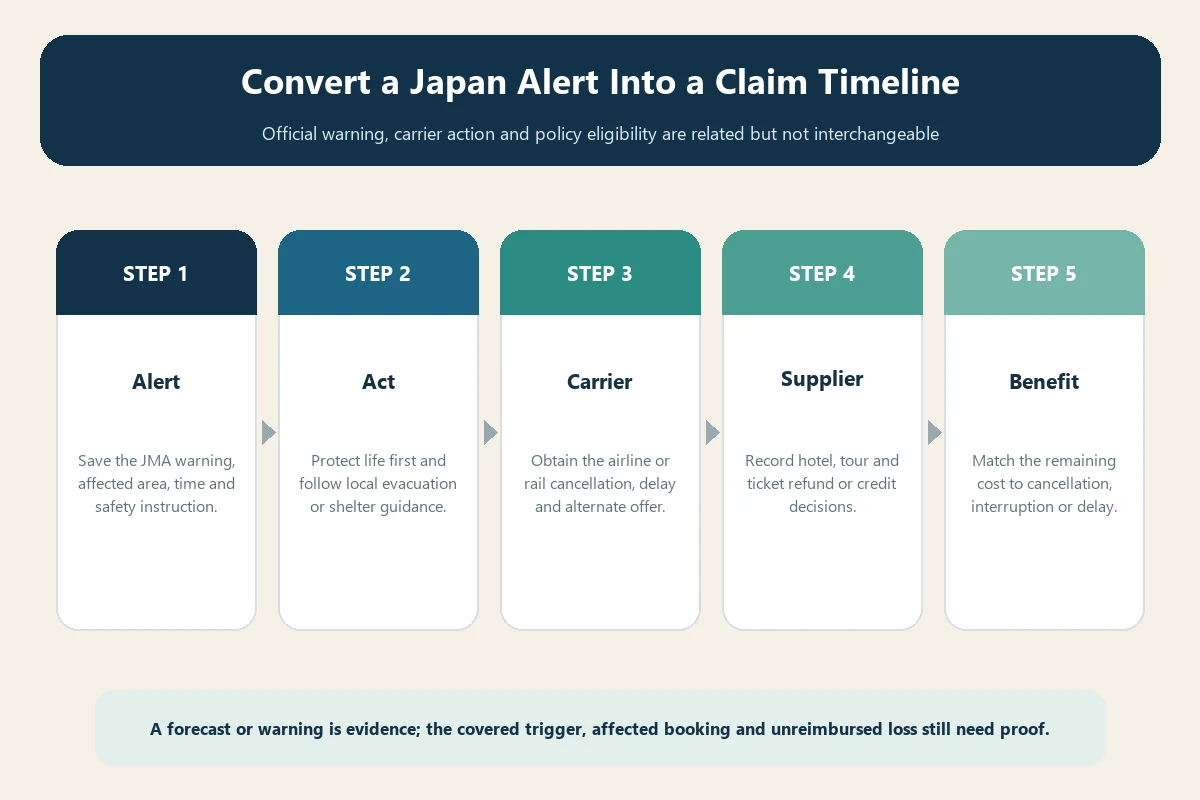
Save the warning, affected prefecture, issue time and recommended action. Add the airline, railway, hotel and tour response. A social-media video or general forecast cannot substitute for the official event and affected booking.
Separate an earthquake from its travel effects
An earthquake may trigger an early warning, stop trains for inspection, close a hotel or leave the route operating normally. Ask which policy reasons address natural disaster, destination uninhabitability, mandatory evacuation, common-carrier delay or destination inaccessibility.
JMA explains that earthquake early warnings provide only valuable seconds and that its intensity scale describes shaking at a location. An alert is not a prediction that all Japan travel will stop.
Record the exact place and effect. A voluntary cancellation in Osaka after an event affecting a distant prefecture is not automatically covered. The affected supplier and policy wording matter.
Track typhoon foreseeability and purchase timing
A typhoon develops over time, unlike an earthquake. Build a chronology showing first trip payment, policy purchase, forecast development, JMA warning, carrier decision, hotel response and traveler action.
The weather-delay guide explains known-event timing. Coverage purchased after a storm becomes foreseeable may exclude losses from that storm.
Ask about severe weather, natural disaster, common-carrier delay and mandatory evacuation. Determine whether a warning alone is enough or whether the policy requires a carrier delay, accommodation closure or minimum number of hours.
Audit rail disruption by ticket and operator
List each railway, train number or service, reservation, pass and connection. A national rail pass, private railway, airport train and separately ticketed Shinkansen can have different refund and rebooking rules.
Obtain the operator’s cancellation or delay record and alternate service. Ask whether the train qualifies as a common carrier under the policy. Determine the delay threshold and whether a missed flight on a separate ticket is included.
The delay, interruption and cancellation guide helps classify replacement transport, lodging and unused bookings. Preserve the original and revised itinerary plus every refund.
Protect timed tickets and reservations
Japan itineraries often include timed museums, theme parks, guided tours, ryokan stays, sports events and restaurant reservations. Record supplier, payment date, cancellation deadline, no-show rule and credit option.
A rail delay does not automatically reimburse every missed reservation. Ask whether the event is a covered reason and whether the prepaid cost is nonrefundable. The trip cancellation guide explains why named reasons and supplier recovery come first.
If a supplier offers rescheduling, preserve the usable value. Claim only the eligible unreimbursed loss. Keep taxes and refundable components separate.
Plan assistance and language support
Ask whether the assistance team can locate an appropriate facility, interpret, issue a payment guarantee and coordinate an ambulance or inter-hospital transfer. Confirm the phone method from Japan and a backup when data service fails.
The assistance line versus claims guide distinguishes coordination from adjudication. A facility referral does not promise network status or reimbursement.
Give a companion an offline card with allergies, medications, policy number and consent. After every call, record representative, time, instruction and case number.
Check medications before travel
The State Department warns that some prescription medicines legal in the United States are banned in Japan and directs travelers to Japan’s Ministry of Health. U.S. prescriptions are not honored locally.
Verify legality and import procedure with the responsible Japanese authority before departure. Carry approved medication in original packaging with the prescription and enough supply for a reasonable delay. Insurance cannot override customs law.
If a clinician advises that travel is unsafe, ask what documentation and timing a cancellation claim requires. The pre-existing condition waiver guide helps check look-back and purchase rules.
Audit skiing, hiking and cycling
For Hokkaido skiing, Mount Fuji hiking, cycling or water activities, give the insurer exact facts: route, season, maximum elevation, guide, equipment and technical features. Ask about closed routes, backcountry activity and rescue.
The adventure activity exclusions guide provides a comparison pattern. Search and rescue, nonmedical extraction and medical evacuation can have separate limits.
Follow operator and local-authority closures. An insurer may evaluate a claim differently when the traveler disregards a safety instruction or enters a prohibited area.
Compare policies with one Japan scenario
Use identical ages, dates and prepaid costs. Include Tokyo, a separate rail reservation, a rural ryokan, timed tickets, a typhoon warning, rail suspension, clinic payment and a missed U.S.-bound flight.
- How does cashless service work at the planned locations?
- Which plan pays first and what must the traveler pay?
- Which official alert or supplier action can trigger coverage?
- Does the exact rail service qualify as a common carrier?
- Are the planned activities and rescue stages eligible?
- Which records and notification deadlines control the claim?
Read certificates and endorsements, not provider rankings. Record the page for every answer. Avoid Google’s generic cost or limit claims; age, route, prepaid costs and definitions determine the comparison.
Build a chronological claim file
Keep the itinerary, JMA alert, railway record, airline notice, supplier cancellation, medical note, authorization, itemized bill, payment proof, refund and replacement receipt. Record Japanese yen and actual card conversion.
The travel insurance claim guide explains coordination among suppliers, the U.S. health plan and travel insurer. Label medical, transport and trip costs separately and disclose every credit.
Run the cashless-care workflow before departure
Ask assistance to explain the exact steps for a non-life-threatening illness in Tokyo and a second scenario in a rural area after hours. Determine whether the traveler must call first, how the team selects a facility, who confirms acceptance and when a payment guarantee is sent.
Then ask what happens if the clinic is outside the cashless network or refuses the guarantee. Record the allowed payment methods, claim form, translation requirement and submission deadline. Carry enough secure payment capacity for the deductible and a reasonable upfront amount without assuming a specific bill.
In an emergency, call 119 and prioritize care. Notify assistance as soon as reasonably possible. Keep the ambulance record, facility estimate, diagnosis, itemized receipt and proof that the bill was settled. A card receipt without clinical detail is weak evidence.
Build a rail-and-hotel disruption matrix
For every city change, list the rail operator, reserved service, hotel check-in, timed activity and next flight. Add the last feasible train and a safe alternate route. This reveals where one suspension can create several separate supplier decisions.
If a JMA warning leads to a rail suspension, save both. Ask the railway for cancellation or delay confirmation and the hotel for its no-show or rebooking decision. Do not assume the hotel must refund because the railway stopped.
If the traveler remains safely housed, added nights may be delay expenses after a threshold. If the trip has begun and the traveler must return early for a covered reason, unused arrangements may be interruption. Label every receipt by date, location and reason so the insurer can follow the sequence.
Prepare an offline earthquake and tsunami card
Store hotel address, nearest designated refuge, JMA links, emergency numbers, policy contact and a family check-in plan offline. On the coast, identify high ground and follow local tsunami instructions immediately. Do not wait for an insurer to approve a life-safety movement.
After reaching safety, record the warning and local instruction before contacting suppliers. A home contact can monitor airline and rail updates while the traveler conserves battery and follows authorities. This division of work improves both safety and the eventual evidence file.
Bottom line
A strong Japan plan replaces assumptions with verified processes. Confirm cashless payment, official alert sources, rail and supplier rules, event timing and activity eligibility. Then preserve the records that connect a real disruption to an eligible, unreimbursed cost.
