
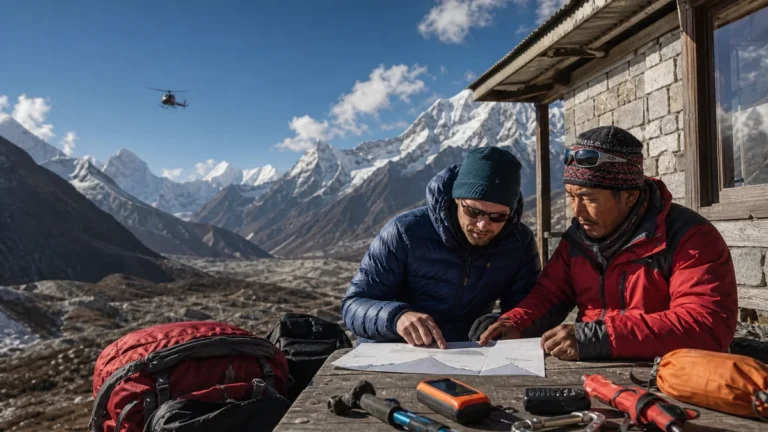
Travel insurance for Nepal from USA trips must match the exact trekking route, maximum sleeping altitude, licensed-guide rules and the way a helicopter rescue is approved and paid. A plan marketed for “adventure travel” can still exclude the route, height, unapproved flight or nonmedical retrieval that matters most.
Key takeaways
- Give the insurer the route, highest point, highest sleeping altitude and every planned activity.
- Verify current TIMS and licensed-guide requirements with Nepal Tourism Board.
- Ask who approves a helicopter, how the operator is paid and which records are required.
- Separate search and rescue, medical evacuation and later repatriation.
- Build margin for monsoon landslides and weather-related domestic flight disruption.
Planning information reviewed August 16, 2026. Advisories, permits, trekking rules, weather, aviation and policy terms can change. Recheck official sources, the registered agency and the issued certificate for the route and dates.
Write the trek as coordinates, dates and heights
Record the trail, entry and exit points, villages, rest days, side trips, passes and maximum sleeping altitude. Add Kathmandu or Pokhara hotels, domestic flights, jeeps, porters, climbing elements and prepaid permits. Give the same itinerary to every insurer.
Do not describe Everest Base Camp, Annapurna Circuit, Langtang or Manaslu only as “hiking.” Policy definitions may distinguish walking, trekking, mountaineering, technical climbing and expeditions. The precise route determines guide rules, access and evacuation feasibility.
Verify TIMS and guide requirements at the route level
Nepal Tourism Board’s current TIMS guidance identifies trekking regions and routes that require a trekking-agency-issued card and licensed guide. Check the named route rather than assuming one national rule fits every trail.
Use a government-registered trekking agency where required and preserve the agency registration, guide details, TIMS record and permits. An operator accepting a booking does not prove insurance eligibility, but breaking a local requirement can create both safety and claim problems.
Check the current Nepal advisory before committing
The U.S. Department of State maintains current Nepal travel guidance on unrest, health care, trekking, rescue payment, weather and transportation. Match the itinerary to the advisory’s date and affected locations.
Ask how civil-unrest, government-advisory and foreseeable-event exclusions apply. Save the guidance at purchase and before departure. Insurance cannot make a route safe when authorities, the guide or weather conditions say otherwise.
Match the policy’s height definition to the trek
Ask whether the certificate measures the highest point reached, highest sleeping altitude or altitude at the incident. Obtain the answer in writing with meters and feet. Check whether the limit changes when a guide is present or when the trek uses technical equipment.
The activity-exclusions guide provides a comparison method. A route can be nontechnical and still exceed a policy’s trekking-height limit.
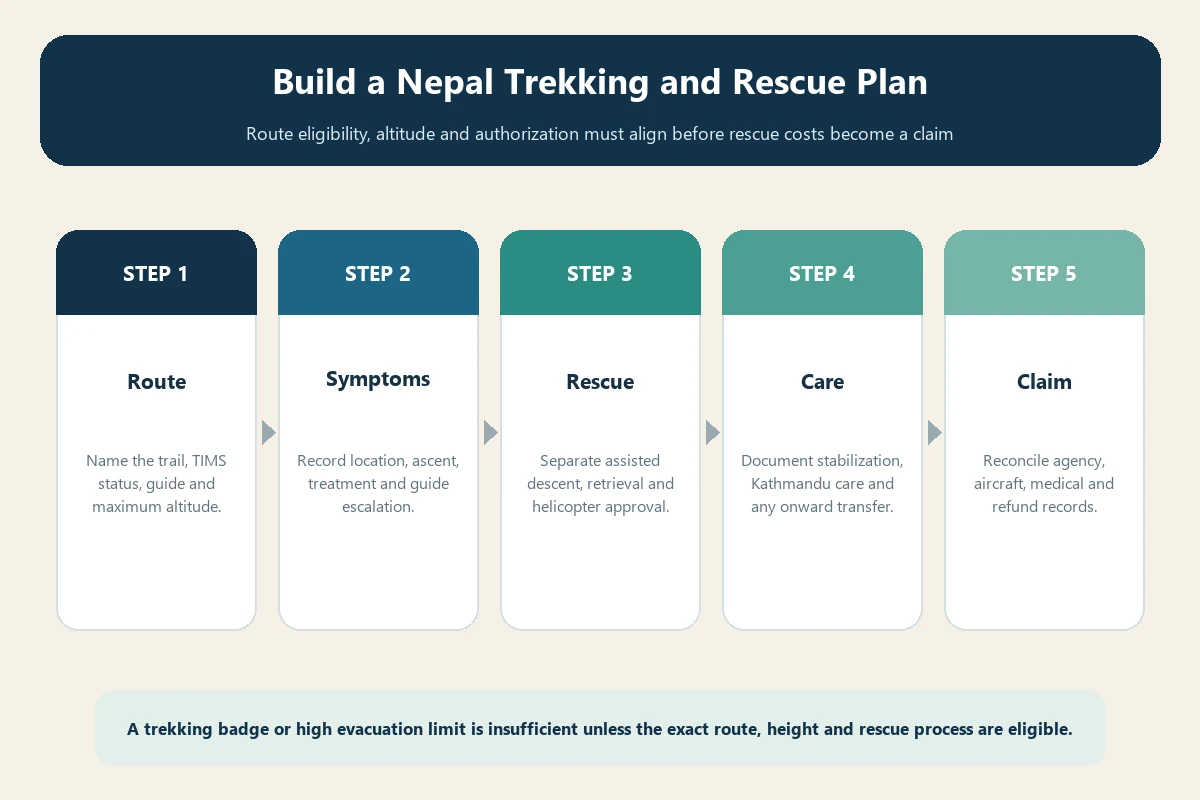
Plan for altitude illness before coverage questions
State guidance warns that popular routes reach very high elevations. Agree with the guide on acclimatization days, turnaround rules and the response to symptoms. A high coverage limit is not permission to ascend through illness.
The CDC’s current Nepal traveler health guidance should be reviewed with a clinician. Discuss altitude, vaccines, medicines, food and water, animal exposure and the traveler’s medical history early enough to change the plan.
Distinguish trail rescue from medical evacuation
A traveler may first need guides, porters or ground retrieval before reaching a helicopter landing area. Ask whether search and rescue is covered separately, subject to a sublimit or excluded. Then ask when medical evacuation begins and who decides it is necessary.
The remote evacuation guide separates retrieval, stabilization, transfer to Kathmandu and possible movement to another country. Do not treat those stages as one guaranteed flight.
Ask who authorizes a helicopter
Official U.S. guidance says helicopter companies may request insurer preapproval or a credit card before transport. Before departure, ask the insurer which assistance number must be called, what happens when communication is unavailable and who can approve on the traveler’s behalf.
Record whether the treating clinician, guide, agency, helicopter company or assistance physician made each decision. In a life-threatening emergency, obtain necessary help; a companion should document why advance approval was impractical and contact assistance as soon as possible.
Understand rescue payment pressure
Ask whether assistance can issue a guarantee of payment directly to an approved helicopter provider. Learn what the traveler may need to provide if no guarantee is available. Keep secure emergency payment capacity, but do not authorize unnecessary movement only because a provider demands it.
State guidance also warns about rescue scams and disputes. Use a registered trekking agency, record symptoms and location, preserve call logs, and request the flight record, medical reason, invoice and receiving-hospital note. Never surrender a passport casually; seek U.S. consular guidance in a dispute.
Choose an evacuation limit from the scenario
A fixed online estimate cannot predict weather, aircraft availability, location, clinical crew or onward treatment. Price is not the same as a sufficient limit. Ask whether helicopter rescue shares a limit with medical care, ground transfers or later repatriation.
The evacuation-limit guide helps test destination and authorization wording. A large number is useful only when the route, activity and altitude are eligible.
Map care from the trail to Kathmandu
Identify the nearest aid post or clinic, plausible landing locations discussed by the guide, and the receiving hospital process in Kathmandu. Official guidance notes that Kathmandu facilities may be crowded, lack equipment or ask for upfront payment, while serious cases may require treatment in another country.
Ask who identifies the nearest suitable facility and who confirms a bed. Keep the first medical note, oxygen or treatment record, transfer recommendation, authorization and receiving record. Suitability is a clinical and operational decision, not simply the nearest map pin.
Build a monsoon and landslide buffer
State guidance identifies the June-to-September monsoon as a period when landslides and domestic flight cancellations can occur. Add contingency days before the international departure. Ask which weather events and carrier delays trigger benefits and what minimum wait applies.
The weather-delay guide explains the known-event trap. Preserve the airline or road operator’s decision, not only a forecast or a photograph of clouds.
Audit domestic flights separately
Record the airline, flight, airport, baggage, scheduled time and connection buffer. Mountain weather can affect one airport while another operates. Ask whether a missed international flight is covered when domestic tickets were purchased separately.
Keep the cancellation message, stated reason, refund, replacement booking and added lodging. The benefit-classification guide helps distinguish a delayed departure from an early trip ending.
Compare one Nepal trekking scenario
Use identical ages, dates and trip costs. Include the named trail, altitude profile, licensed guide, domestic flight, monsoon delay, progressive altitude symptoms, assisted descent, helicopter consideration and treatment in Kathmandu.
- Is the route and maximum height covered?
- Are TIMS and guide conditions satisfied?
- Does retrieval differ from evacuation?
- Who authorizes and pays the helicopter?
- Which hospital is suitable?
- What evidence and refunds reduce the claim?
Require answers from the full certificate and insurer, not from a generic “trekking included” badge.
Use the assistance line before the signal disappears
Store the policy, emergency number, agency contact, guide contact, allergies and medicines offline. Give a companion authority and instructions to open a case. Consider a legal and route-appropriate satellite communication plan where ordinary service is unreliable.
The assistance versus claims guide explains why coordination does not equal reimbursement. Record every call, attempted call, representative and instruction.
Assemble the rescue-to-claim record
Preserve the itinerary, permits, TIMS, guide record, GPS or village location, symptom timeline, treatment, agency messages, helicopter request, authorization, invoice, flight record, hospital notes, payment and refunds. Label amounts in Nepalese rupees and other currencies.
The claim documentation guide explains reconciliation. Show the original charge, supplier recovery, other insurance payment and final request without combining unrelated travelers or events.
Set a written turnaround protocol
Agree before departure on who can stop the trek, how symptoms are reported and which village or rest day becomes the fallback. Share the check-in schedule with a home contact. Insurance should support sound decisions, not pressure the group to continue.
If the route changes, record the safety reason, guide decision, unused service, refund and replacement. A voluntary upgrade or preference belongs in a different column from a medically necessary or operator-directed change.
Audit the trekking agency before departure
Confirm the agency’s government registration, emergency contact, guide assignment, porter arrangements, permits and rescue protocol. Ask which helicopter companies it may contact and whether it can communicate with the insurer without acting as the insurer. Keep the written itinerary and service agreement.
Ask how the agency prevents conflicts of interest in rescue decisions. A guide should escalate symptoms and safety facts, while medical necessity and insurance approval follow their proper channels. Preserve the original incident report, not only a later claim summary. If the guide, agency and assistance company give different instructions, record each one and prioritize immediate safety.
Plan an assisted descent alternative
A helicopter is not the only possible response, and weather may make flying impossible. With the guide, identify lower villages, lodges, roads and aid posts that could support a medically appropriate descent. Do not improvise a route during illness without local expertise.
Ask the policy how porters, pack animals, ground vehicles, extra guide time and unplanned lodging are classified. Search and rescue, emergency medical transport and trip interruption may use different definitions. Keep the clinical recommendation, guide log, route, timestamps and receipts so the insurer can see why descent was necessary and how it connected to later care.
Bottom line
A strong Nepal plan names the trail and altitude, satisfies current guide rules, and rehearses the rescue approval and payment sequence. Verify every stage from retrieval to Kathmandu care, then preserve the evidence that connects medical necessity to the final unreimbursed cost.
