

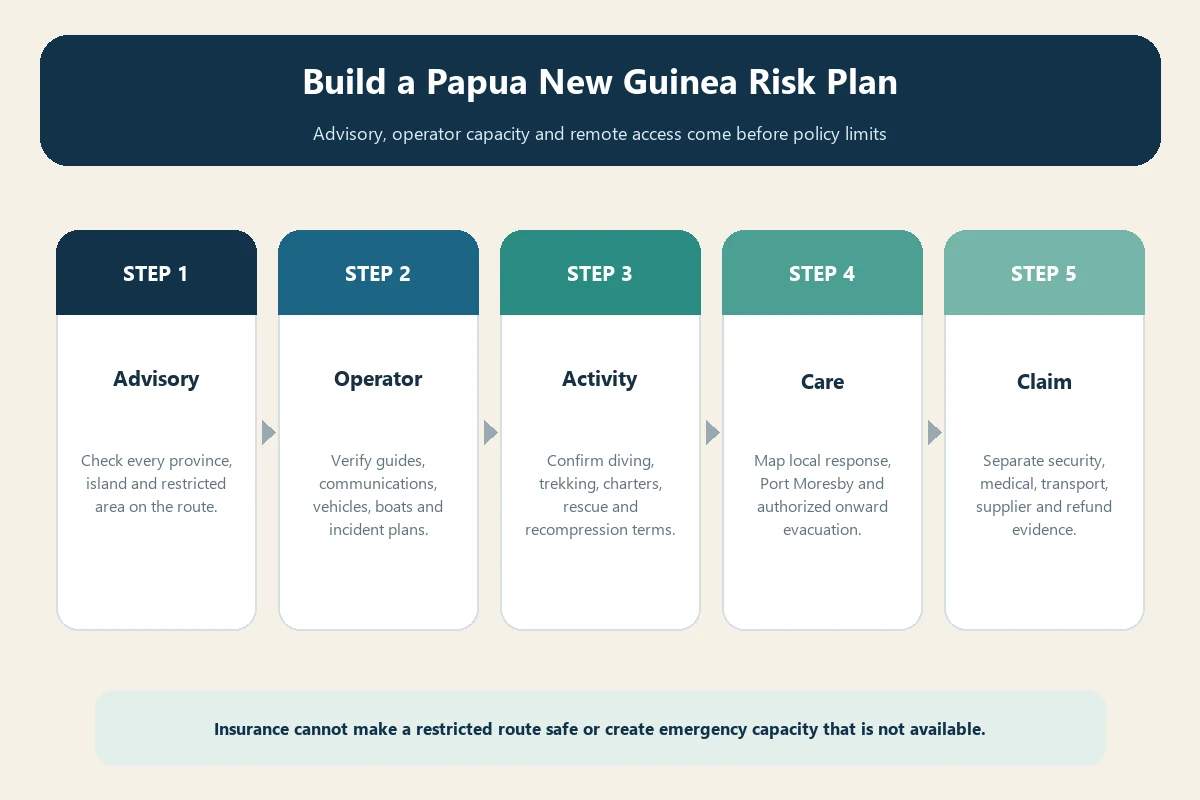
Travel insurance for Papua New Guinea from USA trips needs a route-specific review of official advisories, medical access, remote transport, diving and evacuation. A policy cannot make an unsafe area safe or create a hospital, aircraft or response team where capacity is limited.
Key takeaways
- Check the current advisory and every named region before committing money.
- Map the first movement from an island, village, trail or dive boat to appropriate care.
- Confirm diving, trekking and expedition activities in the issued policy.
- Ask whether evacuation can move a patient to Australia or another suitable destination and who authorizes it.
- Keep supplier, security, medical and transport evidence in separate claim folders.
Planning information reviewed August 16, 2026. Advisories, entry rules, regional access, healthcare capacity and policy terms can change quickly. Recheck official sources and obtain professional safety and medical advice for the planned dates.
Start with a go-or-no-go review
The U.S. Department of State publishes current Papua New Guinea travel information. Its advisory addresses crime, civil unrest, piracy, kidnapping, unexploded ordnance, healthcare availability and natural hazards, with additional restrictions for some areas.
Read every regional section before making a nonrefundable payment. Recheck at policy purchase, before the final balance and immediately before departure. Insurance is not permission to disregard a do-not-travel area, operator instruction or local restriction.
Ask how advisory changes affect coverage
Give the insurer the provinces, islands, ports, airfields and expedition dates. Ask how the certificate defines a destination and whether an advisory issued before purchase, a later advisory change, an operator cancellation or a personal decision is treated differently.
Request the answer in writing with the relevant policy section. A current warning may affect underwriting or exclusions, while a later change may or may not activate a named benefit. Never describe the route only as “PNG.”
Draw the remote response chain
For each stop, identify the operator contact, communication method, boat or vehicle, nearest practical clinic, urban hospital and suitable airfield. State guidance says first responders may be unable to reach locations outside major cities and that appropriate treatment is generally concentrated in or near them.
Ask who is responsible for the first movement and how assistance joins the response. The remote medical evacuation guide helps distinguish a credible route from a large benefit number without an operating plan.
Do not confuse rescue with evacuation
Search, rescue, off-road extraction, boat transfer, ground ambulance and medical evacuation can be different services under a policy. Ask whether the plan covers the step from an accident site to a clinic as well as medically necessary transport between facilities.
Find out who chooses the receiving facility and whether “nearest suitable” could mean Port Moresby, Australia, Singapore, the Philippines or another location based on the case. The evacuation limit guide identifies authorization, escort and transport questions that matter.
Plan for receiving-country entry requirements
State guidance notes that severe cases may require evacuation abroad and specifically warns that medical movement to Australia requires an Australian visa or Electronic Travel Authority. Ask assistance how it handles immigration documents for the patient and any companion.
Do not purchase a replacement flight or charter on the assumption that it will be reimbursed. In a nonemergency, obtain written authorization. In an emergency, get necessary local help first and document why advance approval was not practical.
Prepare for upfront medical payment
State guidance says hospitals may require advance payment or proof of insurance and that patients bear transfer costs. U.S. Medicare and Medicaid do not apply overseas, and many providers do not accept U.S. health insurance directly.
Ask whether the assistance team can contact a provider or arrange a payment guarantee. Maintain secure backup payment capacity. Collect the diagnosis, itemized invoice, payment proof, clinical notes, prescription, discharge summary and referral. The health insurance abroad guide structures the call to the domestic plan.
Audit scuba diving and recompression terms
State guidance advises travelers to confirm an operator’s current certification, equipment and training. It also notes that Papua New Guinea has one hyperbaric recompression chamber, located in Port Moresby. That fact does not guarantee current operation, staffing or access during an incident.
Give the insurer the certification level, depths, breathing gas, liveaboard, night dives, remote sites and operator. Ask separately about boat response, medical treatment, recompression, island transfer and international evacuation. Use the activity exclusion guide to compare conditions.
Verify trekking and expedition activities
List every trek, climb, cultural expedition, caving trip, fishing charter and motorized activity. Ask about altitude, guide, trail status, remoteness, equipment and any search-and-rescue exclusion. A generic “adventure included” label is not enough.
Request the operator’s emergency plan, guide qualifications, communications and medical kit. Ask how the group records an incident and who can alter the route. A capable operator remains essential even when an activity is eligible under the policy.
Review health guidance with the exact route
The CDC provides current Papua New Guinea traveler health guidance. Discuss vaccines, malaria prevention, mosquito exposure, food and water, medicines and planned activities with a travel-health clinician well before departure.
Ask how the certificate handles unexpected illness, pre-existing conditions, preventive care and medicine replacement. Carry lawful medicine in original packaging with supporting records. Remote access makes adequate supply and a delay margin especially important.
Treat earthquakes, volcanoes and tsunamis as operational events
State guidance says the country experiences seismic activity, active volcanoes and tsunami exposure. Identify the official alert sources used by the operator and each accommodation. Record evacuation zones, assembly points and alternative transport before arrival.
Insurance generally requires a defined event and documented financial loss. Save the official alert together with a closure, carrier cancellation, operator decision or accommodation response. The weather and disruption guide shows how to link hazard evidence to supplier action.
Test domestic flights and charters
Record the operating carrier, scheduled or charter status, baggage allowance, ticket terms, next service and onward international connection. Ask whether each flight fits the policy’s carrier definition. A charter embedded in a lodge package may be treated differently from a public scheduled flight.
After a disruption, request the reason, next available service and refund. Save the lodge or tour operator’s revised itinerary. The delay and interruption guide helps separate extra nights, replacement tickets and unused services.
Compare one realistic remote scenario
Use the same travelers, route, dates, medical history and prepaid costs for every quote. Test an injury at a remote lodge or dive site, boat or road movement to an airfield, treatment in Port Moresby and medically recommended transfer to a higher-capability facility.
- Is the exact activity eligible?
- Who controls first movement from the site?
- Where does rescue end and evacuation begin?
- Who selects and authorizes the receiving facility?
- How are upfront medical bills handled?
- Which operator refunds reduce the claim?
Read the definitions, exclusions and benefit schedule together. Do not substitute a broker comparison table for the issued certificate.
Build a complete prepaid-cost ledger
List international and domestic flights, charters, lodge nights, expedition fees, dive packages, transfers, permits and nonrefundable taxes. Note the first deposit date, cancellation schedule and amount that remains refundable on each date.
Update the insured amount when adding services if the policy requires it. If an operator cancels, request a breakdown of refund, credit and retained amount. Claim only the eligible unreimbursed balance.
Use assistance as an operating record
Download the certificate and save the assistance number offline. Record every call, case number, instruction, facility, transport provider and authorization in local time. Ask for written confirmation before an expensive nonemergency transfer whenever possible.
The assistance versus claims guide explains why operational coordination is not final coverage approval. Follow urgent clinical advice while preserving why normal notification steps could not be completed.
Organize evidence by incident layer
Keep an advisory and security folder, an operator folder, a medical folder, a transport folder and a refund folder. Use one master timeline to connect them. Label documents with place, local date, traveler, supplier and currency.
The claim filing guide helps reconcile invoices, provider records, supplier returns, card benefits and domestic-plan payments. Preserve original documents and translate only what the insurer requests.
Create an offline emergency card
List passport name, allergies, medicines, policy number, assistance line, operator, guide, coordinates, satellite contact and the next practical response point. Give the same information to a companion and home contact. Agree on a missed-check-in escalation time.
Carry independent power and test the communication method before traveling remotely. This does not guarantee rescue, but it can reduce delay caused by missing identity, medical or location details.
Know what insurance cannot do
A policy does not neutralize an advisory, guarantee police or ambulance response, certify an operator, keep a chamber open or force an aircraft to fly. It also cannot guarantee admission to a specific overseas hospital.
The State Department’s general travel insurance guidance recommends checking validity by destination, trip duration, emergency care, medical transportation, planned activities and a 24-hour help line. Apply each item to the real PNG route.
Bottom line
A responsible Papua New Guinea insurance decision begins with the current advisory and a credible operator plan. Verify remote access, activity eligibility, medical payment and evacuation authorization before committing funds. If the route cannot be supported safely, an advertised policy limit is not a solution.
