
Travel insurance for seniors traveling with a caregiver should be compared as a two-person contract and cost ledger. The senior, caregiver, family member, paid attendant, or travel companion can have different insured status, trip costs, medical risks, cancellation reasons, and authority. A policy bought for one person does not automatically reimburse the other.
This U.S.-focused guide shows how to map both travelers without treating caregiving as a diagnosis or assuming legal authority. It is educational, not insurance, medical, employment, or legal advice. Policy definitions and applicable law control.
Key takeaways
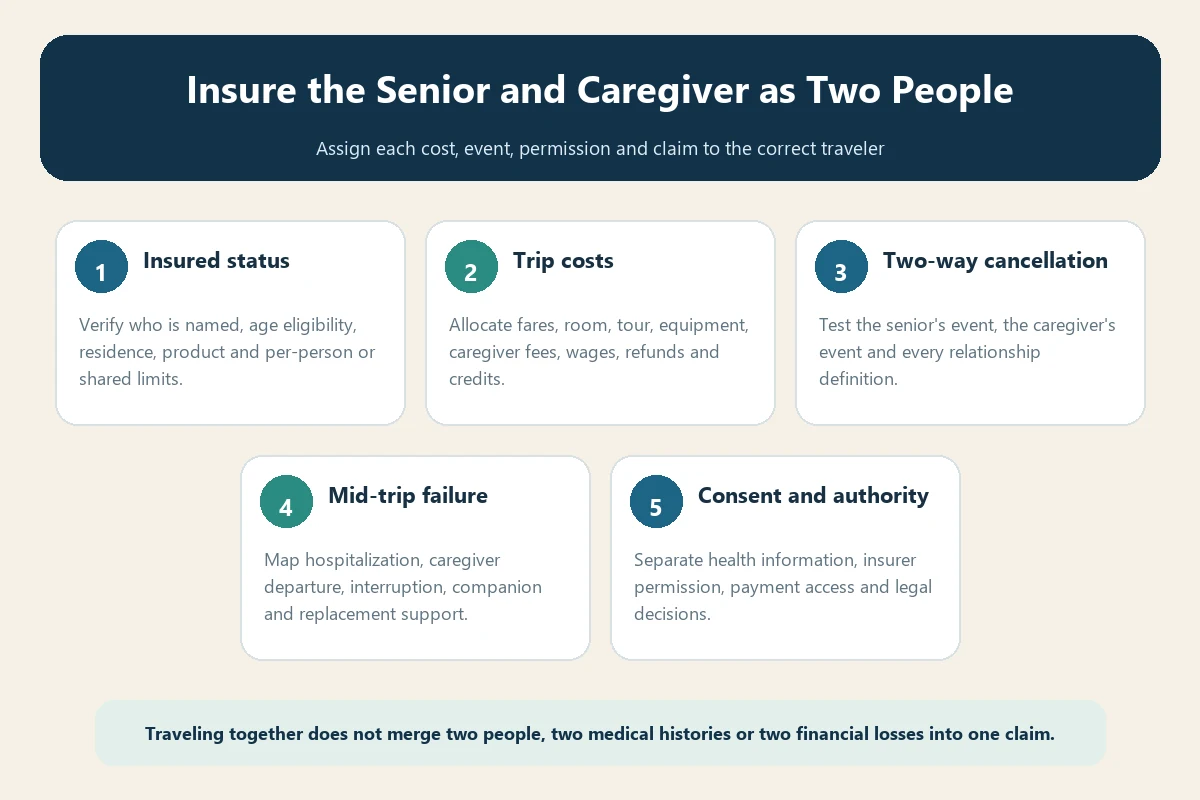
- Name every traveler and verify who is insured under each certificate.
- Allocate deposits, airfare, lodging, wages, and replacement-care costs to the correct person.
- Separate a caregiver’s own illness from the senior’s covered medical event.
- Do not assume a caregiver can receive medical information or make decisions.
- Test what happens if the caregiver cannot depart or must leave mid-trip.
Reviewed August 16, 2026. “Insured,” “traveling companion,” “family member,” “caregiver,” “attendant,” and “covered reason” can mean different things in different contracts.
Define the caregiving arrangement first
Record whether the companion is a spouse, relative, friend, paid employee, contractor, agency worker, nurse, aide, or other attendant. Describe the actual tasks: mobility assistance, transfers, meals, medication reminders, communication, personal care, overnight supervision, claims support, or companionship.
Then ask which services the airline, tour, cruise, hotel, or assistance company will provide. The U.S. Department of Transportation explains that airline personnel are not required to provide personal services such as help with eating, restroom use, or administering medication. An accessible trip can still require a personal care attendant.
Build two traveler columns, not one household row
| Item | Senior traveler | Caregiver or attendant |
|---|---|---|
| Named insured? | Confirm certificate and date of birth | Confirm separate or shared certificate |
| Trip cost | Own fare, tour, room share, equipment | Fare, room share, fees, wages if insurable |
| Medical coverage | Exact-age maximum and prior-condition rules | Own eligibility, deductible, exclusions |
| Cancellation trigger | Senior’s covered event | Caregiver’s covered event or relationship rule |
| Authority | Retains decisions unless lawful authority applies | Only the permission or authority actually granted |
| Claim evidence | Medical, trip-cost, payment, and refund records | Own bookings, status, loss, and expense records |
If both travelers appear on one purchase, confirm whether limits are per person, per trip, per policy, or shared. If policies are separate, compare covered reasons and definitions across both forms. The same event can produce different results.
Identify who owns each prepaid cost
Create an itemized ledger for airfare, tour, cruise, hotels, transfers, equipment rental, accessible room, single supplement, caregiver fee, wages, agency charge, and replacement services. Save who paid, who is named on the booking, refund rules, credits, and nonrefundable amounts.
Travel insurance typically addresses covered prepaid travel loss, not every caregiving expense. Wages, lost income, agency penalties, or the cost of hiring a replacement may be outside the contract unless a specific benefit applies. Ask in writing rather than adding them to trip cost automatically.
Test cancellation before departure in both directions
Scenario A: the senior has a covered illness and cannot travel. Does the caregiver’s policy reimburse the caregiver’s own prepaid loss? That can depend on traveling-companion or family-member definitions, medical evidence, and whether both were scheduled on the same trip.
Scenario B: the caregiver becomes ill or unavailable while the senior remains medically able to travel. Does the senior have a covered cancellation reason? A personal need for that particular caregiver is not automatically insured. Check whether the caregiver qualifies as an insured traveling companion and whether inability to provide care is itself listed.
The traveling companion pre-existing-condition guide shows how one person’s medical history can affect another traveler’s claim.
Test interruption after departure
Model three events: the senior is hospitalized and the caregiver stays; the caregiver is hospitalized and the senior needs assistance; the caregiver must return home for a separate covered reason. For each, assign unused trip cost, new transportation, lodging, meals, local care assistance, and any replacement attendant.
Use the delay, interruption, and cancellation guide to choose the correct benefit. A new hotel night can arise from medical care, interruption, delay, or an uncovered operational choice; the receipt alone does not identify the benefit.
Do not confuse a traveling companion with a medical escort
A caregiver who accompanies the traveler from the start is different from a medical escort arranged for a return flight. An insurer-approved escort may be a clinician or trained person required by the patient’s condition. The original caregiver may or may not qualify.
The medical evacuation travel-companion guide separates patient transport, companion travel, bedside visit, and return of dependents. Ask whether the caregiver’s extra lodging, meals, return ticket, or continued stay uses a companion benefit, interruption benefit, or no benefit.
Create a replacement-care plan outside the policy
Identify what tasks cannot safely stop and which person or agency could replace them at the destination. Check licensure, language, availability, background checks, payment, hotel access, medical-facility rules, and whether the traveler consents. The insurer’s assistance line might make referrals without paying the service.
Ask the policy administrator whether replacement care is an insured benefit. If it is not, price the contingency and decide who can contract and pay for it. A generic promise of “travel assistance” should not be interpreted as funded caregiving.
Preserve the senior traveler’s autonomy
The caregiver should not be treated as the decision-maker merely because support is provided. Ask the senior who may receive information, speak with the insurer, assist with payment, communicate with clinicians, and make decisions if the senior cannot. Use jurisdiction-appropriate professional advice for any health-care proxy, power, employment, or privacy document.
HHS explains that family access to protected health information can depend on the individual’s direction, authorization, applicable representative authority, lack of objection, professional judgment, and the specific information relevant to care. A paid caregiver or family relationship does not automatically grant unrestricted access.
Coordinate insurer permission and medical privacy
Ask the travel insurer how the senior authorizes the caregiver to discuss an assistance case or claim. Ask the U.S. health plan how to designate a helper. Carry only necessary health information securely. A medical privacy authorization and an insurer’s representative form may both be needed for different purposes.
The assistance-line and claims guide explains why permission to coordinate care does not decide reimbursement.
Prepare the medical and functional plan
- Medication list, allergies, diagnoses, generic names, and clinician contacts
- Mobility, transfer, personal-care, sensory, communication, oxygen, and device needs
- Tasks the senior performs independently and tasks the caregiver performs
- Emergency medical information chosen by the senior for disclosure
- Accessible transport, room, bathroom, charging, refrigeration, and rest needs
- Backup if the caregiver, device, phone, or transport becomes unavailable
CDC recommends evaluating the whole itinerary and confirming necessary accommodations. The State Department advises older travelers to carry medical alert and emergency information, original labeled medication, and a provider letter where appropriate.
Check airline seating and personal-care boundaries
DOT’s disability Bill of Rights provides adjoining seating accommodations for certain companions, including a personal care attendant who performs a function airline staff are not required to perform. Confirm the request with each airline and document the caregiver’s function; do not assume a free extra ticket.
Airline seating rights, caregiver airfare, and travel-insurance reimbursement are separate. If an aircraft substitution splits the seats, contact the airline first and preserve the record if the disruption creates an insured loss.
Audit medical and pre-existing-condition rules for both people
Run the exact date of birth, residence, destination, and trip dates for each insured. Copy medical maximums, deductible, evacuation, and age tiers. Review the pre-existing-condition definition and waiver requirements separately for the senior, caregiver, and any non-traveling person whose illness could trigger cancellation.
The look-back-period guide provides a shared timeline template. Do not assume a waiver purchased for one traveler fixes another person’s exclusion.
Rehearse the caregiver-unavailable scenario
Start at the least accessible overnight location. The caregiver cannot continue. Who contacts the insurer? Can the senior stay safely alone? Which local service can help? Who contracts and pays? Can the senior interrupt the trip under a covered reason? Which transport and medical records are needed?
Write answers and point to the certificate, operator agreement, authorization, or funded backup for each. If the only answer is “the tour leader will handle it,” obtain the tour operator’s actual scope in writing.
Use this two-person claim packet
- Both certificates, declarations, identification, and assistance contacts
- Itemized trip-cost ledger showing owner, payer, booking name, and refund
- Caregiver relationship or service agreement where relevant
- Accessibility requests, seating confirmation, and provider communications
- Medical reports and privacy or representative documents appropriate to the task
- Interruption timeline, new transport, lodging, care, and replacement-service receipts
- Refunds, credits, other-insurance payments, and denied amounts
- Claim forms for each insured rather than one blended narrative
Questions to ask the insurer
- Are both the senior and caregiver named insureds?
- How is traveling companion defined?
- Does one traveler’s covered illness protect the other’s prepaid cost?
- What if the caregiver is unavailable but the senior is not medically ill?
- Are caregiver fees, wages, or replacement services ever eligible?
- Which benefit pays the caregiver’s continued stay during hospitalization?
- Can the caregiver speak with assistance and claims teams?
- How are separate pre-existing conditions reviewed?
- Are limits per person or shared?
- What documentation proves each traveler’s loss?
FAQ about senior caregiver travel insurance
Is a caregiver automatically covered by the senior’s travel insurance?
No. Verify whether the caregiver is a named insured and whether the contract treats that person as a traveling companion or family member for specific benefits.
Will insurance pay for a replacement caregiver abroad?
Only if a specific benefit covers the expense and its conditions are met. Assistance referrals do not necessarily include payment.
Can a senior cancel if the caregiver becomes ill?
It depends on the covered-reason and traveling-companion definitions, the caregiver’s insured status, medical evidence, and exclusions. The need for care alone is not proof of coverage.
Can the caregiver make medical decisions?
Not automatically. The senior retains decisions unless applicable law and valid authority provide otherwise. Information access, insurer representation, and health-care decisions are separate.
Bottom line
Travel insurance for a senior traveling with a caregiver is a two-person verification task. Name both travelers, allocate every cost, test cancellation and interruption in both directions, fund replacement care, and document the senior’s chosen permissions. The policy should support the care arrangement, but it should never be assumed to insure every service or transfer the traveler’s autonomy.
Sources
- U.S. Department of Transportation — Airline Passengers with Disabilities Bill of Rights
- U.S. Department of Transportation — Seating Accommodations
- CDC Yellow Book — Travelers with Disabilities
- U.S. Department of State — Age 65+ Travelers
- HHS — Family Access to Health Information
- NAIC — Should I Get Travel Insurance?
