

A travel insurance traveling companion pre existing condition can affect another traveler’s cancellation or interruption claim, but only through the issued policy’s own definitions and benefits. A shared trip does not merge two people, two losses, or two insurance contracts — even when both travelers bought a plan from the same company on the same day.
This U.S.-focused guide builds a two-person, two-policy review. It is educational information, not medical, legal, or coverage advice.
Key takeaways
- Confirm that the sick traveler meets the defined term Traveling Companion in the certificate, not just “someone I was traveling with.”
- Map each traveler’s bookings, insured costs, certificate, and waiver separately — a shared invoice is not a shared policy.
- Distinguish the companion’s treatment from the other traveler’s cancellation loss; they are different claims, sometimes with different insurers.
- Use the correct benefit for the event date: cancellation before departure, interruption after it.
- If one traveler relied on a credit card benefit instead of a standalone plan, treat that as a third, differently-structured policy in the map, not a variant of the others.
- Coordinate claims without assuming one insurer’s approval binds the other.
Reviewed August 24, 2026. Companion definitions and state forms differ. Each traveler’s issued certificate controls their claim.
Begin with a two-person, two-policy map
Label traveler A and traveler B. For each person, record the insurance company, plan, policy number, state form, purchase date, first trip payment, insured trip cost, and departure date. Then list which flights, rooms, tours, or cruise reservations are shared.
Add the medical event only to the person who experienced it. Add financial loss to the person who paid or is named on the booking. This prevents a frequent error: submitting traveler B’s hospital bills as though they prove traveler A’s nonrefundable trip cost.
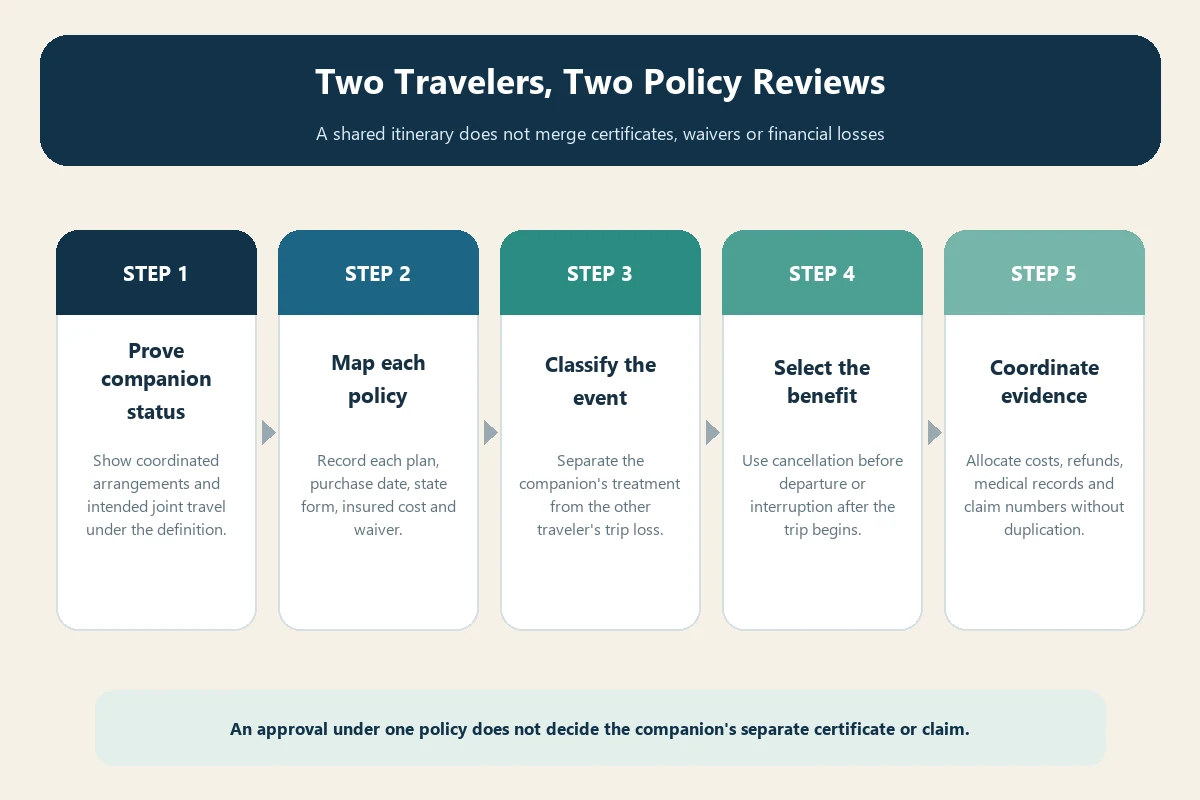
Prove that the person is a traveling companion
The term usually requires more than incidental proximity. A certificate may require coordinated travel arrangements and an intent to travel together. It may address tour leaders, group leaders, or people who happen to be on the same departure.
A current Travel Guard Pennsylvania sample policy defines a traveling companion through coordinated arrangements and intended joint travel. It also limits when a group or tour leader qualifies. That is an illustration, not a rule for every product.
Keep the joint itinerary, booking confirmation, room assignment, and invoices. If tickets were purchased separately, preserve correspondence showing the coordinated plan.
Do not equate “same tour” with “traveling companion”
Two strangers on the same cruise, bus, or guided tour may have overlapping travel without coordinating their arrangements. A friend on the same flight may be a companion under one definition but not another. Read the capitalized term before relying on the person’s sickness as a covered reason.
Ask the insurer a narrow question using the actual facts. Avoid a generic “are friends covered?” because the answer may depend on rooms, bookings, and intended joint travel.
Classify the other traveler’s loss
Traveler B’s medical expense claim asks whether their treatment is eligible under B’s plan. Traveler A’s trip-cancellation claim asks whether B’s sickness is a listed reason that forces A to cancel and whether A has covered nonrefundable loss.
The trip cancellation guide explains the before-departure path. The trip interruption guide applies when the covered event prevents continuation after the trip begins.
One event can generate separate files: B’s treatment invoices, A’s forfeited booking costs, and possibly different return-transportation expenses. Do not combine amounts or claim the same cost twice.
Apply the pre-existing definition to the named people
Some forms define a pre-existing medical condition to include an insured, traveling companion, family member, or other named person. Review the exact list. Then apply the stated look-back period to the companion’s symptoms, worsening, visits, tests, treatment advice, and medication events.
The pre-existing look-back guide provides a date method. Count from the anchor named in the relevant certificate, not from the shared departure date unless the form says so.
Traveler A and traveler B may have purchased on different days. Even when both policies use the same number of look-back days, the windows can differ.
Check two waiver files, not one
Traveler B’s early purchase does not prove traveler A met A’s waiver conditions. Each policy can have its own deadline, trip-cost requirement, medical-ability test, and update obligation. Even two certificates from the same insurer may differ by state or plan.
Use the waiver eligibility checklist once for each traveler. The waiver timing guide helps track the initial payment and later trip-cost additions.
A waiver under B’s medical-expense claim does not automatically decide A’s cancellation claim. Each benefit must still contain a covered reason and satisfy its conditions.
When a Companion Is Covered by a Credit Card Benefit, Not a Standalone Policy
A common gap in the two-policy map: one traveler bought a standalone plan, and the other is relying on a trip cancellation or interruption benefit that comes bundled with a credit card. Treat that card benefit as its own, differently structured policy — not a lighter version of the standalone one.
Card benefits typically require the trip to be paid for with that specific card to trigger coverage at all, run on their own definitions of a covered traveling companion (sometimes narrower, sometimes broader than a standalone plan’s), and often carry lower per-person or per-trip payout caps than a purpose-built travel policy. A pre-existing condition waiver, if the card benefit offers one, usually has its own separate purchase-timing and eligibility rules tied to the trip charge date, not the standalone traveler’s purchase date.
Before assuming a card-covered companion’s claim will track the standalone traveler’s outcome, pull the card’s guide to benefits (available from the card issuer, not the merchant) and check it against the same three questions used for a standalone plan: is the companion a defined term under this benefit, is the trip cost actually insured under it, and does a pre-existing condition waiver apply and on what timeline.
Compare shared and separate trip costs
A shared hotel room may be booked under one name, while each traveler buys airfare independently. A cruise cabin may show both passengers on a single invoice. Determine who paid, who owns any refund or credit, and which amount each policy insured.
| Cost item | Who to record as payer | Which traveler’s policy insures it |
|---|---|---|
| Shared cruise cabin or hotel room | Name on the invoice, even if funds came from both | Whichever traveler’s certificate lists that booking as an insured cost |
| Separately booked airfare | Each traveler individually | Each traveler’s own policy, for their own ticket |
| Prepaid tours or excursions | Whoever the receipt names | The named payer’s policy, unless the certificate states otherwise |
| Refunds or future travel credit issued by a vendor | The traveler entitled to the credit under the vendor’s terms | Subtract from that traveler’s claimed loss before filing |
Create a row for every cost category in your own trip — airfare, lodging, cruise or tour, ground transport, and activities — with payer, traveler, cancellation terms, refund, credit, and claimed balance. This financial map is as important as the medical timeline.
Use physician proof that addresses the right question
A benefit may require a physician to certify that the companion cannot travel or continue the trip. A diagnosis alone may not establish that functional restriction. Ask for records showing onset, examination date, treatment, and the restriction that existed at the time of loss.
The physician should report medical facts, not decide insurance coverage. Do not ask for altered dates or a statement that ignores earlier symptoms. If medical privacy limits what traveler A can obtain, follow the insurer’s authorization process.
Coordinate notifications and assistance calls
Notify both insurers promptly when two policies are involved. Record claim numbers, deadlines, required forms, and the name of each representative. If the event occurs during the trip, contact assistance services when the certificate requires or recommends it.
The assistance-line versus claims guide explains that an assistance representative can help arrange care or transport without issuing a final claim decision. Save call records and written approvals.
Read exclusions beyond the pre-existing clause
Even if a waiver removes the pre-existing exclusion, other provisions remain. Travel for planned treatment, travel against physician advice, routine care, known losses, intoxication, or benefit-specific exclusions may apply if stated in the form.
The five-layer exclusions guide helps follow definitions, general exclusions, benefit exclusions, conditions, and endorsements without stopping at a summary page.
The National Association of Insurance Commissioners’ consumer overview recommends comparing covered events, limits, and exclusions. Apply that method to every policy in the map, including a credit card benefit.
Do not assume approval under one plan controls the other
Traveler B’s insurer may approve emergency medical expenses while traveler A’s insurer denies cancellation because A lacks an eligible nonrefundable loss or B does not meet A’s companion definition. The reverse can also occur when benefit language and evidence differ.
Allianz’s pre-existing-condition explanation is one example of plan-specific waiver requirements. It cannot determine how a second carrier’s certificate, or a card issuer’s benefit terms, will respond.
Build a coordinated claim packet
Create a shared cover timeline with booking, purchase, medical-event, cancellation, and departure dates. Then attach separate sections for traveler A and traveler B (and, if relevant, the card-benefit claim). Each section should contain its own certificate or guide to benefits, application, insured costs, claim form, medical authorization, and proof of loss.
Use the claim documentation guide to index receipts, refunds, credits, physician records, and communications. Mark documents supplied to more than one carrier without changing the originals.
CDC’s travel insurance chapter explains that domestic health insurance, travel health coverage, and evacuation protection can differ. Traveler B should identify every potentially applicable payer while traveler A documents the trip loss.
Work through three companion scenarios
Shared cruise cabin, separate policies
Traveler B becomes medically unable to travel. Both travelers are on the cabin invoice, but A and B bought different plans on different dates. Each traveler must prove companion status, their insured share, the medical restriction, and their own waiver conditions.
Same tour, separate rooms
A and B intend to travel together but booked independently. Preserve messages and coordinated itinerary details. Whether they qualify depends on the issued definition, not simply the tour operator’s passenger list.
Companion leaves after departure
B becomes ill abroad and returns home. A continues traveling for two days, then leaves. The file must explain why A could not continue, when that decision occurred, which transportation costs changed, and what refunds were available. This is an interruption analysis, not a cancellation claim.
Ask the insurer these questions before you file
Ask how Traveling Companion is defined; whether the shared arrangements qualify; which sickness or injury trigger applies; what physician restriction is required; which people the pre-existing definition includes; what look-back window applies; whether the waiver reaches companion-caused losses; which trip costs must be insured; how shared refunds are allocated; and how two carriers (or a carrier and a card issuer) should coordinate documents.
Provide the exact itinerary and purchase dates without transmitting unnecessary private health information through an insecure channel. Request the certificate or guide to benefits, and written answers.
Bottom line
A traveling companion’s condition can affect another person’s travel claim, but a shared itinerary does not create shared coverage. Prove companion status, separate each policy and waiver — including a credit card benefit if one is in play — choose the benefit by event date, and allocate each loss to the traveler who incurred it.
A two-person, two-policy map turns a confusing group event into two traceable contract reviews. Preserve every file from purchase through the final claim decision.
A senior and caregiver can have different insured status, trip costs, medical risks and authority even when they travel together. Use the senior caregiver travel insurance two-person ledger to test cancellation in both directions, interruption, replacement care, consent, shared limits and claim evidence.
Frequently Asked Questions
Does one traveler's pre-existing condition waiver cover a companion's claim too?
No. Each traveler's policy has its own waiver conditions: purchase timing, insured trip cost, and medical fitness at purchase. Meeting the waiver on one policy says nothing about whether the other traveler met it on theirs.
What if my companion's trip protection came from a credit card, not a travel insurance policy?
Treat it as a separate, differently structured benefit. Card-based trip protection usually requires the trip to be charged to that card, defines a covered companion on its own terms, and often has lower payout caps than a standalone travel insurance policy. Check its guide to benefits directly rather than assuming it mirrors a standalone plan.
Can I combine my companion's medical bills with my own cancellation claim?
No. They are different losses under different benefits, sometimes with different insurers. The companion's treatment supports their own medical expense claim; your forfeited trip costs support your cancellation or interruption claim. Filing them as one combined amount is a common cause of claim delays.
Does the look-back period for a pre-existing condition start on the shared departure date?
Not unless the certificate specifically says so. The look-back period is normally counted from the anchor date named in each traveler's own policy, such as their individual purchase date, so two travelers on the same trip can have different look-back windows even with the same number of days.
