

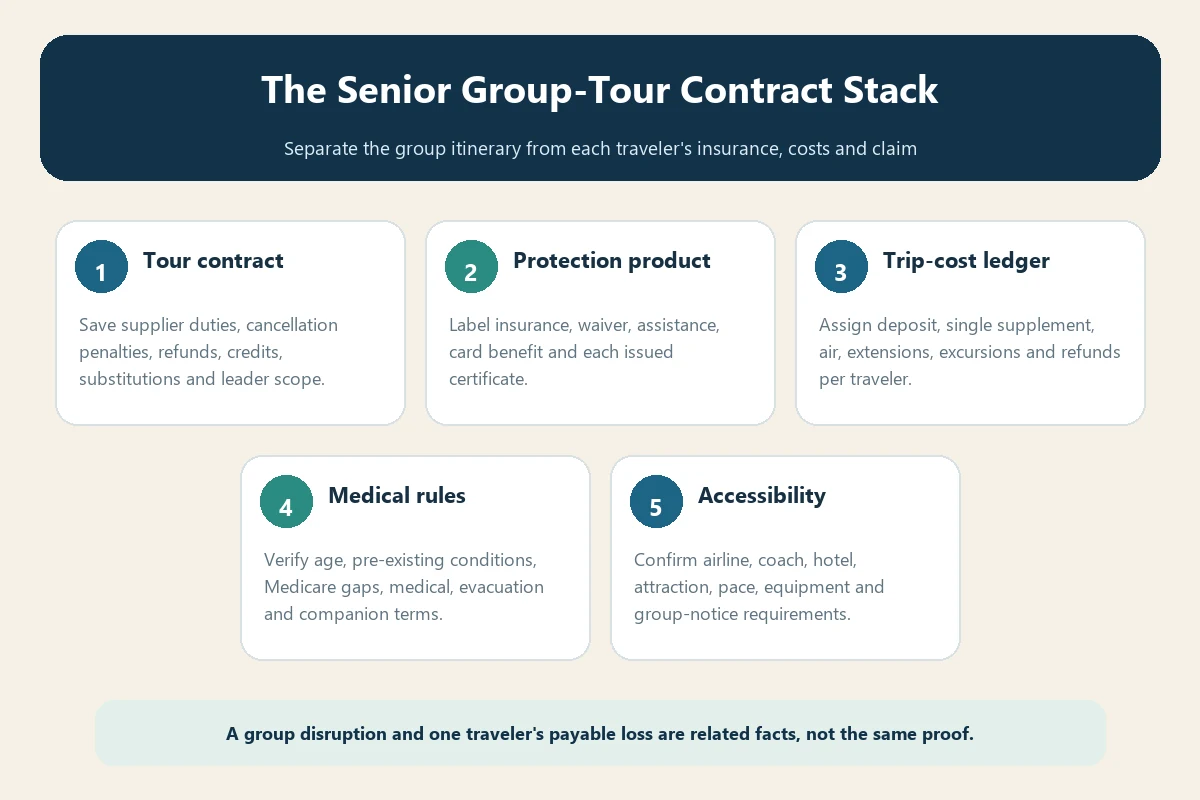
Senior travel insurance for an escorted group tour should be compared against the tour contract, not the group itinerary alone. A tour leader may coordinate the schedule, but the airline, hotels, local operators, insurer, medical providers, and traveler still have separate responsibilities. “Group coverage included” can mean insurance, a waiver, assistance, or a narrow plan that does not fit the traveler’s age or medical needs.
This U.S.-focused guide builds a contract stack and loss ledger for senior group tours. It does not rank tour companies or insurers. The booking terms, proof of coverage, and issued certificate control.
Key takeaways
- Identify whether the offered protection is insurance, a cancellation waiver, assistance, or a combination.
- Itemize the tour deposit, single supplement, flights, extensions, and independent expenses.
- Confirm age, pre-existing-condition, medical, evacuation, and accessibility terms.
- Do not assume the tour leader can authorize treatment, evacuation, or a claim.
- Model what happens when one traveler leaves while the group continues.
Reviewed August 16, 2026. “Group,” “blanket,” “traveling companion,” “supplier,” “covered reason,” and “single supplement” can be defined differently in contracts and policies.
Build the group-tour contract stack
Collect the tour booking agreement, cancellation schedule, supplier terms, air contract, extension terms, accessibility statements, protection-plan description, insurance certificate, declarations, and any master-policy or evidence-of-coverage document. Save the version accepted when the deposit is paid.
The Federal Trade Commission advises travelers to obtain cancellation and refund policies before paying and to verify that a travel-insurance agency is licensed. The National Association of Insurance Commissioners emphasizes that each policy has its own limits, covered situations, and exclusions.
Identify what the tour’s protection product actually is
| Product label | What to request | Critical question |
|---|---|---|
| Travel insurance | Certificate, declarations, underwriter, form, state notice | Who is insured and which benefits apply? |
| Cancellation waiver | Waiver terms and supplier obligations | Does it return cash, credit, or another value? |
| Assistance service | Scope, provider, limits, and charges | Does it coordinate only, or pay an insured expense? |
| Credit-card benefit | Current guide to benefits | Which purchases, travelers, and causes qualify? |
| Individual retail policy | Issued form for residence and traveler | Does it cover the entire group itinerary? |
A plan sold at checkout can combine insurance and non-insurance services. Record each component separately. A waiver from the tour operator may not follow the traveler to an independently booked flight, while a retail policy can still exclude a supplier event or require all nonrefundable cost to be insured.
Create the trip-cost ledger
Itemize the deposit, staged payments, base tour fare, single supplement, airfare, taxes, pre- and post-tour hotels, optional excursions, rail, visas, equipment rental, accessible transport, and independent bookings. Record the person named, payer, due date, refund schedule, cancellation penalty, credit, and amount declared to the insurer.
If a roommate cancels and the remaining traveler must pay a single supplement, ask whether any benefit addresses that cost and under what relationship or covered-reason definition. Do not assume “roommate cancellation” is insured merely because the group booking price changed.
Test the tour operator’s cancellation versus the traveler’s cancellation
If the operator cancels the whole tour, the supplier contract may provide a refund, credit, or rescheduled departure. If the traveler cancels for illness, the operator’s penalty schedule and the insurer’s covered-reason test both matter. If a hotel or local supplier changes while the tour proceeds, there may be no traveler cancellation at all.
The delay, interruption, and cancellation guide helps label the event. First subtract refunds and credits, then identify the remaining eligible nonrefundable loss.
Compare group and individual insurance evidence
Ask whether every traveler receives a certificate or only a plan summary. Confirm the named insured or eligible class, effective dates, residence rules, state form, age limits, trip-cost amount, benefit schedule, exclusions, claim method, and free-look or review period.
If the tour offers group or blanket coverage, ask how eligibility is recorded and what proof the traveler will receive. If the traveler buys an individual policy, confirm it recognizes every supplier, country, extension, and travel day. “Covered with the group” is not adequate documentation.
Audit age and pre-existing conditions early
Use the exact date of birth and state of residence. Check enrollment eligibility and whether medical, evacuation, accidental-death, or other benefits change at an age tier. The travel insurance age-limits guide separates eligibility, benefit, duration, and renewal rules.
Record the first deposit and policy purchase date. Review the pre-existing-condition definition, look-back period, waiver timing, insured-cost requirement, medical-fitness rule, and treatment of non-traveling family members. The pre-existing-condition waiver guide provides a deadline worksheet.
Check the tour pace against the traveler’s functional plan
Read the daily schedule for walking distance, stairs, uneven surfaces, standing time, early departures, luggage movement, coach steps, bathroom access, altitude, heat, and free time. Ask for the physical requirements and accessible alternatives in writing.
CDC recommends evaluating disability accommodations throughout the itinerary. The State Department notes that accessibility laws and implementation differ by destination. A group tour can provide structure without guaranteeing that every hotel, coach, attraction, or local operator can meet the same need.
The guided-tour insurance guide offers a supplier-level accessibility checklist for Europe; use the same method with destination-specific rules elsewhere.
Coordinate group accessibility with the airline
DOT generally does not require advance notice merely because a passenger has a disability, but it says airlines may require up to 48 hours’ notice and early check-in for certain services, including accommodation for a group of ten or more travelers with disabilities. Individual equipment, oxygen, stretcher, and smaller-aircraft needs can have their own procedures.
The tour company’s passenger list does not replace direct confirmation with each airline. Record seating, wheelchair handling, connection assistance, aircraft limitations, and the airline’s disability contact. Insurance does not create an accommodation the carrier or destination cannot provide.
Map the group leader’s real authority
Ask what the tour director can do: contact local emergency services, help translate, locate a clinic, rearrange a coach, store luggage, contact family, or coordinate with headquarters. Ask what the leader cannot do: provide personal care, make medical decisions, authorize an insurer’s evacuation, pay deposits, or file a claim without permission.
Save the tour’s 24-hour operational number and the insurer’s assistance number separately. The tour leader works for the itinerary; the assistance administrator works under its service and policy rules; the treating clinician makes medical decisions within local practice.
Model one traveler leaving the group
Use three scenarios: the senior is hospitalized, a companion is hospitalized, or a non-traveling family member has a covered emergency. Record unused tour cost, independent hotel, new return transport, luggage retrieval, local care, companion stay, and rejoining the group.
The travel-companion evacuation guide separates patient transport from the companion’s travel. Confirm who collects the traveler’s luggage and documents after the coach leaves, and which expenses require assistance-company approval.
Do not treat the group as a medical network
A tour leader’s clinic recommendation is not proof that the provider is in the insurer’s network or can accept direct payment. Identify medical access at remote or overnight stops, the expected payment method, and the next appropriate facility.
Confirm whether the travel medical plan is primary or secondary, whether Medicare-related coverage applies, and who authorizes evacuation. Carry the certificate, assistance contact, medication list, allergies, and concise medical records independently of the group.
Track optional excursions and free time separately
Optional tours may be sold by the main operator, local operator, or independent seller. Record who contracted, refund rules, activity exclusions, transport, accessibility, and emergency contacts. A missed independent excursion can be outside both the tour package and the policy benefit.
Search the certificate for motorbike, hiking, rafting, skiing, altitude, alcohol, and other relevant exclusions. Do not rely on the tour’s decision to offer an activity as proof of insurance coverage.
Prepare the disruption and claim packet
- Tour contract, protection description, insurance certificate, and declarations
- Itemized payments, traveler ownership, refunds, credits, and cancellation penalties
- Original and revised itineraries, supplier notices, and group-leader communications
- Airline delay, baggage, disability-accommodation, and rebooking records
- Medical reports, assistance case numbers, authorizations, and itemized bills
- Unused tour days, independent lodging, new transport, and meal receipts
- Companion, single-supplement, and optional-excursion evidence
- Other-insurance and credit-card decisions
Preserve the group-wide facts and the individual traveler’s loss separately. A notice sent to the whole group does not prove the amount lost by one traveler.
Questions to ask the tour company and insurer
- Is the offered protection insurance, waiver, assistance, or a combination?
- What certificate or evidence does each traveler receive?
- Are age tiers or pre-existing-condition rules different for this traveler?
- Must all prepaid nonrefundable costs and extensions be declared?
- What happens if the operator cancels, changes suppliers, or provides a credit?
- Is a single-supplement increase covered after a roommate’s covered cancellation?
- Who assists if one traveler is hospitalized while the group departs?
- Which accessibility services are confirmed at every supplier?
- Can the tour leader communicate with the insurer or family, and with whose permission?
- How are optional excursions and independently booked air handled?
FAQ about senior group-tour travel insurance
Is group travel insurance better for seniors?
Not inherently. Compare the exact certificate, age rules, medical and evacuation benefits, pre-existing-condition terms, trip-cost protection, and proof of coverage with an individual option.
Does a guided tour include travel insurance?
Only if the booking documents say so. Some packages offer insurance, waivers, assistance, or optional protection. Request the actual terms before paying.
Will insurance cover a single supplement if a roommate cancels?
Only if a benefit expressly addresses the resulting cost and the relationship, covered reason, documentation, and limits are satisfied. Ask for the clause.
Does the tour leader handle a medical evacuation?
The leader may assist operationally, but insurer authorization, medical necessity, receiving care, and transport arrangements follow the relevant policy and clinical decisions.
Bottom line
Senior travel insurance for an escorted group tour is an individual coverage decision inside a group contract stack. Identify the protection product, itemize each traveler’s cost, verify age and medical rules, confirm accessibility with every supplier, and model the moment one person leaves while the tour continues. The group can coordinate logistics; only the issued contracts explain who pays.
Sources
- NAIC — Should I Get Travel Insurance?
- Federal Trade Commission — Avoid Scams When You Travel
- U.S. Department of Transportation — Travel Tips for Persons with Disabilities
- CDC Yellow Book — Travelers with Disabilities
- U.S. Department of State — Accessibility Needs
- U.S. Department of State — Age 65+ Travelers
