

Travel insurance over 90 can exist, but a search result is not proof that a plan is available or adequate for a particular traveler. Some products state no maximum age; some trip-protection products state eligibility through a high age; some medical plans accept age 90 while reducing the available maximum. Others do not quote. Residence, state, destination, trip dates, and product class determine which statement matters.
This guide uses an accept-cap-decline audit. It never treats age as a judgment about fitness, capacity, or the value of a trip. It is educational, not insurance, medical, legal, financial, accessibility, or Medicare advice. Use exact applications, quotes, and issued forms.
Key takeaways
- Prove age-90-plus availability with an actual quote or explicit eligibility clause.
- Separate outbound U.S. travel, inbound visitor coverage, trip protection, and medical-only plans.
- Mark every exact-age benefit cap and trip-duration limit.
- Measure excluded and upfront costs before deciding the premium is affordable.
- Stop or redesign the trip if no adequate contract and funding plan survives.
Reviewed August 16, 2026. “Eligible,” “no maximum age,” “up to age 99,” “maximum limit,” “period of coverage,” and “pre-existing condition” are product-specific terms.
Why the exact query produces misleading answers
Google results for over-90 insurance mix U.S. visitors, U.S. residents traveling overseas, United Kingdom products, social recommendations, and rankings. A plan for a 92-year-old visiting family in Florida is not automatically available to a 92-year-old Florida resident visiting Europe. A British product cannot be assumed available under a U.S. state form.
The age-limit guide explains how eligibility, benefit, duration, and renewal rules differ. At age 90, the first deliverable is a verified quote record, not a provider list.
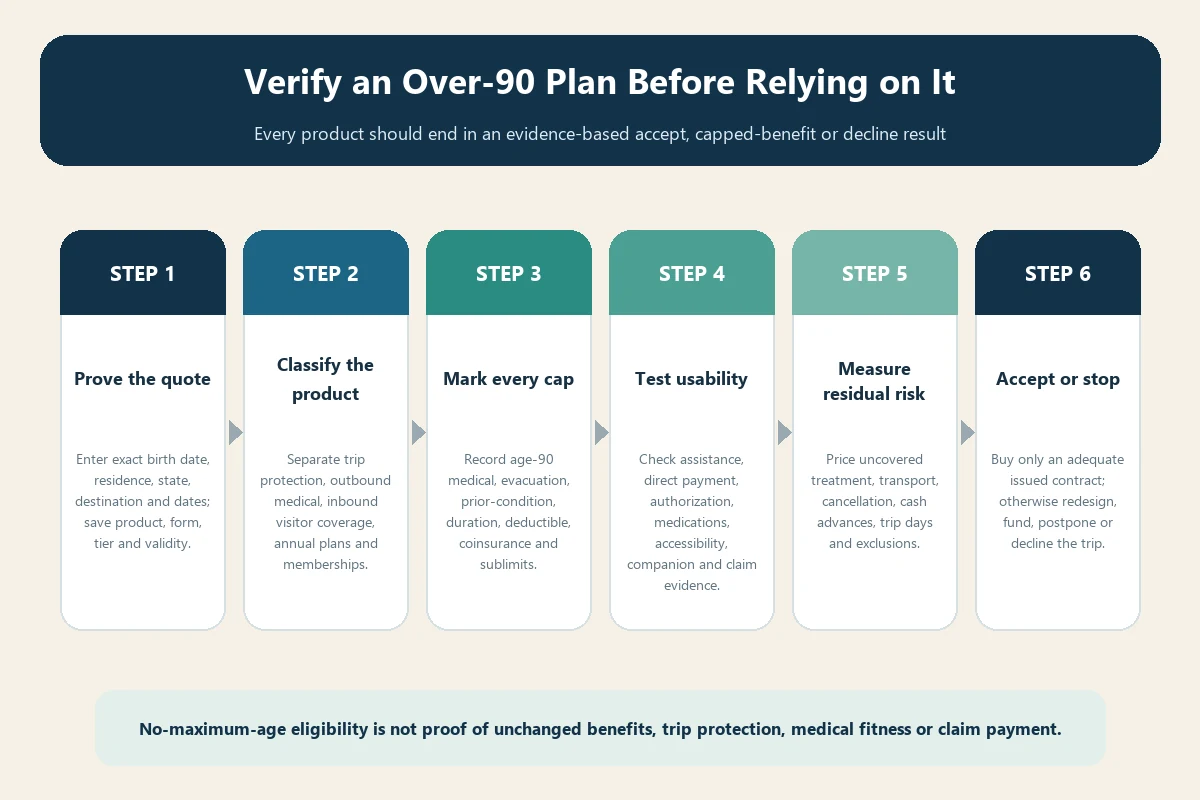
Step 1: prove the quote is real
Enter the exact date of birth, state and country of residence, citizenship if required, destination, departure and return dates, trip cost, and requested benefit options. Save the timestamp, quote number, plan name, underwriter, administrator, state form, medical tier, deductible, premium, and validity period.
If the website will not accept the date, contact the licensed seller or insurer through its official channel. Ask for a written answer; do not change the birth year to inspect later screens. If a companion makes the inquiry, the traveler should control personal information and decisions unless lawful authority says otherwise.
Step 2: classify the product
| Class | Can address | May not address |
|---|---|---|
| Trip protection | Cancellation, interruption, delay, baggage, some medical and evacuation | High medical maximum or long stays |
| Outbound travel medical | Temporary medical treatment and evacuation abroad | Prepaid trip cancellation |
| Inbound visitor medical | Medical expenses for a nonresident visiting the U.S. | Outbound U.S.-resident eligibility |
| Annual multi-trip | Several journeys in a policy year | One continuous trip beyond its per-trip cap |
| Evacuation membership | Defined transport service under membership rules | Hospital bills and insurance indemnity |
The existing over-80 market guide provides a broad product overview. For over 90, write the class beside every quote so an attractive visitor-medical maximum is not compared with an outbound cancellation benefit.
Step 3: separate acceptance from benefit caps
IMG’s current GlobeHopper Senior page and supporting brochure describe no maximum-age restriction for that U.S.-resident outbound medical product while presenting lower available medical choices at age 80+ than at ages 65–79. The current sample contract contains the detailed age tiers and conditions. This is one product-specific example, not proof of an age-90 quote in every state.
Seven Corners’ current Basic/Choice page is a different example: it states availability to U.S. residents up to age 99 for that trip-protection product, subject to plan documents and availability. It does not mean the medical amount equals a medical-only plan or that every benefit remains unchanged at age 90.
Build an accept-cap-decline table
For every product, mark “accepted,” “not quoted,” or “needs human confirmation.” Then copy medical, evacuation, repatriation, return-of-remains, trip cancellation, interruption, deductible, coinsurance, and major sublimits from the exact age tier. Mark each prior-condition rule, duration, approval condition, and claim deadline.
A cap is not automatically a failure. It becomes a decision when compared with the trip. A $20,000 age tier can be material for one route and clearly insufficient for another; the article does not set a universal threshold.
Step 4: test the medical maximum against the destination
Consider length of stay, local private-care practice, cruise or remote segments, altitude or heat, planned activities, existing coverage, and ability to return home. Record hospital, ambulance, imaging, surgery, prescription, therapy, and continuation sublimits.
WorldTrips’ current senior travel medical page is another product-family example showing that age 80+ acceptance can coexist with a reduced overall maximum. Use this as a reading lesson, then verify the actual quote and certificate.
Step 5: map evacuation as a separate exposure
Copy the exact age-90-plus evacuation maximum and determine whether it is inside or outside the medical maximum. Read medical necessity, nearest appropriate facility, home-country return, company authorization, arranging party, exclusions, transport mode, and destination controls.
The evacuation risk worksheet maps local ambulance, hospital transfer, commercial escort, air ambulance, borders, receiving care, and route failure. A high limit does not guarantee a preferred hospital or a flight home.
Step 6: classify prior-condition protection precisely
Record whether the product uses a waiver, limited sudden recurrence, acute onset, medical screening, stability test, or broad exclusion. Copy the look-back period, purchase clock, medically-able-to-travel condition, full-trip-cost rule, age ceiling, deductible, limit, symptoms, and related evacuation treatment.
The senior prior-condition checklist organizes the questions without promising coverage. At age 90, do not infer that a plan accepting the applicant covers the conditions most likely to require care.
Medicare and other coverage must be verified
Also verify how the contract handles care coordination and payment. The emergency assistance versus claims guide explains why arranging help, authorizing treatment, advancing funds, and reimbursing a completed claim are separate functions. Record the actual phone route and payment process instead of treating a 24-hour assistance label as a promise of direct settlement.
Medicare’s official foreign-travel page states that Medicare usually does not cover care abroad, subject to limited exceptions, and notes that some Medigap policies may provide foreign emergency coverage. Check the person’s Medicare Advantage, Medigap, retiree, employer, military, and private plans directly.
Record whether each plan pays primary or secondary, whether it requires an EOB, and whether it excludes evacuation. An exception that pays a foreign hospital does not automatically pay transport to the United States.
Step 7: count every trip day
Confirm the minimum and maximum period, per-trip limit on annual cover, extension conditions, renewal, home-country return effect, and treatment continuation. Include departure and return days, time zones, cruises, side trips, and possible recovery delay.
A plan that accepts age 92 for 30 days does not answer a 90-day itinerary. Do not split one continuous trip into fictional segments unless the certificate permits it and the traveler actually returns as required.
Step 8: test whether the policy can be used in an emergency
Prepare the assistance number, policy card, secure portal, claim form, medical summary, generic medication list, allergies, emergency contacts, passport copies, and translation plan. Confirm direct-payment practices, provider network, required deposits, precertification, and records-release process.
The State Department’s age 65+ guidance recommends a provider letter, medical alert information, original labeled medication containers, enough medicine, and emergency contacts. These are preparation steps, not evidence that the insurer will pay.
Respect autonomy while planning support
Ask the traveler whom they want contacted, who may receive health information, and who can assist with claims or funds. A spouse, adult child, tour leader, or companion does not automatically hold legal authority. Carry appropriate health-care proxy or other documents after obtaining jurisdiction-specific advice.
Plan mobility, hearing, vision, cognition, oxygen, refrigeration, charging, accessible transport, and rest needs based on the individual—not on age alone. Record the airline, cruise, hotel, and tour accommodations separately from insurance.
Step 9: measure residual risk in dollars and operations
- Medical bills above the exact-age maximum
- Evacuation cost above the transport benefit
- Excluded or capped pre-existing-condition loss
- Routine care, monitoring, medication, and equipment
- Trip days beyond the maximum or after a return-home event
- Prepaid trip cost not protected by medical-only coverage
- Hospital deposits and provider bills before reimbursement
- Companion, accessibility, accommodation, and changed-flight costs
Compare those amounts with liquid emergency funds, refundable bookings, credit access, family arrangements, and the insurer’s payment process. Insurance transfers defined risk; it does not make every outcome affordable.
Step 10: accept, redesign, or stop
Accept only after the issued contract passes eligibility, age-tier, medical, evacuation, prior-condition, duration, operational, and residual-risk tests. If it fails, shorten the trip, choose a destination with stronger care, make bookings refundable, remove a risky segment, increase available funds, seek a different product class, or postpone.
A clinician’s advice informs fitness and precautions; it does not create insurance. The traveler makes the trip decision with appropriate support. A truthful “no adequate plan found” is better than relying on an ineligible or materially insufficient policy.
Use this evidence packet
- Saved quote, date-of-birth input, state, residence, destination, dates, and validity
- Plan class, form, revision, underwriter, administrator, and assistance provider
- Exact-age medical, evacuation, return, trip, deductible, and sublimit table
- Prior-condition classification, timing, age rule, maximum, and exclusions
- Trip-day calculation, extension, renewal, return-home, and continuation rules
- Current-plan coordination, EOB requirements, and direct-payment process
- Medication, accessibility, emergency contact, document, and companion plan
- Residual-risk ledger, available funds, redesign options, and final decision
The practical conclusion
Travel insurance over 90 is a verification task. An official product may accept the age, but the exact age tier, product class, duration, medical history, and state form decide what the traveler can actually rely on. Mark every cap and exclusion before price.
If no adequate contract survives, the correct result is not a weaker recommendation. It is an explicit redesign, funding, postponement, or stop decision that matches the traveler’s priorities and the real residual risk.
