

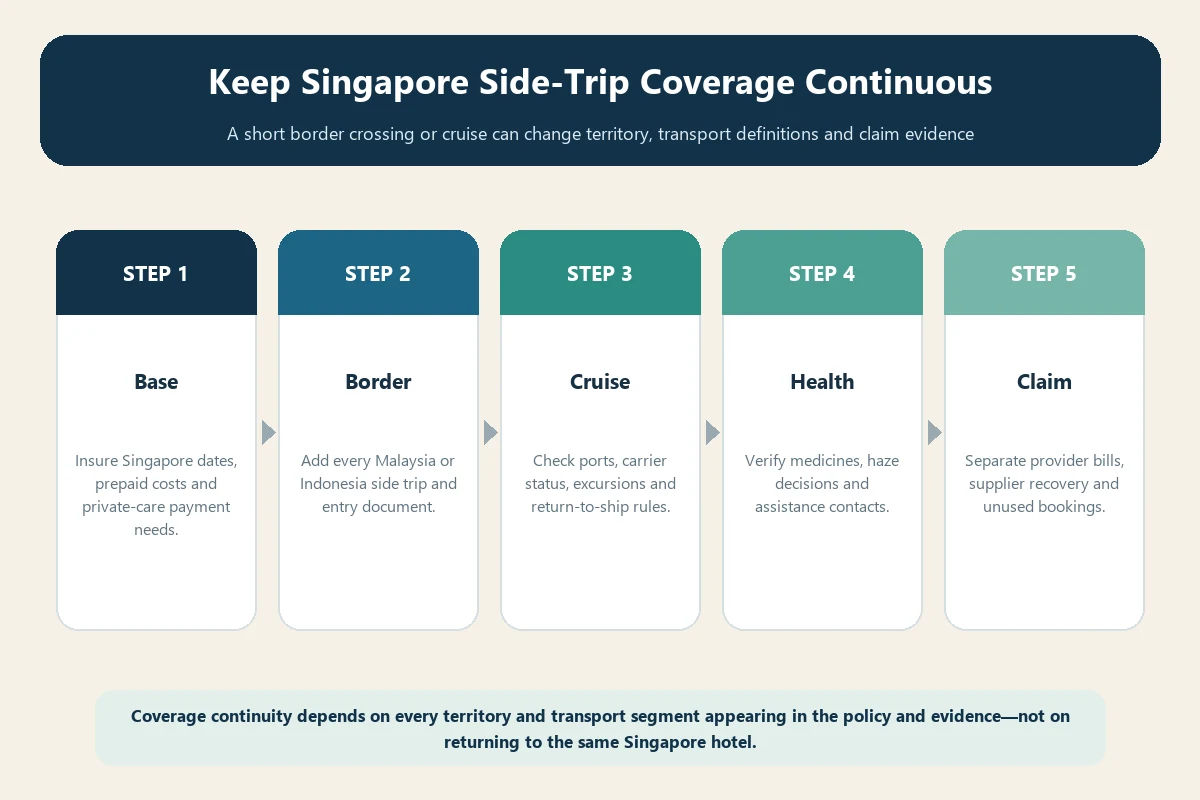
Travel insurance for Singapore from USA trips should account for private-hospital payment, prescription controls and every cruise or nearby-country side trip. Singapore may be the hotel base, but a ferry to Indonesia or Malaysia changes the territory, transport contract and evidence needed for a claim.
Key takeaways
- Private hospitals usually require advance payment or proof of insurance.
- Verify medicine legality with Singapore’s health authority before travel.
- Add every side trip, cruise port and excursion to the policy test.
- Use official haze readings with medical and supplier decisions.
- Separate Singapore expenses from costs incurred in another country.
Planning information reviewed August 16, 2026. Entry rules, medical practices, air quality, transport and policy terms can change. Recheck official and supplier information for the travel dates.
Build the complete Singapore trip, not only the hotel stay
List international flights, Singapore hotels, attractions, business events, cruises, ferry crossings and every Malaysia or Indonesia side trip. Add the traveler, dates, prepaid costs and return connection for each segment. A three-night regional excursion cannot be treated as if the traveler never left Singapore.
Mark refundable rates and supplier credits. Use the delay and interruption guide to classify unused bookings and added nights. Insure the same cost and itinerary when comparing plans.
Verify current arrival requirements from the authority
Check the Singapore Immigration and Checkpoints Authority’s current SG Arrival Card guidance, passport rules and entry channel shortly before departure. Use the official page rather than a commercial article that may preserve an old pandemic requirement.
Entry eligibility and insurance eligibility are separate questions. Also verify the requirements for every neighboring country and the cruise or ferry operator. A document accepted for Singapore does not establish admission elsewhere.
Prepare for private-hospital advance payment
The current State Department Singapore travel guidance says medical care is not free and private hospitals usually require advance payment or proof of adequate insurance before admission.
Ask whether assistance can issue a payment guarantee to a named facility, and what happens if the hospital requires a card deposit first. Keep secure payment capacity and request an itemized bill, diagnosis, payment proof and discharge instruction.
Call the U.S. health plan separately
Most hospitals abroad do not accept U.S. insurance directly, and reimbursement rules can differ from network care at home. Ask the U.S. plan about overseas emergency services, prior notice, deductibles, claim forms and coordination with travel insurance.
The health insurance abroad guide structures that conversation. Save the plan’s written response with the travel certificate rather than relying on a wallet card.
Check medicines before packing
The Singapore Health Sciences Authority provides official personal medication guidance and explains when approval may be needed. Check the ingredient, dose, quantity and intended stay rather than assuming a U.S. prescription is sufficient.
Carry permitted medicine in original packaging with the prescription and relevant approval. Insurance cannot override import law. Ask how the policy handles an eligible replacement if medicine is lost, recognizing that preventive supply and unlawful import are different issues.
Audit a cruise as its own contract
Record the cruise line, ship, embarkation, ports, cabin cost, excursions and required return-to-ship times. Ask whether the policy defines a cruise, common carrier, missed port or missed connection separately. Confirm whether shipboard treatment is included and how evacuation from the vessel is authorized.
The cruise policy clauses guide identifies the wording to compare. A cruise line’s assistance service, onboard bill and travel-insurance benefit are not the same layer.
Map every nearby-country side trip
For Johor Bahru, Batam, Bintan or another regional trip, list immigration, ferry or road transport, hotel, activities and return connection. Ask the insurer to confirm that the destination and entire date range are within the covered territory.
Store entry documents and the insurer contact offline. If the traveler receives care outside Singapore, the provider, currency, payment method and medical standard change. Do not assume the Singapore private-hospital plan controls an incident in another country.
Test the return-to-Singapore dependency
Work backward from an international flight, event or cruise departure. Identify the last sensible ferry or road return, the next service and a safe overnight alternative. Ask what delay threshold and covered reason must be met.
Preserve the foreign carrier’s cancellation, Singapore supplier response, replacement fare and refund. The weather-delay guide explains why conditions and carrier action must both be documented.
Use haze information for the decision it proves
Singapore’s National Environment Agency publishes current haze and PSI guidance. The agency distinguishes readings for immediate decisions from the 24-hour PSI used for longer planning.
Save the reading, region, time and health advisory. Then document a clinician restriction, event cancellation, airline action or attraction closure. Haze information alone does not establish that a policy benefit applies.
Review health guidance for the actual traveler
The CDC publishes current Singapore traveler health guidance. Review it with a clinician for age, health history, length of stay and side trips, since neighboring destinations can produce different recommendations.
Ask the policy about acute illness, pre-existing conditions and preventive care. The pre-existing condition waiver guide explains purchase deadlines and trip-cost requirements.
Separate event, business and leisure losses
List conference registration, client-paid travel, personal hotels and leisure excursions separately. Confirm who owns each payment and who could claim it. A traveler cannot recover a cost already reimbursed by an employer or supplier.
Ask whether work equipment, professional duties or a canceled event are covered. Standard baggage and trip-cancellation benefits may not treat business property or a schedule change the way a commercial policy would.
Plan assistance before an incident
Store 995 for emergency medical services, the policy number and assistance line offline. Give a companion allergies, medicines and consent information. Ask how assistance handles a private hospital deposit and a claim originating on a ship or foreign side trip.
The assistance versus claims guide explains why a facility referral is not final approval. Record the representative, instruction, time and case number.
Compare one Singapore hub scenario
Use identical ages, dates and prepaid costs. Include a Singapore hotel, private-hospital deposit, prescription approval, a regional ferry side trip, a cruise and unhealthy haze affecting an outdoor event.
- Which countries and waters are covered?
- How is private care funded?
- What cruise and excursion provisions apply?
- Which carrier action triggers delay?
- How are event costs treated?
- Which refunds reduce the final loss?
Read the certificate. Search-result prices do not answer territory, private payment or supplier-definition questions.
Build a two-country evidence file
Start with the incident location and time. Add the provider record, local amount, actual conversion, transport notice, border document, supplier response and assistance instruction. Keep Singapore dollars separate from Malaysian ringgit or Indonesian rupiah.
The claim filing guide explains payer coordination. Show employer reimbursement, cruise credit, hotel refund and any health-plan payment before calculating the remaining request.
Rehearse a side-trip failure
Ask what the traveler does if the ferry is canceled, the passport is unavailable, a clinic demands cash or the return misses an international flight. Put the safe response, contact and document beside each scenario.
Do not wait for disruption to discover that the policy territory ended at the Singapore border. A one-page route and benefit matrix makes coverage gaps visible while the itinerary can still be changed.
Run a private-hospital admission rehearsal
Create a one-page sheet with the traveler’s passport name, policy number, assistance number, allergies, medicines, emergency contact and preferred language. Ask the insurer which Singapore facilities it can contact, while recognizing that a directory listing is not a reservation or guarantee of clinical capability.
In the scenario, the hospital requests a deposit before admission. Determine whether the traveler pays, assistance issues a guarantee or both happen while eligibility is reviewed. Ask who obtains the clinical record and whether the hospital sends the final bill to the traveler or insurer. Preserve any temporary card hold separately from the settled charge.
Do not delay urgent treatment to complete an ideal insurance call. If prior contact is not practical, record the emergency circumstances and notify the insurer promptly. A companion can document names, times, instructions and the reason a particular facility was used.
Keep a territory and currency ledger
Give every expense a country, currency, traveler, supplier and policy section. A Singapore hospital bill, Indonesian ferry replacement and Malaysian hotel night may arise from the same side-trip failure but require different provider records and conversions.
Record the actual card conversion instead of applying one later exchange rate. Add supplier refunds, cruise credits and employer reimbursements on the same row as the related cost. This shows the remaining loss without hiding value returned in another currency.
When the incident begins outside Singapore but treatment continues after return, keep the first clinical note, transport record and Singapore admission in order. The medical narrative should explain the handoff without implying that crossing the border created a new illness.
Audit the final connection to the United States
Work backward from the long-haul departure and identify check-in time, baggage transfer, immigration and the last safe arrival from a cruise or side trip. Ask whether the policy’s missed-connection benefit applies to the actual incoming transport, not merely any late arrival.
If the traveler chooses an earlier ferry or extra Singapore night to create margin, record it as planned travel unless a covered event required the change. Sensible risk reduction is valuable even when it is not reimbursable.
Bottom line
A strong Singapore plan prepares for private-care payment and follows the traveler across cruises and nearby-country side trips. Verify medicines, haze evidence, territory and supplier recovery, then document the final unreimbursed loss in the currency and location where it occurred.