

Travel insurance for Sri Lanka from USA trips should be chosen around road transfer time, seasonal rain, medical access outside Colombo and the activities on the route. A beach stay, hill-country rail trip and wildlife circuit create different transport and care decisions even within one vacation.
Key takeaways
- Map every road, rail, wildlife and coastal segment with a safe fallback.
- Separate the southwest and northeast monsoon exposure by place and month.
- Plan how a patient outside Colombo could reach suitable higher-level care.
- Check animal, water, motorbike and hiking exclusions before booking.
- Save official warnings, operator decisions and refunds as different evidence.
Planning information reviewed August 16, 2026. Weather, advisories, entry rules, health guidance, transport and policy terms can change. Recheck official sources and suppliers for the travel dates.
Turn the island loop into insured segments
List Colombo, the Cultural Triangle, Kandy, tea country, Yala, the south coast, the east coast or every planned stop. Add private drivers, trains, domestic flights, safari jeeps, boats, surf lessons and prepaid hotels. Record transfer time and the last safe alternative.
A washed-out road, canceled train and closed national park may affect different reservations. Use the delay, interruption and cancellation guide to classify the loss before comparing benefits.
Read the current advisory beyond its headline
The U.S. Department of State publishes current Sri Lanka travel guidance covering security, demonstrations, transportation, health care and regional conditions. Compare the actual route with the details and any areas where emergency support may be limited.
Ask how civil-unrest, terrorism, government-advisory and foreseeable-event language works. Demonstrations can disrupt roads without closing the entire country. Save the advisory, operator notice and reason for any route change as separate records.
Plan medical access outside Colombo
Official guidance describes stronger emergency and trauma options in Colombo while facilities outside the capital can be more limited. For every overnight stop, identify a plausible first-care location, route back to Colombo and onward international transfer if a physician recommends higher-level treatment.
Do not treat a map pin as a guarantee of capability. Ask assistance who selects the facility, confirms acceptance and coordinates transport. The evacuation planning guide separates stabilization from later movement.
Ask how public and private care are paid
State guidance notes that government hospitals offer walk-in care, but capacity and available services differ. A traveler may still need private treatment, ground transport or transfer abroad. Ask the insurer whether it can issue payment guarantees and what records are required when the traveler pays directly.
Keep an itemized bill, diagnosis, clinical notes, prescription, proof of payment and discharge restriction. The health insurance abroad guide structures the separate U.S. health-plan check.
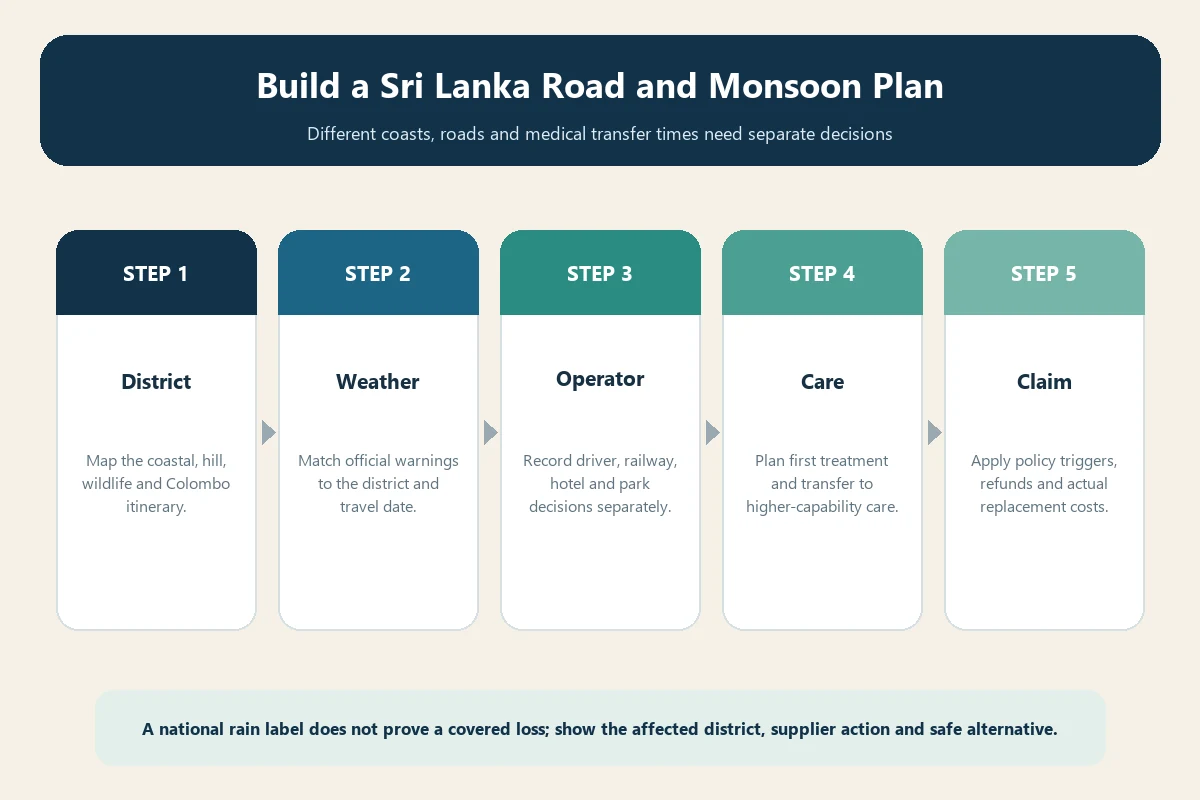
Match monsoon exposure to the coast
Sri Lanka does not have one uniform rainy season. Official meteorological information from the Department of Meteorology should be checked for the specific district and travel window. Southwest and northeast patterns affect different parts of the island at different times.
Record the forecast, official warning and local operator response. Heavy rain can create flooding or landslides, but a forecast alone may not trigger a policy. The weather-delay guide explains covered reasons, minimum waits and the known-event issue.
Use disaster alerts for instructions, not claim conclusions
Sri Lanka’s Disaster Management Center publishes hazard and emergency information. Follow official instructions and preserve the issue time, affected district and action. Then obtain the hotel, driver, railway, airline or park decision that caused the expense.
An evacuation direction can establish why movement was necessary; it does not by itself prove every new purchase is reimbursable. Record available alternatives, original refunds and why the chosen lodging or transport was reasonable and safe.
Audit long road transfers
For each drive, record the operator, vehicle, seat belts, pickup, expected duration, daylight margin and planned stops. Road conditions and traffic can turn a short map distance into a long transfer. Ask whether missed-connection coverage requires a common-carrier delay rather than ordinary congestion.
Preserve the driver’s message, police or authority notice when available, airline response and replacement cost. A traveler’s decision to leave late or change drivers voluntarily is different from an officially closed road.
Decide whether to drive or hire a driver
If renting, confirm license requirements, vehicle class, damage waiver, liability, deductible and exclusions for unpaved roads. Travel medical insurance does not automatically cover the rental vehicle or third-party liability. Keep the rental contract separate from the travel policy.
If hiring a driver, verify the business, vehicle and seat belts. The road-trip insurance checklist provides a useful coverage framework after Sri Lanka-specific legal and policy terms are confirmed.
Protect rail connections without assuming protection
Record the train, class, stations, scheduled times and onward reservations. Scenic hill-country travel can be central to the itinerary, but a separate hotel or flight may not be protected by the railway. Ask what delay and missed-connection definitions require.
Save the railway notice, station information, refund response and actual replacement. If the route is unsafe, follow official and operator directions. Do not rely on social media alone when a carrier record can be obtained.
Check wildlife and safari clauses
List each national park, safari jeep, walking activity, boat and animal encounter. Ask about guide requirements, vehicle use, participation exclusions, medical treatment, search and rescue and evacuation. A park ticket or operator waiver does not amend the certificate.
The activity-exclusions guide helps compare the actual activity. Avoid feeding or approaching wildlife, and follow park instructions even when the insurance wording appears broad.
Review water, heat and animal health risks
The CDC maintains current Sri Lanka traveler health guidance. Review insect, food and water, freshwater, animal and heat risks with a clinician based on season and activities.
Ask the policy how acute illness, preventive care, prescription replacement and pre-existing conditions are treated. Carry permitted medicines in original packaging. If symptoms begin, record onset and seek suitable care rather than waiting only for a coverage opinion.
Separate political disruption from preference
A protest may block one road, change a tour or cause a curfew without making the whole itinerary impossible. Ask whether the covered reason requires a specific event, destination proximity or supplier action. “I felt uncomfortable” may not satisfy the certificate.
Preserve the official notice, route affected, hotel response, driver message and reasonable alternative. If authorities issue an instruction, follow it. Insurance review comes after immediate safety.
Compare one Sri Lanka scenario
Use identical ages, dates and prepaid costs. Include Colombo, hill country, one national park, a coastal stay, private road transfers, a rail segment, a monsoon warning and a patient who needs higher-level care.
- Which district and date does the weather event affect?
- What supplier action triggers delay or interruption?
- How is care outside Colombo coordinated?
- Who authorizes a transfer?
- Are safari and water activities covered?
- Which refunds reduce the request?
Compare answers in the certificate, not in a product summary or generic price table.
Use assistance without mistaking it for adjudication
Store the policy number, international assistance line, allergy list and medicines offline. In an emergency, obtain necessary care and have a companion open the case when practical. Record the representative, case number and instructions.
The assistance versus claims guide explains why coordination and reimbursement are different. A referral may help locate care without guaranteeing every service.
Reconcile a route-based claim
Create folders for medical care, road, rail, weather, wildlife and lodging. Keep official warnings, supplier decisions, itemized bills, clinical notes, receipts, refunds and replacement costs. Label each by traveler, district, date and Sri Lankan rupee amount.
The claim documentation guide explains payer coordination. Show the original charge, supplier refund, card benefit or health-plan payment and final unreimbursed loss.
Build a safe route fallback
Before departure, identify a shorter coastal route, an extra night near the airport and a way to bypass a disrupted hill road. Give a home contact the itinerary and check-in rule. Store documents and maps offline with backup power.
A fallback is an operational tool, not proof of coverage. If it becomes necessary, record the official or supplier reason, the alternatives considered and the actual cost. That evidence makes the claim easier to understand.
Rehearse a coast-to-Colombo medical transfer
Choose one coastal overnight and ask the driver or hotel how emergency services are contacted, where initial assessment occurs and how a patient could reach higher-level care. Include road time, night conditions, flooding alternatives and the possibility that the nearest facility cannot accept the case.
Ask assistance who verifies suitability, arranges an ambulance, contacts the receiving hospital and determines whether later movement abroad is medically necessary. Keep the first clinical note, transfer order, vehicle invoice, receiving record and discharge restriction together. If ordinary transport is used because an ambulance is unavailable, document who recommended it and why it was medically reasonable.
Build a low-connectivity communications card
Store 119 for police emergency, 110 for ambulance and fire, the insurer’s international line, driver, guide, hotels and home contact offline. Verify current numbers with official or local sources before departure. Carry backup power and a written location description for each remote stay.
Set a missed-check-in rule with the home contact. A delayed message alone is not an emergency, so define when the contact should call the hotel, operator or authorities. During an incident, log local time, person contacted, instruction and case number. This record helps explain why a later purchase or route change was necessary.
Bottom line
A strong Sri Lanka plan follows the island district by district, distinguishes monsoon patterns and verifies how care outside Colombo becomes a safe transfer. Match road, rail and wildlife activities to the certificate, then preserve the evidence linking each covered event to the remaining loss.
