

Travel medical insurance mental health coverage is not automatic. A plan can cover an unexpected psychiatric emergency, exclude every mental health disorder, or cover only a narrowly defined service. The answer comes from the certificate issued for the traveler, state, destination and dates—not from the product name.
This guide is for U.S. residents comparing short-term protection abroad. It separates emergency psychiatric treatment from routine counseling, ongoing medication, pre-existing conditions and medical evacuation. It is insurance education, not medical advice. In an immediate crisis, contact local emergency services or the plan’s assistance center.
Key takeaways
- Search the full certificate for mental, nervous, psychiatric, psychological, substance-use and self-harm terms.
- Test the event, service, timing and exclusion separately; a covered emergency does not make every related service eligible.
- Ongoing counseling and routine prescription supply are commonly treated differently from unexpected emergency care.
- A pre-existing-condition waiver does not override every mental-health exclusion unless the wording says it does.
- Confirm whether psychiatric evacuation is eligible and who controls the destination and transport decision.
Reviewed August 16, 2026. Policy terms and destination resources change; verify the current certificate before purchase and departure.
Start with a four-part coverage test
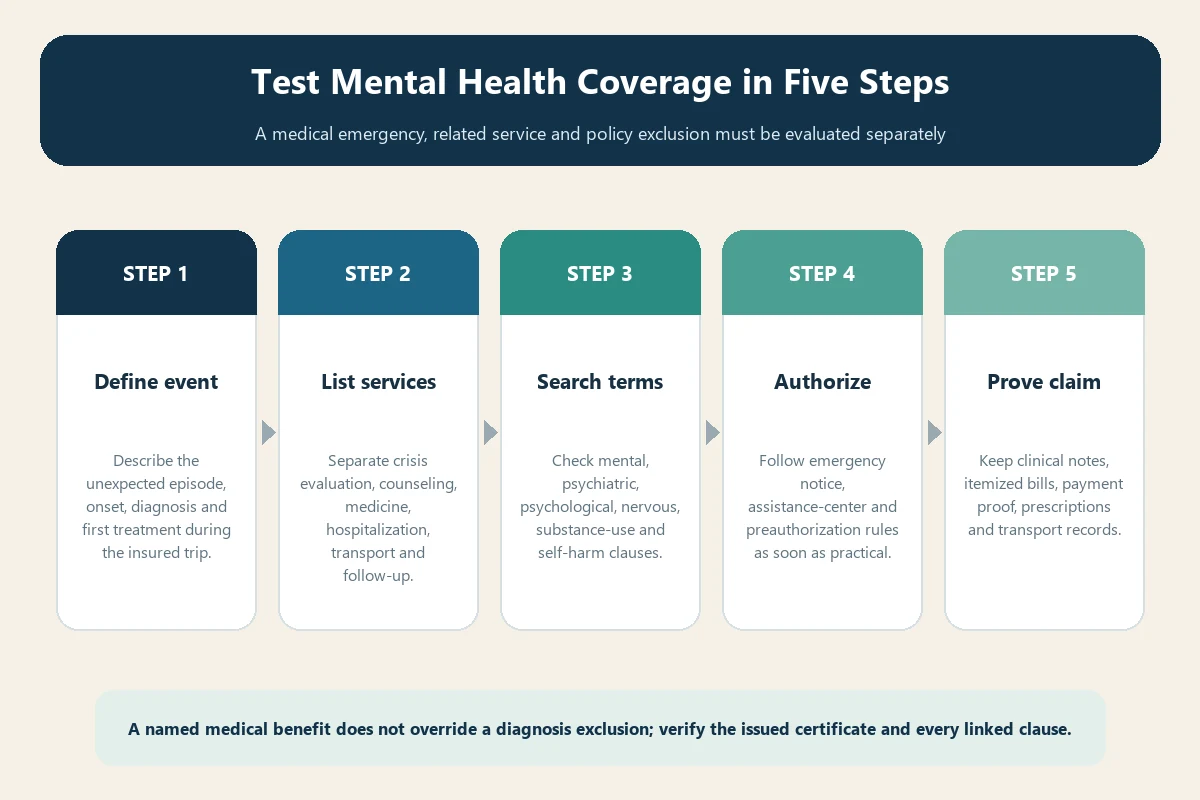
Write one sentence describing the event you want insured. Then test four items: what happened, what care was delivered, when it happened and which exclusion could apply. “Anxiety abroad” is too broad. “An unexpected acute episode led to an emergency-department evaluation and one night of medically necessary inpatient treatment during the covered trip” is specific enough to compare with definitions.
The broader travel medical benefits guide explains why a named benefit is only the first layer. Definitions, eligible expenses, maximums and exclusions must still align.
Find every mental health term in the certificate
Do not search only for “mental health.” Certificates may use mental, nervous, psychiatric, psychological, behavioral, emotional, substance abuse, alcohol, self-inflicted injury, suicide, psychosis, counseling or rehabilitation. Review the schedule, definitions, medical-expense section, general exclusions, evacuation section and any rider.
Record each relevant page number. If a summary says emergency medical care is covered but the exclusion section removes mental health disorders, the summary does not restore the benefit. Ask the insurer for a written explanation tied to the exact form number.
Separate emergency care from routine treatment
An unexpected crisis may involve physician assessment, laboratory testing, emergency medication, observation or hospitalization. Routine psychotherapy, a planned medication-management visit or a scheduled residential program has a different purpose. Some wording pays only for a sickness that first begins during the trip. Other wording excludes the diagnosis category even when the episode is acute.
The CDC Yellow Book insurance guidance specifically tells travelers to ask whether psychiatric emergencies are included or excluded. That question is more useful than assuming all “medical” treatment is treated alike.
Use an event-to-service worksheet
Create one row for each service: crisis hotline, telehealth consultation, outpatient clinician, ambulance, emergency department, medication, inpatient admission, interpreter and transport. Beside it, copy the certificate term that appears to include or exclude the charge. Add any deductible, coinsurance, per-visit cap and overall maximum.
This prevents a common reasoning error. The underlying event might be eligible while one service is excluded, or a service may be listed while the diagnosis is excluded. The worksheet forces both sides of the test onto the same page.
Compare inpatient and outpatient wording
A certificate can distinguish psychiatric hospitalization from outpatient counseling. Confirm whether “hospital” includes the facility used at the destination and whether admission must be ordered by a physician. Ask if observation status is treated differently from inpatient admission. For outpatient care, check whether the provider must meet a local licensing definition and whether preauthorization is required.
The primary care coverage guide provides a provider-and-purpose test that also helps with a first mental-health evaluation. The clinical setting alone does not decide eligibility.
Do not assume counseling is included
“Counseling” can mean a crisis evaluation, psychotherapy, family support or a continuing treatment program. Read how the certificate defines treatment and whether counseling, psychotherapy or rehabilitation is specifically excluded. If telehealth is available through an assistance service, confirm whether it is a covered medical expense, an assistance feature, or only a referral.
Ask whether a visit arranged by the assistance center still requires a claim, deductible or coinsurance. Assistance can help locate care without guaranteeing reimbursement.
Check medication under two different questions
First ask whether a new prescription used to treat an eligible emergency is a covered expense. Then ask whether replacement or continuation of medication the traveler already takes is covered. Routine supply, loss and an emergency prescription are different events.
The travel medical prescription guide separates these pathways. Keep the generic drug name, dose, original prescription, pharmacy invoice and the treating clinician’s note. Destination law can restrict a medicine even when an insurer would otherwise consider the expense.
Test pre-existing-condition language independently
A prior diagnosis, symptom, hospitalization, counseling visit or medication change may fall inside a certificate’s look-back definition. Read whether the test uses treatment received, advice recommended, symptoms a prudent person would investigate, or a change in condition. The look-back period guide helps build the required timeline.
Do not decide that a stable condition is covered merely because no appointment occurred. Conversely, do not assume any history makes coverage impossible. The issued wording controls.
Understand what a waiver can and cannot do
A pre-existing-condition waiver can remove a specific exclusion when every eligibility condition is satisfied. It may require purchase within a defined period, coverage of all required trip costs, medical ability to travel on the purchase date and compliance with other plan rules.
The waiver checklist shows how to document those conditions. A waiver does not automatically erase a separate mental-health, self-harm or substance-use exclusion. Look for the clause that states which exclusion is waived.
Read self-harm and substance-use exclusions carefully
Some certificates contain distinct exclusions for intentionally self-inflicted injury, attempted suicide, intoxication or substance-use treatment. These clauses may operate independently of a mental-health benefit. Do not infer how a claim will be handled from a headline or generic article.
Ask the insurer how emergency stabilization, accidental injury, substance use and psychiatric treatment interact under the issued form. Keep the response in writing, but remember that the certificate remains controlling.
Confirm medical evacuation rules
Psychiatric transport may require clinical escorts, a receiving facility and carrier approval. Determine whether the evacuation benefit excludes mental or nervous disorders, whether the patient must be hospitalized, who selects the destination and whether transport home is available after stabilization.
The medical evacuation limits guide explains why a dollar maximum alone is inadequate. Eligibility and insurer control can be more decisive than the displayed limit.
Build a care plan before departure
The CDC’s mental health guidance for travelers notes that travel stress, fatigue and disrupted routines can worsen existing problems. Discuss a suitable plan with the traveler’s clinician, especially after prior inpatient treatment, psychosis, severe mood symptoms, violent behavior or suicidal behavior.
List emergency contacts, destination crisis resources, the assistance-center number, current medicines and a trusted contact. Decide how records can be accessed securely. Do not put sensitive details in an unlocked luggage tag or unprotected shared document.
Check destination access, language and licensing
A benefit is useful only if care can be reached. Ask the assistance center about hospitals with psychiatric capability, English-speaking clinicians, translation, telehealth and admission procedures. In some destinations, culturally compatible services may be limited.
The U.S. Department of State medicine guidance explains how embassies and consulates can help locate doctors or hospitals, while making clear that the U.S. government does not pay the bill.
Know when authorization is required
Save both the emergency rule and the non-emergency authorization rule. In a crisis, seek necessary help first. As soon as reasonably possible, contact the assistance center and record the time, number called, representative and reference number. For planned follow-up, obtain any required authorization before the visit.
Authorization is not the same as final coverage. Ask what documents the claims team will need and whether the provider can bill directly or requires payment up front.
Prepare for payment and privacy constraints
Foreign providers may require a deposit or full payment. Ask whether the plan can issue a guarantee of payment and what information can be shared with a trusted person. Mental-health records can be particularly sensitive, yet a claim may require enough clinical information to establish diagnosis, onset, medical necessity and treatment.
Use secure channels provided by the insurer. Submit only the requested information, keep copies and track every transfer.
Assemble a defensible claim file
Collect the clinician’s report, symptom and treatment dates, diagnosis, medical-necessity statement, itemized invoice, payment proof, prescription record, discharge summary and authorization reference. If an evacuation occurred, include the assistance-center decision and transport records.
The travel insurance claim documentation guide provides a practical ledger. Translate documents if requested, but retain the original-language versions.
Compare two real policy patterns without generalizing
A current Travel Guard state specimen illustrates one pattern: a travel-medical section can list treatment for mental or psychological disorders while retaining other exclusions, conditions and benefit limits. A current Atlas description illustrates the opposite pattern by listing mental health disorders among excluded medical expenses. These are examples, not recommendations and not promises about another certificate.
NAIC’s current travel insurance consumer guidance states the correct general rule: each policy defines its own covered situations, limits and exclusions. Compare the actual forms available to the traveler.
Ask these questions before buying
- Are psychiatric emergencies included, excluded or subject to a separate maximum?
- Are inpatient care, outpatient crisis evaluation, counseling and telehealth treated differently?
- Does a pre-existing-condition waiver apply to mental-health claims and separate exclusions?
- How are ongoing prescriptions, emergency prescriptions and lost medication handled?
- Are substance-use treatment, self-harm or attempted suicide addressed separately?
- Can psychiatric medical evacuation be covered, and who authorizes it?
- Which services require preauthorization, and how quickly must the plan be notified?
- What records are required, and how are sensitive documents submitted securely?
Make the final coverage decision
Choose only after the exact scenario survives every layer of the certificate. A useful plan should give a clear answer about the event, service, diagnosis category, pre-existing-condition rule, authorization, maximum and claim proof. If the language is unclear, obtain a written explanation or compare another form.
Finally, compare the travel policy with existing domestic coverage using the health insurance abroad guide. The best preparation combines an appropriate care plan, legal medication supply, reachable assistance and policy wording that matches the risk the traveler actually needs to manage.
Mental-health history requires more than one policy check. Use the travel insurance mental health pre existing condition guide to separate look-back facts, waiver eligibility, independent exclusions and claim evidence.
