

Travel medical insurance primary care coverage depends on the reason for the visit, not simply on whether the clinician is a family doctor or general practitioner. A visit for a new, unexpected illness during the trip may be eligible, while a planned physical, preventive screening, routine refill or management visit may not be. The issued certificate decides.
Key takeaways
- Primary care is a provider type; primary medical coverage is a payer-order rule.
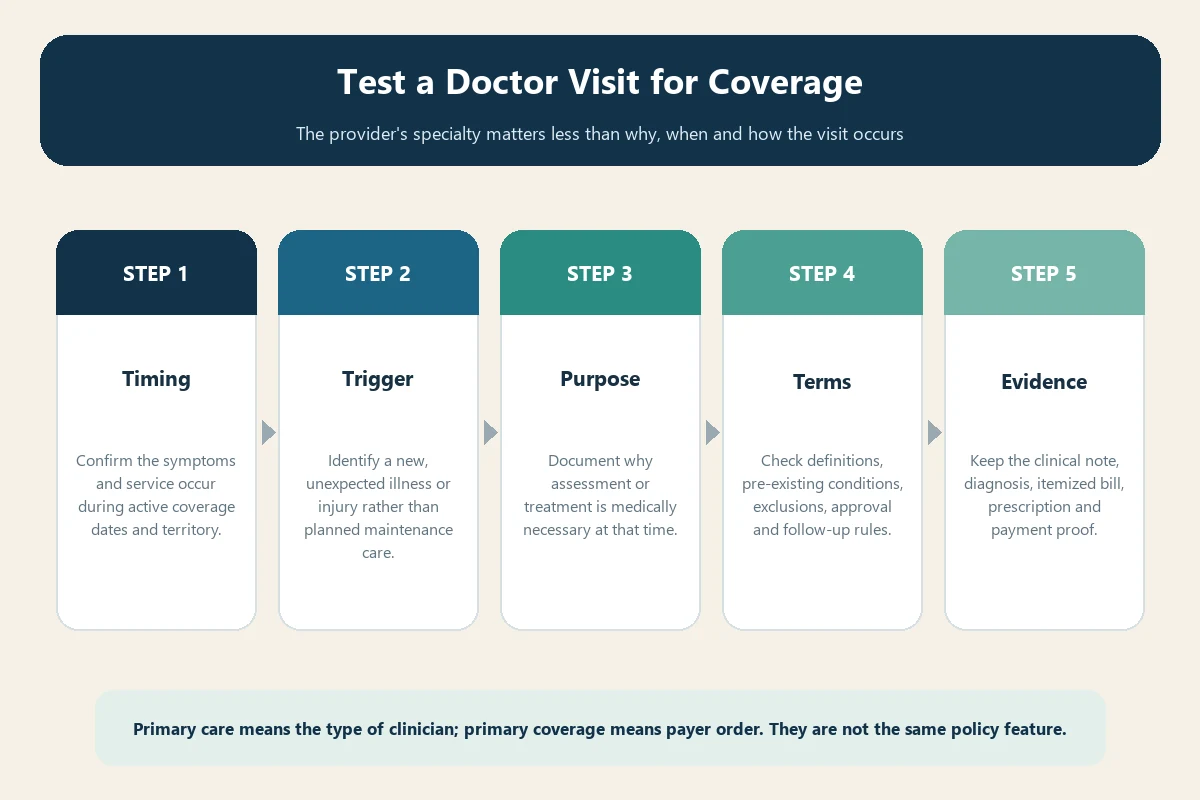
- Test the visit’s timing, trigger, purpose, exclusions and evidence.
- A general doctor can treat an eligible emergency without turning routine care into a benefit.
- Follow-up visits may need authorization, a physician order or treatment within the trip dates.
- Ask the insurer to apply the certificate to a concrete scenario before purchase.
Planning information reviewed August 16, 2026. Medical terms, eligibility and exclusions vary by certificate. This guide does not diagnose a condition or replace advice from a clinician or insurer.
Primary care and primary coverage are different
Primary care describes broad first-contact medical assessment and treatment. Primary insurance describes which payer processes an eligible expense before another insurer. A policy can be primary for claims yet exclude planned checkups. It can be secondary and still cover an eligible visit for a new illness.
Use the primary versus secondary travel medical guide only for payer order. For a doctor visit, start with the covered-expense and exclusion wording.
The practical coverage question
Do not ask only, “Are doctor visits covered?” Ask whether assessment and treatment for a named event, during stated dates and at this destination, are eligible. Then ask what deductible, service cap, authorization and evidence apply.
NAIC’s current travel insurance consumer guidance describes travel medical coverage as short-term care when a traveler becomes sick or injured. It also recommends asking whether approval is needed and which limitations or exclusions apply.
Routine care versus an unexpected medical need
A scheduled annual physical, stable-condition review, preventive screening or wellness visit is different from evaluation of new fever, pain, rash, breathing difficulty or injury. The same clinic can provide both. The purpose and clinical record separate them.
A marketing page may use “emergency” broadly. Read how the certificate defines sickness, injury, emergency, medically necessary treatment and covered expense. The policy reading guide shows how definitions control the later benefit section.
When a general doctor visit may qualify
A visit may fit the medical benefit when a new illness or injury begins during active coverage and prompt assessment is medically appropriate. The provider does not always have to be an emergency department. A local doctor or urgent care clinic may be the reasonable first setting.
Eligibility still depends on the diagnosis, dates, exclusions, recognized charges and policy process. The travel medical benefits guide explains how outpatient treatment moves from event to service, payment and claim evidence.
Planned physicals and preventive services
A physical arranged before departure, a routine screening, preventive laboratory test or general wellness consultation is normally a planned health need rather than an unexpected trip event. Do not assume the word “doctor” makes it an emergency medical expense.
Complete needed routine care before travel. The CDC encourages travelers to plan ahead, assess destination risks and arrange appropriate pretravel care. Its health care during travel guidance also advises knowing how overseas care will be paid.
Vaccines and pretravel consultations
Destination vaccines, malaria prevention, travel consultations and health certificates are usually obtained because the trip is planned. They should not be inferred from an emergency medical benefit. Check domestic health coverage, a clinic price and any separate preventive benefit.
Arrange the consultation early enough to complete vaccine schedules and medication planning. Keep the emergency travel policy separate from the budget for preparation.
New symptoms related to a chronic condition
A new symptom can still involve a pre-existing-condition definition, look-back period, stability rule or waiver. Do not decide from the symptom alone. The insurer may review records from before purchase and before departure.
The pre-existing conditions guide separates waiver eligibility from general coverage. A waiver can change an exclusion but does not automatically cover routine monitoring or expected treatment.
Urgent care, house calls and telemedicine
A certificate may recognize an urgent care center, licensed local clinician, house call or telemedicine service when medically appropriate. It may also limit provider types or require assistance coordination. Verify licensure, territory and documentation rules.
Ask for a clinical note even when the visit happens by video or at a hotel. It should show symptoms, onset, assessment, diagnosis, treatment and follow-up instructions. A platform receipt alone does not prove the medical service.
Follow-up after an emergency visit
A treating clinician may request a wound check, repeat laboratory test, dressing change or progress review. Follow-up can be part of an eligible episode, but the certificate can limit visits, require prior approval or end coverage when the trip ends.
Contact assistance before a stable follow-up when practical. Record whether the visit is authorized, merely recommended or outside the benefit. The assistance and claims guide helps document that distinction.
Mental health and counseling visits
Travel medical policies can treat mental-health assessment, crisis care, ongoing therapy and substance-related treatment differently. Never infer coverage from the general outpatient benefit. Search for mental, nervous, psychological, psychiatric and substance-use wording.
In an immediate safety emergency, seek local emergency help first. Insurance questions can be handled as soon as practical. Medical safety should not wait for a claims prediction.
Pregnancy-related primary care
Routine prenatal visits, expected childbirth and treatment of an unexpected complication can occupy different policy categories. Gestational timing, medical necessity and exclusions may matter. A generic doctor-visit answer is not enough.
Ask the insurer to apply the exact wording to the traveler’s dates and scenario. Obtain destination medical advice from a qualified clinician before travel.
Routine prescription management
A visit whose purpose is to renew a stable medicine may be routine care. A prescription ordered after assessment of a new eligible illness may sit within the medical event. Lost medicine introduces another distinction: replacement logistics, baggage loss and medical treatment are separate questions.
Bring enough lawful medicine and documentation for the trip. Do not rely on a travel medical claim to supply routine prescriptions abroad.
Check coverage dates and territorial limits
Symptoms can start before the effective date, care can continue after the return date, or a traveler can cross into an excluded territory. Record when symptoms began, when care was sought and where every service occurred.
A visit during the trip is not automatically covered if the underlying event began earlier. Conversely, a claim should not be rejected in the traveler’s own worksheet merely because the provider is a general doctor. Apply the certificate to the facts.
Understand deductibles and visit caps
An eligible outpatient visit can still be subject to a deductible, coinsurance, copayment, recognized-charge rule or smaller service limit. Several visits for one condition may share a cap or deductible reset unit.
Use the travel medical deductible guide to test per-person, incident, trip and policy-period wording. Ask how separate clinician, laboratory and prescription charges enter the calculation.
Payment at the clinic
Many outpatient providers require payment when care is delivered. A provider directory or assistance referral does not prove direct billing. Ask for an estimate and an itemized invoice in the local currency.
The U.S. Department of State recommends checking whether a U.S. plan covers emergency and routine care abroad. Document that answer before buying a supplemental plan. The health insurance abroad guide provides a call worksheet.
Use a five-question visit test
- Did the illness or injury begin unexpectedly during active coverage?
- Was assessment or treatment medically necessary at that time?
- Is the provider and territory eligible under the certificate?
- Do pre-existing-condition, preventive-care or other exclusions apply?
- Can the traveler prove the event, service, charge and payment?
A “yes” to the first two questions is not a claim decision. It means the visit deserves a complete certificate review rather than an assumption based on provider type.
Compare three realistic scenarios
Scenario one: a traveler schedules an annual physical during a long vacation. That is planned routine care. Scenario two: a new infection causes symptoms during the trip and a general doctor provides necessary treatment. That can fit an unexpected illness benefit if all terms are met. Scenario three: the doctor monitors a stable chronic condition with no new event. Pre-existing and routine-care provisions require close review.
Use these scenarios when asking an insurer for written clarification. Replace generic labels with the actual timing, purpose and provider.
Build a complete outpatient claim file
Keep the appointment record, symptom onset, clinical note, diagnosis, test order, result, prescription, itemized invoice and payment proof. Record assistance contacts and any domestic insurer response. Translate records only when requested.
The travel insurance claim guide provides a ledger for currencies, refunds and other payer amounts. A brief cash receipt without the medical purpose is a weak substitute for an itemized record.
Make the coverage decision before departure
The CDC’s insurance guidance recommends checking existing coverage and considering supplemental travel health insurance when it is inadequate. Apply that advice to routine needs as well as emergencies.
If the traveler needs predictable monitoring, ongoing therapy or regular prescriptions, a short-term emergency policy may not be the right tool for those services. Budget planned care separately or identify a product that expressly addresses it. Judge every visit by why it happens, when it happens and what the issued certificate says—not by the words “primary care” alone.
Later treatment may depend on the original event, location and benefit end date. Use the travel medical insurance follow up care guide to track one episode from first treatment through the return home.
A virtual visit abroad is both a care-access and insurance question. Use the travel medical insurance telemedicine abroad guide to check licensing, provider access, prescriptions, escalation, payment and claim records.