

Travel medical insurance physical therapy coverage usually depends on why rehabilitation is needed, when it begins and what the certificate calls eligible. Some plans can reimburse limited therapy after a covered injury or sickness. Others exclude rehabilitation, cap each visit, require a physician’s order or stop paying when the traveler returns home.
This article concerns a traveler receiving physical therapy as a patient. It is not about employer health insurance for a traveling physical therapist, a different topic that appears in the same Google results. The goal is to turn vague marketing language into a claim-ready coverage test.
Key takeaways
- The original injury or sickness must usually be covered before related rehabilitation can qualify.
- Confirm physician referral, medical necessity, licensed-provider and preauthorization requirements.
- Look for per-visit, per-day, visit-count and overall medical maximums.
- Map the permitted treatment window against trip dates, policy expiry and return-home care.
- Keep the initial medical record, therapy plan, progress notes and itemized receipts in one episode file.
Reviewed August 16, 2026. Benefits vary by certificate, state and plan; verify the issued document before relying on coverage.
Disambiguate the search before comparing plans
“Travel physical therapy insurance” can describe health coverage for a clinician working temporary assignments. That is not the same as short-term medical insurance paying for a traveler’s rehabilitation abroad. In every insurer conversation, say: “I am asking about outpatient physical therapy received by the insured traveler after a covered event during the trip.”
That sentence keeps sales, assistance and claims representatives focused on the correct benefit. It also reduces the risk of saving an irrelevant employer-plan answer as evidence.
Connect therapy to the original covered event
Start with the first diagnosis and treatment. A fall that causes an eligible fracture may lead to surgery, a brace and rehabilitation. The therapy claim depends on that event remaining eligible under the sickness or injury definition. Treatment for a condition that existed before coverage, a routine strengthening program or a trip taken to obtain therapy may be excluded.
The travel medical benefits guide shows how to follow one event through definitions, expenses and exclusions. Do not evaluate the therapy invoice in isolation.
Find all rehabilitation language
Search the full certificate for physical therapy, physiotherapy, rehabilitation, rehabilitative care, occupational therapy, chiropractic, manipulation, exercise program, home health and post-hospital care. One clause might list physical therapy as eligible while another excludes exercise programs or care delivered in a rehabilitation establishment.
Copy the relevant text and page number into a comparison table. Note whether the wording applies to outpatient care only, a direct transfer from an acute-care hospital, or treatment during the certificate period.
Confirm the clinician and referral requirements
A plan may require treatment by a physician, treatment ordered by a physician, or services delivered by a licensed physical therapist under physician supervision. These are different conditions. Ask whether the destination’s physiotherapist credential meets the certificate definition and whether the referring clinician must be in the same country.
Save the referral before the first session when possible. It should state the diagnosis, body area, medical reason, frequency and expected duration. A referral proves purpose, but it does not erase an exclusion or cap.
Prove medical necessity rather than general benefit
Travel policies are designed for unexpected medical expenses, not open-ended wellness or fitness programs. The therapist’s plan should connect each service to functional recovery from the covered event. Generic stretching, gym membership, massage or unsupervised exercise may not meet the definition even if a clinician thinks it is helpful.
The primary care coverage guide offers a similar purpose test. Ask what problem the service treats, why it is needed now and what clinical record supports that conclusion.
Audit four different kinds of limits
List the overall medical maximum, therapy sublimit, per-day or per-visit cap and maximum visit count. A plan can display a high medical maximum while reimbursing only a small amount for each therapy session. Deductible and coinsurance can further reduce payment.
Use the travel medical sublimits guide to find nested caps. Convert every rule into dollars and visits for the traveler’s expected treatment plan.
Calculate the treatment window
Some wording requires the first treatment during the trip and permits later visits only for a set number of days. Other wording ends expenses at the return date or certificate termination. A continuing-treatment clause can extend certain covered expenses, but its own conditions may apply.
Build a calendar with the injury date, first physician visit, therapy order, first session, each later session, return date and policy end date. The follow-up care timeline guide explains how to test location and time without breaking the episode chain.
Separate therapy abroad from therapy after returning home
Short-term travel medical insurance may focus on care outside the home country. Do not assume it becomes secondary domestic health insurance after return. If the certificate has a home-country or follow-up benefit, read its geographic, time and maximum rules.
Coordinate planned U.S. rehabilitation with the traveler’s domestic insurer. The health insurance abroad guide helps identify which payer is expected to handle each location.
Check whether preauthorization is needed
Emergency treatment often follows a different notice rule from scheduled rehabilitation. Once the patient is stable, the assistance center may require authorization before non-emergency sessions. Ask whether a referral is enough or a separate insurer approval is required.
Record the authorization number, approved dates, provider, body part and number of visits. If the plan says authorization is not a guarantee of payment, continue checking eligibility and proof requirements.
Plan around direct payment and reimbursement
Many outpatient clinics require payment at each visit. Ask whether the insurer has a network, can arrange direct billing or expects the traveler to submit receipts. Obtain the clinic’s legal name, address, provider credential, tax or registration information if available, and an itemized invoice.
Currency conversion can affect the claimed amount. Keep card statements or official exchange documentation required by the insurer rather than estimating the rate later.
Use current policy examples carefully
Travel Guard’s official medical-expense benefit page says some plans may include physical therapy for covered reasons. A current Virginia specimen then supplies the important detail: up to 30 physical- or occupational-therapy visits, a treatment window and a per-visit maximum shown elsewhere in the plan.
A current WorldTrips Atlas page shows another structure by listing outpatient physical therapy and chiropractic care with a daily cap. These examples prove variation, not a market-wide benefit. Obtain the certificate for the traveler’s state and quote.
Do not confuse a cap with an expected price
A benefit that pays “up to” a stated amount does not predict the clinic’s fee. The traveler may owe the balance above a cap, plus deductible or coinsurance. Ask the clinic for a written estimate and test several sessions, not just one.
The policy limits guide provides a worksheet for stacking expenses against the overall maximum. Include hospital and physician charges already incurred from the same event.
Distinguish treatment from maintenance
Acute rehabilitation aims to restore function after a covered event. Maintenance therapy manages a long-standing condition without a new covered change. Certificates may exclude routine, preventive, custodial or ongoing care even when a provider prescribes it.
Ask the clinician to document the new functional deficit and the connection to the trip event. Avoid asking for exaggerated wording; accurate records are more defensible and safer for later care.
Handle a pre-existing condition separately
If therapy treats a body part or condition with prior symptoms or treatment, apply the certificate’s look-back rule. A new injury to the same area does not automatically make every service pre-existing, and a pre-existing-condition waiver does not automatically make unrelated maintenance eligible.
Build a neutral medical timeline and ask for a written coverage explanation. Do not ask a therapist to decide insurance eligibility; that determination belongs to the insurer under the contract.
Preserve a complete clinical record
Keep the first physician report, imaging, referral, operative or discharge note, therapy evaluation, plan of care, session dates, progress notes and final summary. The record should show why therapy was reasonable, what was done and how function changed.
The CDC Yellow Book’s travel insurance guidance advises travelers to keep care records, charges and receipts. Give relevant overseas records to the U.S. clinician who continues treatment.
Build the claim package by session
Create one line per visit with date, provider, service code or description, amount paid, currency, payment proof, authorization and remaining visit allowance. Attach the prescription or referral and episode-level medical record once, then add session documents in order.
The claim documentation guide helps track supplemental requests. Meet the filing deadline even if the clinic has not yet produced every optional record; ask the insurer how to supplement an open claim.
Compare the certificate with consumer guidance
NAIC’s current travel insurance guidance reminds buyers to ask about insurer approval, pre-existing-condition exclusions and exact policy limits. Apply those questions specifically to rehabilitation.
Also confirm whether the policy is primary or secondary. A secondary benefit may require an explanation of benefits or denial from another insurer before it processes the remainder.
Run a realistic fracture scenario
Imagine a traveler fractures an ankle abroad. The hospital stabilizes the injury, a physician orders six outpatient sessions, and the traveler returns home after session two. Test the injury exclusion, physician order, therapist credential, preauthorization, per-visit cap, four later sessions, geographic rule and policy end date.
This scenario is more revealing than asking, “Do you cover physical therapy?” It identifies exactly where the proposed care could stop qualifying.
Ask these questions before purchase
- Is physical therapy an eligible medical expense or a stated exclusion?
- Must it follow a covered injury or sickness that began during the trip?
- Who must prescribe it, and which provider credentials qualify?
- Are preauthorization and assistance-center notice required?
- What are the per-visit, per-day, visit-count and overall maximums?
- When must the first and last sessions occur?
- Can treatment continue after return home, and under which benefit?
- Which invoices, notes and proof of payment are required?
Make the final rehabilitation decision
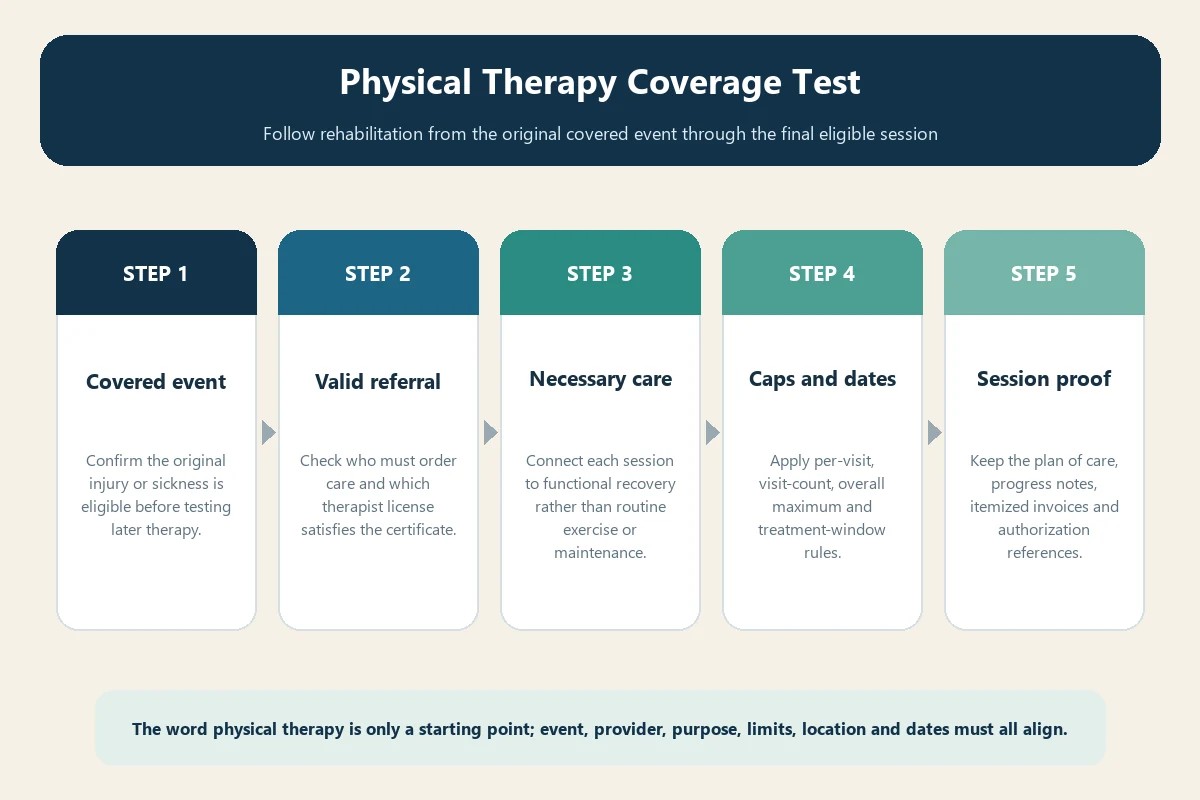
Reliable coverage needs more than the words “physical therapy” in a brochure. The original event, provider, referral, medical necessity, treatment dates, location, authorization and caps all have to agree with the issued certificate.
Read the form as a connected contract using the policy reading guide. If a representative cannot answer the fracture scenario against a specific form, compare a different certificate or plan to self-fund the gap.
Later treatment is not one automatic continuation benefit. Use the travel medical insurance continuation of treatment guide to classify planned care, recurrence, complications, follow-up and post-trip benefit periods.
