
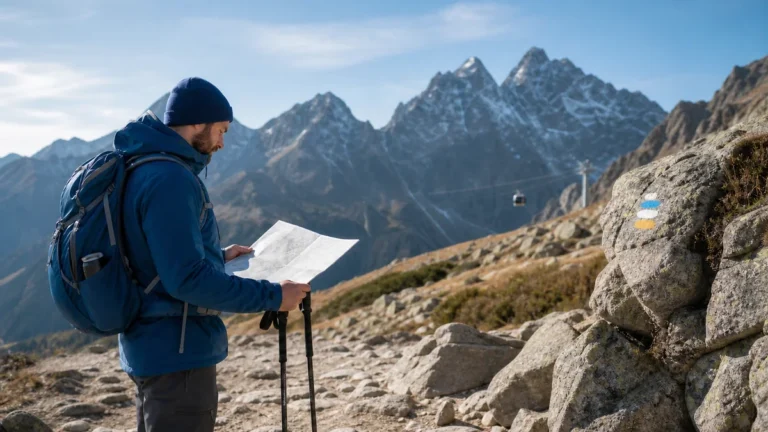
Travel insurance for Slovakia from USA trips should separate mountain rescue, medical treatment, evacuation and winter-sports protection. A Bratislava city visit is not the same risk as a High Tatras hike, ski day or rail-linked mountain itinerary. The issued policy must name the actual activities and expenses.
Key takeaways
- Check explicit search-and-rescue protection because standard medical benefits may not pay HZS costs.
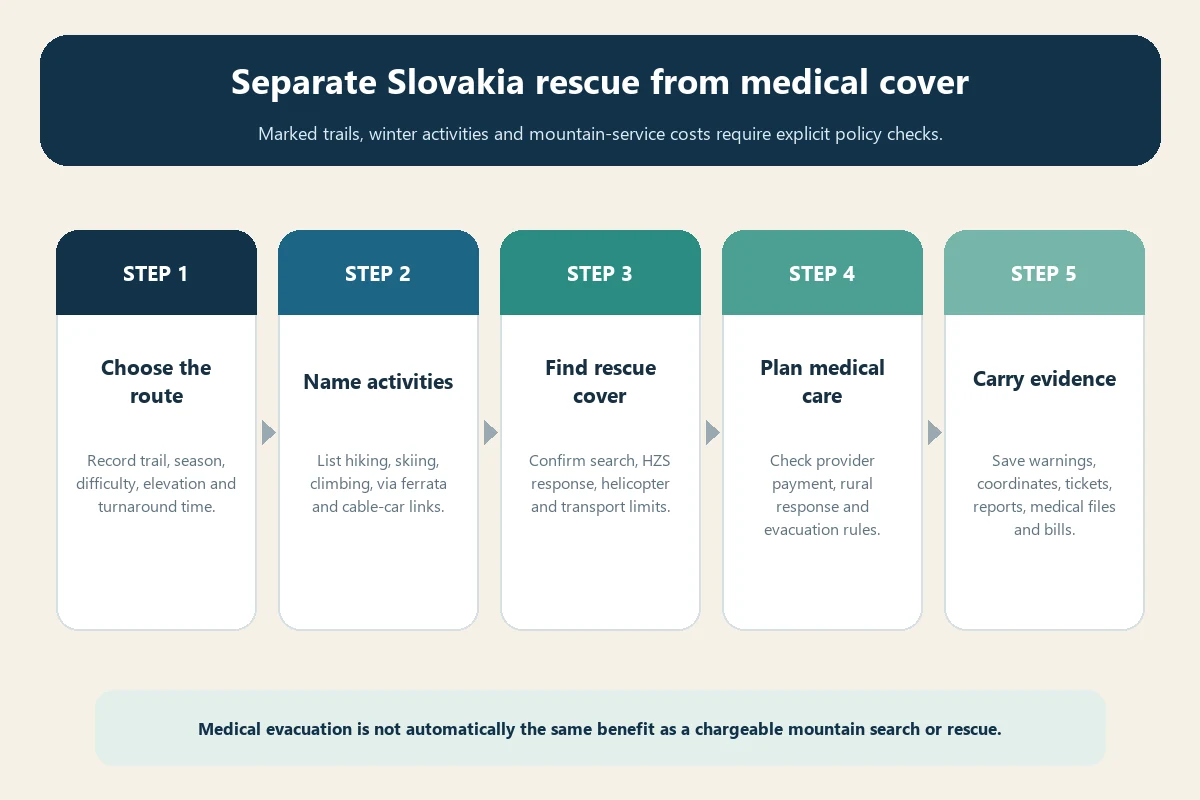
- Record the trail, season, difficulty, altitude, equipment and turnaround time before travel.
- Name hiking, skiing, climbing, via ferrata and off-piste activity separately.
- Prepare for provider payment and slower response in rural mountain areas.
- Keep mountain warnings, coordinates, tickets, rescue reports, medical files and receipts.
Planning information reviewed August 16, 2026. Mountain conditions, trail access, transport rules, provider practices and policy wording can change. Verify them for the route and season.
Map the Slovakia trip by terrain
List the U.S. flights, transit airport, Bratislava stay, train to the Tatras, cable cars, hotels, trailheads, ski areas and return. Add the nearest mountain-rescue station, clinic and hospital to each active day. Record the last safe turnaround time and backup transport.
Calculate prepaid, nonrefundable costs separately from flexible bookings. Include rail reservations, mountain lodging, lift tickets, guides and equipment only to the extent their cancellation terms leave money at risk. Standard cancellation needs a covered reason, not simply poor expected conditions.
For routes through Austria, Poland, Czechia or Hungary, use the multi-country Europe insurance guide.
Do not treat entry proof as rescue coverage
Many U.S. citizens visit Slovakia for short tourism under current Schengen arrangements without applying for a traditional visa. Passport, residence, purpose, duration and earlier Schengen time still determine the individual procedure.
A visa insurance certificate, when required, does not prove that a chargeable mountain search, skiing, climbing or a chosen trail is included. Review the full contract. The Schengen insurance requirements guide explains the role of formal evidence.
Identify the mountain-rescue bill payer
Slovakia’s Mountain Rescue Service explains on its official mountain insurance page that, under Slovak law, a person in a mountain area generally must reimburse costs connected with rescue activity or a search concerning that person, subject to stated exceptions such as minors.
Do not assume a U.S. travel plan includes that obligation. Ask whether search and rescue is covered, whether the benefit applies to HZS charges, what sublimit applies and whether the activity or route must be authorized. Request the answer in writing.
The U.S. Department of State’s official Slovakia travel information specifically advises mountain travelers to review mountain insurance because rescue may not be covered by standard travel insurance and can be costly.
Separate rescue from the medical chain
A search for a lost hiker, technical extraction, HZS transport, ambulance, hospital transfer, medical evacuation and repatriation are different services. A policy can pay one and exclude another. Read the definitions, decision maker and authorization requirements for each.
The HZS emergency number is 18 300, while 112 is the general European emergency number. In an emergency, follow current official guidance and protect life first. Then notify assistance when practical and keep the case number.
The evacuation and repatriation guide distinguishes local rescue from medically necessary return home.
Build a written route dossier
Record the official trail name, season, terrain grade, elevation, expected time, current closure status and forecast. Share the route and return time with a reliable contact. Download the map and warnings for offline use.
HZS publishes official English mountain safety instructions for organized activities. They address suitable equipment and avalanche gear in relevant terrain. Use current HZS conditions and instructions for the actual activity.
These precautions reduce risk but do not guarantee a claim. If the route materially changes, check whether the new difficulty or activity remains insured.
Translate trail choices into policy terms
| Planned activity | Policy wording to find | Extra evidence |
|---|---|---|
| Marked-trail hiking | Hiking altitude and trail conditions | Route, closure check and equipment |
| Via ferrata | Named activity, grade and guide rules | Booking, helmet and harness record |
| Climbing | Technical grade, ropes and professional use | Guide, route and certification where required |
| Downhill skiing | Winter-sports rider and piste limits | Lift ticket, incident and patrol report |
| Off-piste or touring | Guide, avalanche and exclusion language | Forecast, route and required safety gear |
A broad “adventure” label is not enough. The winter-sports and activity exclusions guide provides an exact-name audit.
Marked trails do not remove every exclusion
A policy may condition hiking coverage on marked trails, daytime travel, altitude or compliance with official closures. Confirm how it defines a marked route and whether a temporary detour changes protection.
Alcohol, deliberate exposure, racing, professional activity and ignoring official instructions can have separate consequences. Do not treat an insured activity as permission to continue in unsafe conditions.
Plan medical payment and rural response
The State Department says providers generally expect cash or credit-card payment unless the patient can show qualifying local or private insurance proof. It also notes that help can take longer to arrive in rural areas and recommends medical-evacuation protection.
Ask the U.S. health plan whether care abroad is covered and how out-of-network reimbursement works. Ask the travel insurer whether its medical benefit is primary or secondary, how assistance locates a provider and whether it can issue a payment guarantee.
Collect the diagnosis, medical report, itemized invoice, prescription and payment proof. The primary medical coverage guide explains the payment sequence.
Use the Austria comparison without copying assumptions
Austria and Slovakia both have alpine rescue questions, but laws, providers, geography and policy treatment differ. The Austria Alpine-rescue insurance guide is useful for comparing the layers, not for assuming identical costs or rules.
For Slovakia, require explicit confirmation of the HZS rescue-cost benefit and the planned activity. Keep the local mountain policy document if a separate product is purchased.
Protect rail connections to the mountains
Record whether connecting trains are one through journey or separate tickets. Include the time needed to change platforms and reach mountain transport. A last cable car or hotel transfer can create an additional self-connection outside the railway contract.
Slovak rail operator ZSSK publishes an official English Agreement on Journey Continuation guide for qualifying international tickets. It advises reasonable connection time and delay confirmation, and explains that the arrangement does not reimburse hotels, taxis or tickets.
That is why carrier rights and insurance must be tested separately. The Europe train travel insurance guide explains through tickets and residual loss.
Weather needs a documented consequence
Wind, lightning, snow, ice and avalanche conditions can close trails, cable cars or roads. Insurance usually responds only when a defined event causes an eligible loss. A personal decision to change plans is not automatically cancellation coverage.
Save the HZS warning, operator closure, scheduled time, refund decision and replacement expense. A general forecast without the affected service or route may be insufficient. Contact assistance before major spending when safety permits.
Separate equipment, liability and medical loss
Coverage for an injured skier does not automatically pay for damaged rented skis, a rescue sled, another person’s injury or a lost phone. Read baggage, rental equipment, sports equipment and personal-liability provisions separately.
Per-item limits and unattended-property exclusions can apply at huts, stations, cable cars and vehicles. Keep rental agreements, condition photos and receipts.
Compare Slovakia plans with a mountain worksheet
- all countries, travel dates, trails, ski areas and transit points;
- medical maximum, deductible, payment process and rural assistance;
- HZS search and rescue benefit, sublimit and eligible activities;
- ambulance, facility transfer, evacuation and repatriation;
- marked-trail, altitude, off-piste, guide and equipment conditions;
- rail ticket structure, delay evidence and onward mountain transport;
- weather closure, cancellation, interruption and delay thresholds;
- claim notice, authorization, records and appeal deadline.
Read the contract issued for the purchaser’s U.S. state. Check territorial and advisory wording with the Europe country-exclusions guide.
Create one evidence timeline
Start with route planning and the last official warning check. Add coordinates, emergency calls, HZS actions, ambulance transport and provider care in order. Preserve each report and bill. For rail or cable-car disruption, include the ticket, cause, actual time and remedy offered.
Disclose local mountain insurance, carrier compensation, supplier refunds and card benefits. Claim only eligible net loss. The travel insurance claim guide provides a document structure.
Frequently asked questions
Is travel insurance mandatory for every U.S. tourist in Slovakia?
No single private-policy rule applies identically to every short U.S. tourist. Visa status, passport, purpose and duration determine formal requirements. Mountain rescue creates a separate cost question.
Can HZS charge a traveler for mountain rescue?
Slovak law generally requires a person in a mountain area to reimburse rescue or search costs concerning that person, subject to stated exceptions. Verify current official rules and insurance.
Does medical evacuation pay the HZS bill?
Not automatically. Search, rescue, ambulance, hospital transfer, evacuation and repatriation can be separately defined. Require explicit rescue-cost wording.
Are marked-trail hikes always covered?
No. The activity can still have altitude, season, closure, equipment or conduct conditions. Read the exact issued policy.
Will rail protection pay for a missed cable car?
Only if the carrier contract or insurance wording covers that connection and cost. A self-transfer to mountain transport can remain the traveler’s risk.
This article is educational and is not legal, medical or insurance advice. Official authorities, responders, providers and the issued policy control.
