

The Schengen insurance repatriation requirement covers two serious functions: return for medical reasons and return in the event of death. The visa certificate should show that the policy addresses the required repatriation risk. The full contract then determines who authorizes transport, where the traveler is taken, which services are included and whether the overall medical limit or a smaller sublimit applies.
Key takeaways
- Article 15 includes repatriation for medical reasons or death among the required functions.
- Medical evacuation to suitable care and repatriation home are not always the same benefit.
- Assistance companies commonly control medical necessity and transport arrangements.
- Return in the event of death can require coordination, documentation and a separate sublimit.
- The certificate proves a summary; the policy wording controls an actual service or claim.
What the Visa Code actually says
Article 15 of the EU Visa Code requires adequate and valid travel medical insurance covering expenses connected with repatriation for medical reasons, urgent medical attention, emergency hospital treatment or death. The insurance must be valid throughout the Member States for the relevant period, with a minimum coverage of €30,000.
The rule states the required function and overall minimum. It does not make every transport choice automatic. A policy can define medical necessity, reasonable and customary expense, nearest suitable facility, prior authorization and exclusions. Those clauses decide the real service.
The official Netherlands insurance page asks for at least €30,000 covering hospital care, emergency treatment, prescription medicine and repatriation to the country of residence, including in the event of death. That wording is a useful certificate check for applicants.
Four transport concepts that should not be merged
| Concept | Typical purpose | Destination may be |
|---|---|---|
| Local emergency transport | Move the patient from the incident to nearby care | Local clinic or hospital |
| Medical evacuation | Reach a facility able to provide needed treatment | Nearest suitable facility |
| Medical repatriation | Return the medically stable traveler under arranged conditions | Country of residence or home-area facility |
| Repatriation of remains | Arrange return after death | Place defined in the policy and family instructions |
Policies can use different labels or combine benefits. Find the definitions in the issued contract. A large “evacuation” amount does not prove that return home after stabilization is covered. Likewise, the phrase “repatriation” on a certificate may summarize more than one underlying clause.
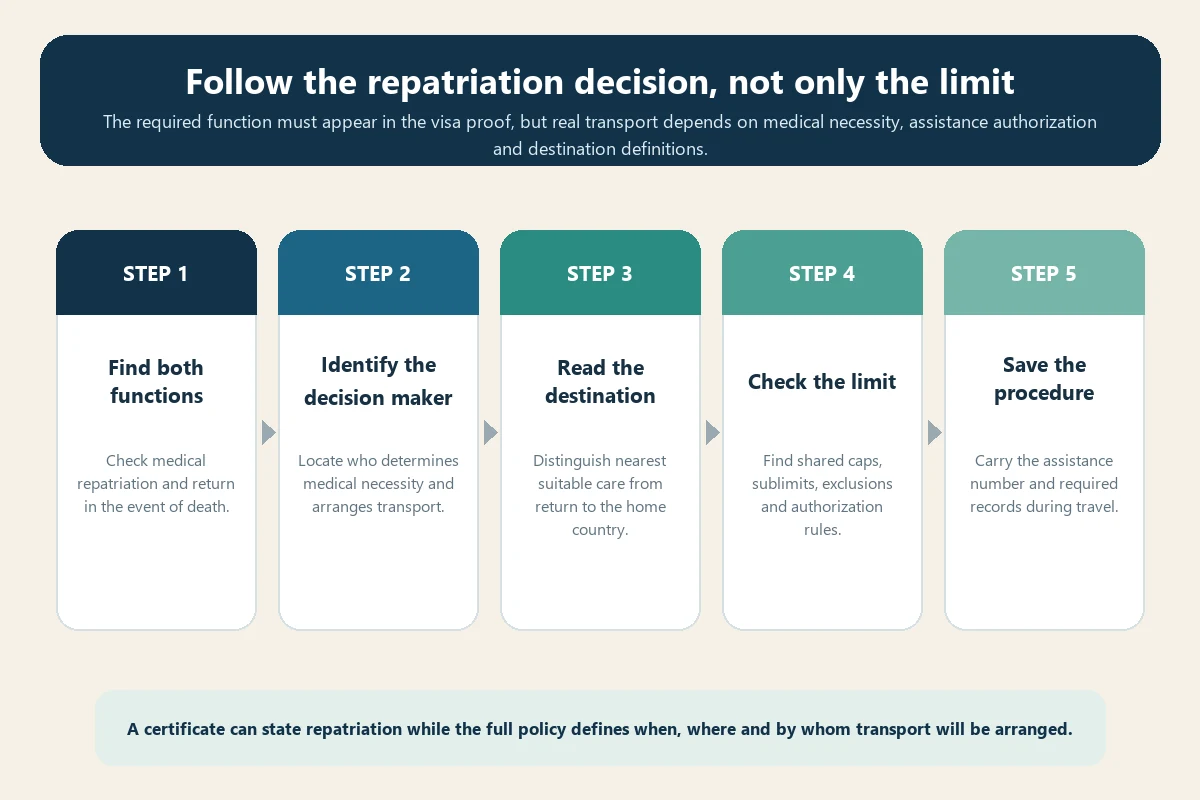
Nearest suitable facility versus home-country return
Emergency evacuation is designed to reach adequate care. The assistance team can decide that a regional hospital is medically suitable, even when the traveler prefers a U.S. hospital. Transport home may become appropriate only after stabilization, or it may not be included at all.
Ask the insurer:
- who determines medical necessity;
- whether the destination is the nearest suitable facility;
- when return to the country of residence becomes available;
- whether a medical escort, special seat or air ambulance is included;
- how a companion’s travel is handled;
- whether onward or return transport after treatment is covered.
The medical evacuation limits guide explains destination and authorization clauses. Use it with the Schengen visa insurance baseline, since practical protection can justify limits above the visa minimum.
Assistance authorization is operationally important
Medical transport is usually arranged through the insurer’s assistance company. The team speaks with treating clinicians, evaluates suitable facilities, confirms benefits and coordinates providers. A traveler who privately books an air ambulance without authorization can face a denial unless an emergency exception applies.
Save the assistance number on paper and in every traveler’s phone. Know how to place an international or collect call. Ask whether messaging, an app or an online portal works when voice service fails. A family member should know the policy number and insured name.
When immediate care is necessary, seek it first. Contact assistance as soon as circumstances allow and preserve the timeline. The policy explains notice duties and emergency exceptions.
What return in the event of death can involve
This benefit is handled sensitively and can involve local authorities, a consulate, medical certification, a funeral provider and transport arrangements. The policy may cover preparation and transportation of remains, or an alternative local burial or cremation benefit. Limits and family choices vary.
The phrase “including in the event of death” should be visible when the consular checklist requires it. The full wording should identify covered services, destination and exclusions. Ask whether a family member’s travel, local funeral costs or document fees are inside or outside the benefit.
Do not expect a visa-application certificate to contain these sensitive details. They belong in the contract and assistance procedure. Keep the policy accessible to the emergency contact.
The €30,000 minimum is not a dedicated transport limit
Article 15 states a minimum overall coverage amount. A policy schedule may apply that amount across medical and repatriation expenses or display separate limits. Check whether evacuation and return of remains share the medical maximum, have their own sublimits or sit outside the headline number.
The Schengen minimum-coverage guide explains why benefits and sublimits matter. An applicant should not claim that every required service receives €30,000 separately unless the schedule actually says so.
Why U.S. travelers often need separate evacuation cover
The U.S. Department of State’s health-abroad guidance says some health plans cover typical medical costs overseas, but most do not pay for a special air-ambulance evacuation back to the United States. It recommends considering medical evacuation insurance.
A domestic health plan, Medicare supplement or employer program may overlap. Document what each pays abroad. If the Schengen policy is secondary, understand which insurer must respond first. The U.S. government does not pay ordinary private medical bills or promise free repatriation.
Certificate audit for repatriation wording
- Confirm the applicant’s passport name.
- Check coverage dates and all-Schengen territory.
- Locate the overall medical amount.
- Find medical repatriation wording.
- Find return in the event of death or equivalent wording.
- Identify the insurer and policy number.
- Save the assistance contact and full policy.
The Schengen certificate guide provides a complete field audit. If the certificate says only “emergency assistance,” request clearer proof. Do not add wording yourself.
Scenario test before purchase
Give the insurer a hypothetical without requesting medical advice: “If the traveler becomes seriously ill in a rural area and the treating facility cannot provide required care, who decides the destination and arranges transport?” Then ask: “After stabilization, when would return to the United States be covered?”
For the death benefit, ask which services and destination are included, what documents the family provides and whether any sublimit applies. Written answers should point to the policy sections.
The CDC’s travel and medical evacuation insurance chapter notes that evacuation from an area with limited care may be necessary and that specialized cover can help travelers obtain care and keep relatives informed. Use that planning advice to test the assistance service, not only the limit.
Claims and coordination records
Keep medical reports, assistance authorizations, transport records, itemized bills and proof of payment. Record call dates, case numbers and the names of representatives. If more than one policy might respond, disclose the other coverage and follow coordination rules.
A medical repatriation claim can involve both service arrangement and reimbursement. Confirm whether the insurer pays providers directly or the traveler must pay and claim later. Never delay emergency treatment solely to collect paperwork.
When another health plan may pay first, obtain its explanation of benefits and preserve any denial. The primary medical coverage guide explains how payment order can affect cash flow. Assistance approval, medical necessity and financial coordination should be documented as separate decisions; approval to arrange transport does not automatically establish which policy pays every related charge.
Common repatriation mistakes
- Treating ambulance, evacuation and repatriation as identical.
- Assuming “nearest suitable facility” means the traveler’s home hospital.
- Reading the certificate but not the authorization clause.
- Assuming the €30,000 minimum applies separately to every benefit.
- Booking private transport before contacting assistance when authorization is possible.
- Failing to give the emergency contact access to the contract.
- Ignoring the separate wording for return in the event of death.
Frequently asked questions
Is repatriation mandatory for a Schengen visa policy?
Yes. Article 15 includes repatriation for medical reasons or death among the required travel medical functions.
Does repatriation mean a flight home?
Not always. Emergency evacuation may end at the nearest suitable facility. Return home depends on the policy, medical status and assistance decision.
Does the policy need a separate €30,000 repatriation limit?
The Visa Code states a €30,000 minimum for the insurance. Check the authority’s certificate instruction and the schedule to see how medical and repatriation benefits share or separate limits.
Can a family arrange its own air ambulance?
Only with care. Policies commonly require assistance authorization and arrangement. Contact the insurer unless immediate circumstances make that impossible, then document the emergency.
What proof should be carried?
Carry the visa certificate, policy, assistance number and policy ID. Keep secure digital copies available to a trusted emergency contact.
This guide is educational, not legal, medical or coverage advice. Read the exact policy and follow current consular instructions and emergency-assistance procedures.
Adding Malta, Gozo or a planned dive? Use the Malta travel insurance guide for U.S. visitors to audit island transport, activity depth, provider payment and medical transfer.
Hiking or skiing in Slovakia? Read the Slovakia travel insurance guide for U.S. visitors to distinguish HZS rescue costs, medical treatment, evacuation and winter-activity clauses.
Driving or hiking in Slovenia? Use the Slovenia travel insurance guide for U.S. visitors to audit Alpine rescue, cave activities, medical transport and cross-border rental-car wording.
Heading beyond Stockholm? The Sweden travel insurance guide for U.S. travelers explains visitor medical charges, remote northern transfers, winter driving and archipelago connections.
Combining Bulgaria’s coast and mountains? Read the Bulgaria travel insurance guide for U.S. visitors for medical proof, rescue, winter-sports and secondary-road checks.
Planning travel across Türkiye? Use the Turkey travel insurance guide for U.S. visitors to compare regional exclusions, private-hospital payment, natural-disaster disruption and evacuation.
Taking Albania’s coastal or mountain roads? Use the Albania travel insurance guide for U.S. visitors to plan remote medical response, hiking, vehicle cover and evacuation.
