
Travel insurance for Slovenia from USA trips should be matched to the route, not purchased from a country name alone. Ljubljana, Lake Bled, a guided Karst cave and a self-guided Julian Alps hike create different medical, rescue, transport and activity questions. A useful policy audit connects each booked day to a written clause.
Key takeaways
- Separate mountain search and rescue from emergency medical treatment and later evacuation.
- Name hiking altitude, via ferrata, climbing, skiing and cave activity exactly.
- Check rental-car territory, roadside assistance and vehicle exclusions before crossing a border.
- Prepare for direct provider payment and possible transport to a larger medical center.
- Save route warnings, assistance approvals, incident reports, bills and original receipts.
Planning information reviewed August 16, 2026. Entry rules, mountain conditions, roads, provider practices and insurance wording can change. Recheck official sources and the issued policy for the travel dates.
Start with a route-and-cost inventory
Write one line for every important segment: U.S. departure, connecting airport, Ljubljana stay, rail or shuttle to Bled, rental-car pickup, cave reservation, mountain lodging, trail day and return. Add any Austria, Italy, Croatia or Hungary extension. This inventory reveals where a single-country assumption can fail.
Next, label each booking as refundable, partly refundable or nonrefundable on the date coverage is bought. Include flights, apartments, mountain huts, guides, attraction tickets and prepaid car charges. Trip cancellation generally responds only to a covered reason and documented loss; a forecast that looks unpleasant is not automatically enough.
If the itinerary crosses national borders, use the multi-country Europe travel insurance guide to verify the full geographic span and transit days.
Do not combine rescue, treatment and evacuation
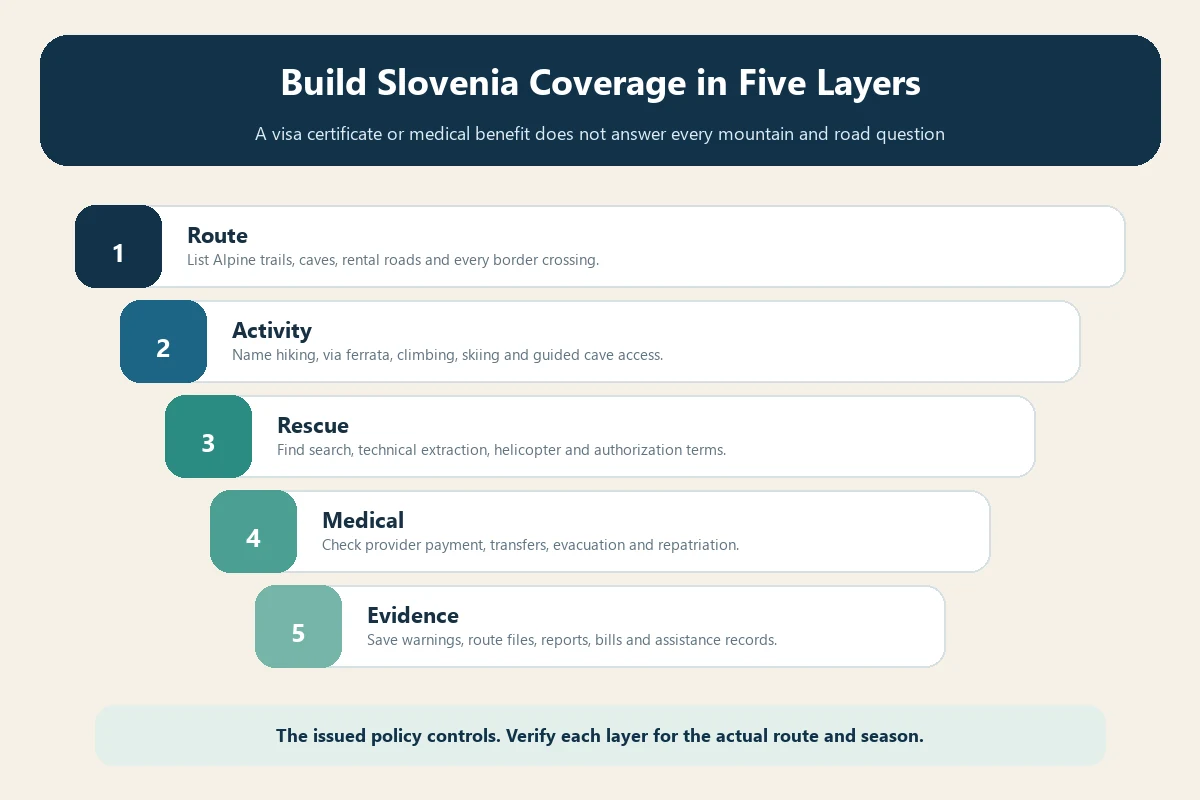
These services can appear in one incident but remain separate expenses. A lost-hiker search can happen without an injury. Technical extraction may end at a trailhead. An ambulance may then transport the traveler to a local facility. A later transfer to Ljubljana, medical evacuation to another country or repatriation to the United States can require a new medical decision and prior authorization.
The U.S. Department of State’s current Slovenia travel information warns that mountain rescue may not be covered by standard insurance and can be expensive. It also notes that U.S. visitors may need to pay medical bills directly and that rural response can take longer.
Ask the insurer to identify the benefit, sublimit, deductible and authorization rule for each link in that chain. The evacuation and repatriation guide explains why transport to appropriate care and a return home are not interchangeable.
Turn an Alpine day into policy language
“Hiking in Slovenia” is too vague for a coverage decision. Record the official route, trail status, maximum elevation, terrain grade, expected duration, season, equipment and whether a guide is involved. If the plan changes, repeat the check for the new route rather than assuming the original answer follows it.
The Mountain Rescue Association of Slovenia publishes official safe-walking recommendations. They emphasize checking conditions, selecting suitable equipment and sharing the route. Its guidance also explains that poor visibility, wind, snow or darkness can limit a helicopter rescue. Insurance cannot make an aircraft available when operating conditions are unsafe.
| Itinerary item | Question for the policy | Evidence to keep |
|---|---|---|
| Marked-trail hike | Are altitude, trail grade and seasonal conditions within scope? | Route file, closure check and forecast |
| Via ferrata | Is the named activity covered, and is a guide required? | Grade, guide booking and equipment record |
| Climbing | What technical, rope-use or elevation exclusion applies? | Route description and guide credentials |
| Skiing | Is a winter-sports option required, and are off-piste areas excluded? | Lift ticket, patrol report and location |
| Mountain rescue | Does search or extraction have its own sublimit? | Rescue report, coordinates and invoice |
Use the adventure and winter-sports exclusions guide to test the exact activity name instead of relying on a broad “outdoor activities” description.
Classify caves before entering them
A staffed visit on a constructed walkway is not the same exposure as crawling, abseiling, underground climbing or exploring an undeveloped cave. Ask how the contract defines caving, spelunking and technical equipment. Confirm whether the operator must be licensed or whether the activity must be guided.
Keep the reservation, operator description and the activity level sold to you. If an excursion is canceled, obtain the operator’s written reason and refund statement. That record helps distinguish a refunded service from an unreimbursed loss, and a weather closure from a covered medical event.
Slovenia’s government identifies 112 as the general emergency number for medical, fire, mountain and cave rescue in its official emergency-call guidance. Protect life first; contact the insurer’s assistance service as soon as reasonably possible afterward.
Audit the rental-car route separately
Travel medical insurance does not replace the rental agreement, mandatory vehicle liability cover or an optional collision product. Before pickup, record who can drive, the permitted countries, paved-road requirements, mountain or winter restrictions, required equipment and the procedure for a breakdown or collision.
For a loop into Italy, Austria, Croatia or Hungary, get the rental company’s cross-border permission in writing. Ask whether roadside assistance ends at the national border and whether a replacement car, towing or an unused hotel night is covered anywhere. Credit-card vehicle protection may have its own vehicle, country, duration and payment conditions.
The Europe road-trip insurance guide provides a separate worksheet for rental, liability, medical and trip-interruption layers.
Plan for medical payment and transfer decisions
Do not equate access to Slovenia’s health system with free care for a U.S. visitor. Ask whether the policy can arrange direct billing, whether the traveler may need to pay first, and what documents are required for reimbursement. Carry a payment method that can handle a reasonable deposit without depending on reimbursement at the point of care.
Map the nearest clinic and hospital for each rural or mountain stay. Then ask what happens if that facility cannot provide the needed specialty. The answer should identify who decides medical necessity, who chooses the receiving facility and when the assistance company must be called.
Travelers with ongoing conditions should examine the look-back period, stability test, medication rules and any waiver deadline. The primary medical coverage guide explains how “primary” changes claims handling without guaranteeing that a provider will accept direct payment.
Connect transport disruption to the correct benefit
A delayed transatlantic flight, missed shuttle, canceled regional train and closed mountain road do not automatically trigger the same coverage. Match each risk to trip delay, missed connection, trip interruption or carrier responsibility. Check the required delay duration, covered cause, daily limit and total cap.
Build realistic connection time around separate tickets and late arrivals. If the airline, railway, hotel or tour operator refunds an expense, insurance generally addresses only the remaining eligible loss. The delay, interruption and cancellation comparison helps assign the correct label before a claim.
Understand what Schengen proof does not prove
Slovenia participates in the Schengen area. A U.S. visitor’s entry procedure depends on nationality, passport, stay length, travel history and purpose. If formal insurance evidence is required for a particular application, use the requested certificate format.
That document does not by itself establish that a specific trail, technical cave, rescue bill, rental-car loss or prepaid booking is insured. The full contract and endorsements control. Review the Schengen travel insurance requirements guide for the difference between entry evidence and broader trip protection.
Compare policies with a Slovenia test case
Give each candidate insurer the same scenario: a U.S. traveler prepays flights, rents a car for Slovenia and neighboring countries, visits a guided show cave, hikes a named Julian Alps route and needs an extraction followed by hospital transfer. Request written answers and page references.
- Is every country and transit point inside the policy territory?
- Are the exact hike and cave activities covered at their stated difficulty?
- Does search and rescue have a separate limit or exclusion?
- Who authorizes ambulance transfer, evacuation and repatriation?
- Must medical costs be paid first, and what proof is required?
- What delay trigger applies to a missed prepaid connection?
Reject a verbal “should be covered” answer. Save the policy version, schedule of benefits, endorsement and written clarification that supported the purchase.
Assemble a claim-ready travel file
Keep the declarations page, assistance number, route plan, bookings, payment records and refund terms available offline. During an incident, record the time, location, people contacted and instructions received. Obtain the carrier notice, police or rescue report, medical diagnosis, itemized bill, proof of payment and refund statement that fits the event.
Do not discard an original receipt after uploading it. Submit within the stated notice period and answer requests with the same factual timeline. The travel insurance claim guide provides a document-by-document workflow.
Bottom line
The best Slovenia plan is the one that can survive a route-specific test. Map the itinerary, name every active pursuit, separate rescue from treatment and evacuation, verify cross-border driving, and preserve the documents that prove both the loss and the policy response. That is more useful than choosing by destination label or headline benefit alone.
