
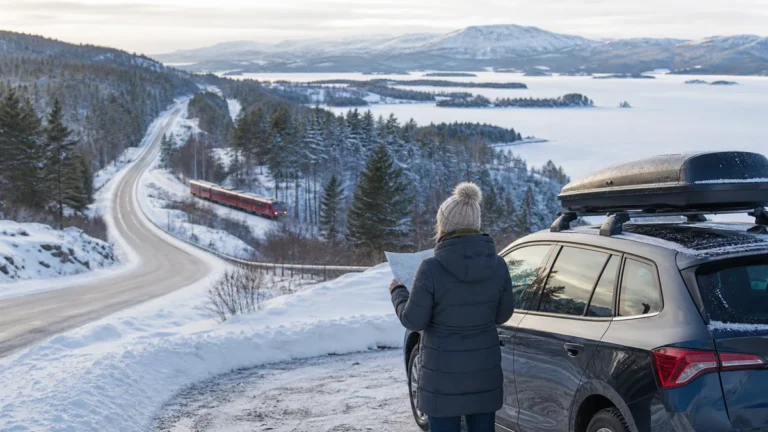
Travel insurance for Sweden from USA trips becomes more important as the itinerary moves farther from a major city. A Stockholm weekend, a winter drive in Norrland, an overnight train to the north and an archipelago island stay do not create the same access or transport problem. The comparison should therefore begin with distance and season, then move to policy limits.
Key takeaways
- U.S. visitors can be responsible for the full cost of Swedish health care.
- Remote treatment, inter-hospital transfer, evacuation and repatriation need separate answers.
- Winter tires, weather warnings and road conditions affect both safety and documentation.
- Snow sports, snowmobiling, skating and remote hiking should be named individually.
- Rail, ferry and flight disruption must be matched to the correct trigger and limit.
Planning information reviewed August 16, 2026. Health charges, transport schedules, weather, road rules and insurance contracts change. Confirm details for the region, season and policy issue date.
Divide Sweden into response zones
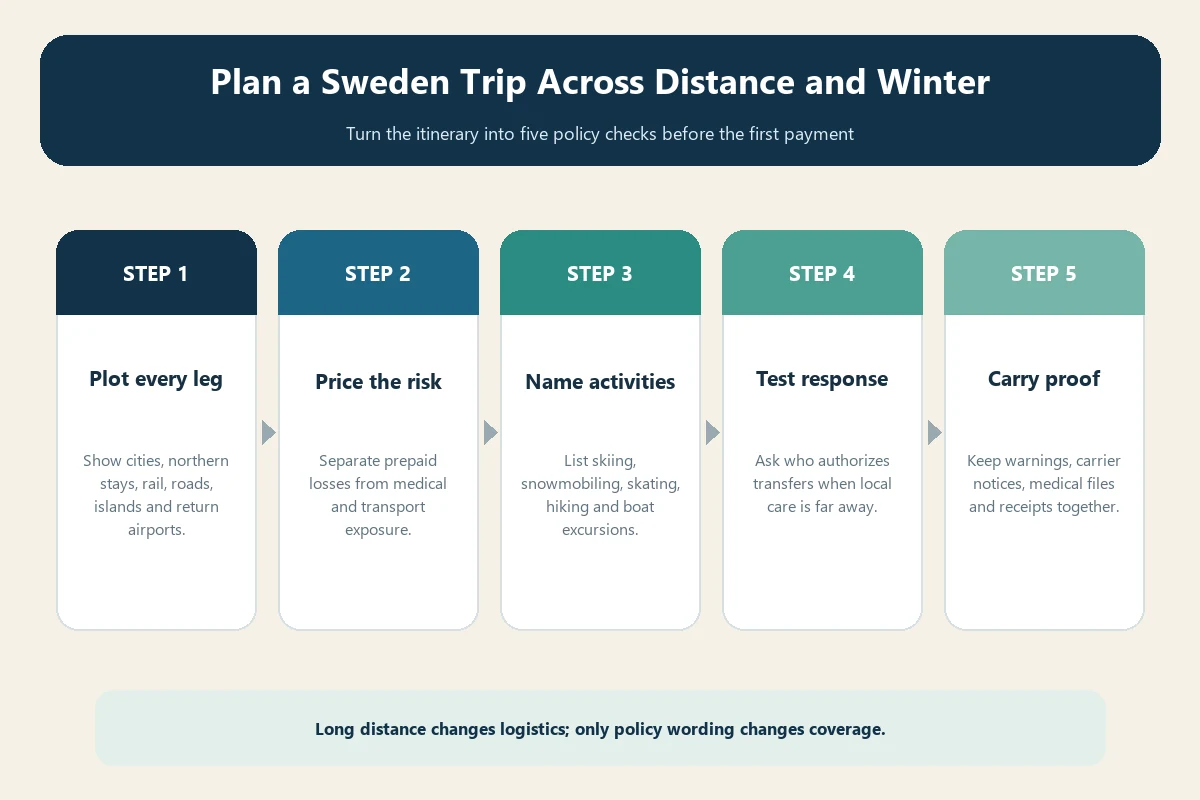
Put every overnight stop and major excursion on one itinerary. Then mark Stockholm, Gothenburg or Malmö days as urban; countryside and island days as regional; and far-northern stays as remote. Record the nearest urgent-care service, hospital, rail station, all-weather road and airport for the last two groups.
This is not a prediction that something will go wrong. It is a test of how the plan would work if local care cannot finish the treatment, a storm interrupts transport or the traveler cannot reach the next prepaid booking. Long distances can turn a modest illness into an expensive logistics problem.
For a route that also includes Norway, Denmark or Finland, apply the multi-country Europe coverage checklist to every country and transit leg.
Protect the purchase date as well as the travel dates
Sweden trips are often assembled over several months: an international flight first, then a sleeper train, northern lodge, rental car and activity reservations. Keep a running total of the first payment date and each later deposit. Some benefits or pre-existing-condition waivers are available only when coverage is bought within a stated period after the initial trip payment.
Ask how later bookings are added to the insured trip cost and when an increased premium must be paid. If the return date changes, verify that the policy period still covers the final overnight and flight home. Record the answer rather than assuming an automatic extension.
Budget for the visitor medical bill
Sweden’s public health system is not a promise of free treatment for a U.S. tourist. Stockholm’s official 1177 health portal states that a visitor from a country outside the EU, EEA, Switzerland or a relevant convention generally pays the entire cost of care. Regional procedures and charges can differ, so use the local 1177 guidance for the place visited.
Ask each insurer whether it can coordinate direct billing or whether reimbursement is the normal path. Confirm the deductible, coinsurance, maximum benefit, covered provider rules and definition of emergency treatment. Keep enough payment capacity for a deposit or bill without assuming instant insurer settlement.
Call 112 for a life-threatening emergency. Sweden’s 1177 service can provide health advice and direct a traveler to appropriate care for non-life-threatening concerns. A policy’s primary medical wording can change the order of claims, but it does not make every clinic bill the insurer directly.
Test the northern transport chain
The U.S. Department of State’s current Sweden travel information notes that health care can be harder to obtain in rural areas. It also warns that nonresident U.S. citizens may have to bear costs for non-emergency inter-hospital transfer and repatriation.
For Kiruna, Abisko, Lapland or another far-northern stop, give the insurer a concrete case. Ask who decides that a transfer is medically necessary, whether transport to the nearest appropriate Swedish facility is covered, and under what conditions treatment in another location or return to the United States can be authorized.
Search-and-rescue response, ground ambulance, air ambulance, hospital transfer and return home may sit in different sections. The medical evacuation and repatriation guide helps separate those decisions.
Treat winter driving as an operational plan
The Swedish Transport Agency’s official winter tire guidance applies special equipment rules during wintry road conditions and states that the requirements also apply to foreign-registered vehicles. A rental company supplies the vehicle, but the traveler should still verify the equipment, pickup location and intended route.
Before departure, confirm winter tires, permitted roads, studded-tire constraints, roadside assistance, towing, replacement-car procedures and cross-border permission. Record the rental company’s emergency number and photograph the vehicle condition and supplied equipment at pickup.
The Swedish Meteorological and Hydrological Institute publishes official warnings and forecasts. Its warnings are impact based and can describe effects on roads and transport. Save the warning and road-status evidence that affected a journey; a generic weather screenshot without location or time is weaker.
Travel insurance does not replace motor liability, collision protection or the rental contract. Use the Europe road-trip coverage guide to keep vehicle damage, roadside costs, medical benefits and trip interruption in separate columns.
Name each northern and winter activity
Do not ask only whether “winter activities” are covered. List downhill skiing, cross-country skiing, snowboarding, snowmobiling, dog sledding, skating, snowshoeing, ice fishing and remote hiking as applicable. Give the insurer the location, supervision, equipment and commercial operator details.
| Planned experience | Clause to locate | Operational question |
|---|---|---|
| Marked cross-country trail | Skiing and trail-condition scope | Are remote or ungroomed routes treated differently? |
| Snowmobile tour | Motorized activity and license rules | Must the operator or guide meet stated conditions? |
| Natural-ice skating | Ice activity and safety exclusions | Does guide status or an official warning matter? |
| Downhill skiing | Winter-sports option and piste limits | What evidence is needed after an incident? |
| Remote hike | Search, rescue and hiking limits | Is there an altitude, distance or route restriction? |
The winter-sports exclusion audit shows how to compare named activities, equipment requirements and off-piste wording without assuming one rider covers everything.
Build an archipelago exit plan
An island stay adds ferry schedules, weather exposure and limited late-day alternatives. Record the final ferry before a flight or rail connection, the ticket’s refund terms and the cost of a backup night. Do not schedule a tight self-connection that depends on ideal conditions.
Ask whether a canceled public ferry is a covered delay cause, whether the policy requires a minimum delay and whether extra accommodation has a daily cap. A tour-boat cancellation may be handled first by the operator. Insurance usually considers only the eligible, unreimbursed remainder.
Use the European ferry travel insurance guide for carrier evidence, alternative transport and missed-connection questions.
Keep rail and air responsibilities distinct
An overnight train delay, a canceled domestic flight and a missed transatlantic departure have different contracts and remedies. Note whether the itinerary is one ticket or several. Ask the carrier for a written delay or cancellation notice and record any rebooking, lodging, meals or refund it provides.
Then compare the remaining loss with the policy’s delay, missed-connection and interruption sections. Look for the covered causes, waiting period, per-day amount, total limit and requirement to use reasonable alternatives.
The Europe train travel insurance guide covers rail-specific evidence, while the delay versus interruption guide helps select the correct insurance benefit.
Use one demanding scenario to compare plans
Give every insurer the same test: a U.S. traveler prepays a Stockholm stay, overnight train and northern lodge, rents a winter-equipped car, joins a snowmobile excursion and later needs treatment plus transfer from a remote area. Ask for page-numbered written responses.
- Are the full dates, transit countries and northern region inside the territory?
- How are pre-existing conditions and the purchase deadline handled?
- Are the named activities included, excluded or subject to a rider?
- Does remote transport require advance assistance approval?
- What limit applies to inter-hospital transfer and repatriation?
- Which weather or carrier events can trigger delay benefits?
- What documents must be submitted, and by when?
Compare definitions and exclusions before comparing the headline maximum. A high limit under a clause that does not match the activity or event has little practical value.
Prepare a Swedish incident record
Carry the policy, assistance number, 1177 and 112 information, bookings, route, medical history summary and medication details offline. During an event, preserve timestamps, location, weather warning, carrier messages, assistance instructions and the names of providers contacted.
Request itemized medical records and proof of payment. For transport disruption, keep the original itinerary, carrier statement, replacement booking, refund evidence and necessary receipts. For a vehicle incident, follow the rental agreement and obtain the required police or operator documentation.
The claim filing guide turns those records into a chronological submission and helps avoid claiming the same expense from two sources.
Bottom line
A strong Sweden policy is designed around distance, winter and the traveler’s actual transport network. Confirm how a U.S. visitor pays for care, how a remote transfer is authorized, how every activity is classified and how a road, rail or ferry interruption is documented. The result is a plan built for the itinerary rather than for a marketing label.
