
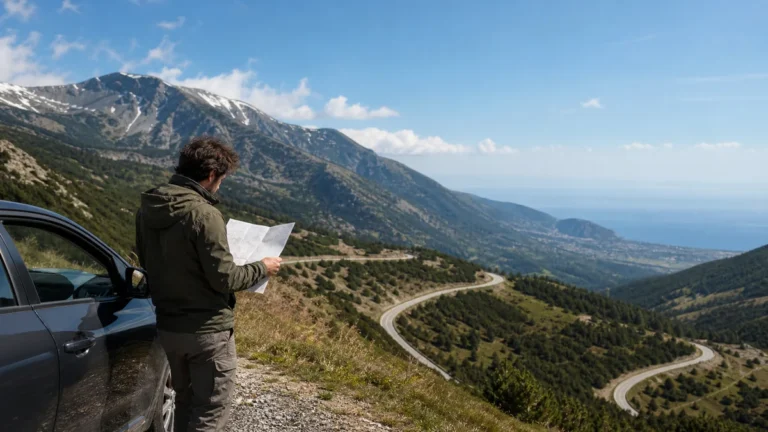
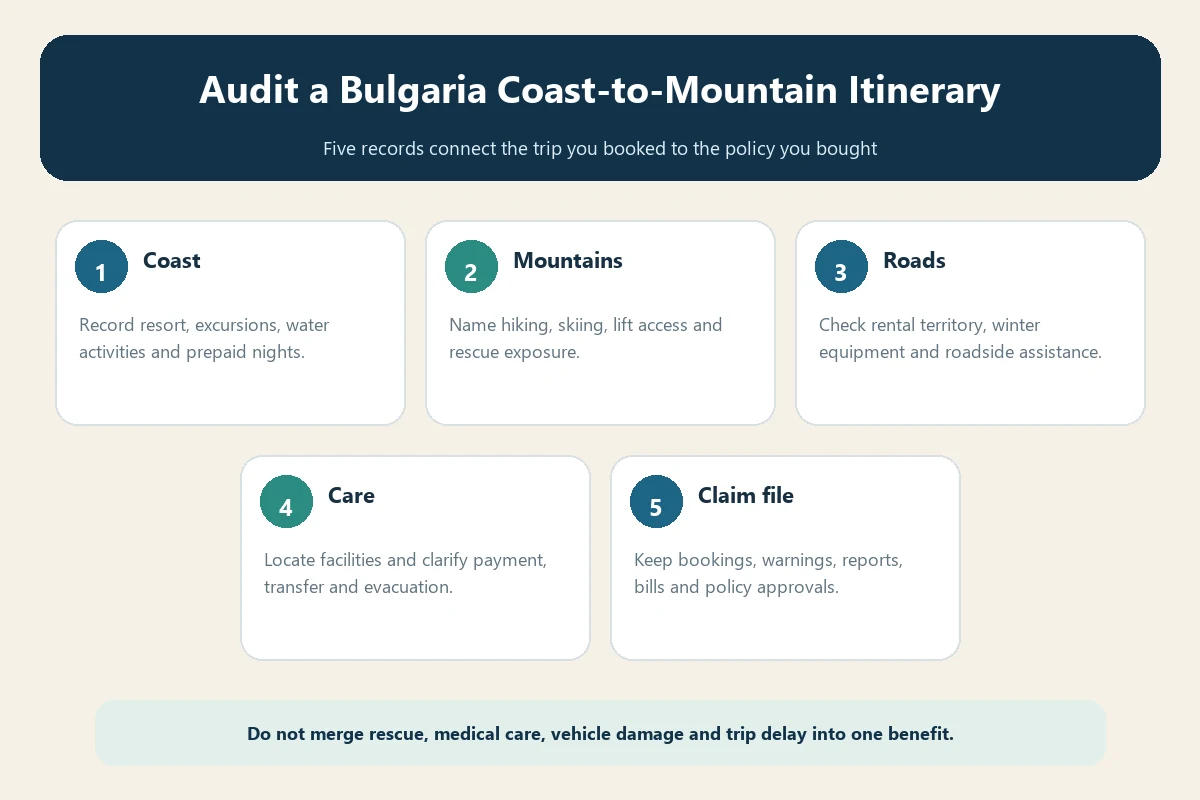
Travel insurance for Bulgaria from USA trips should cover the movement between city, coast and mountains, not just the flight into Sofia. A Black Sea resort stay, a Rila hike, a Bansko ski day and a rental-car journey over secondary roads expose different clauses. The practical task is to identify which loss belongs to medical, rescue, activity, vehicle or trip-disruption coverage.
Key takeaways
- Carry proof of medical insurance and verify that the policy is valid for the full itinerary.
- Confirm mountain search and evacuation separately from hospital treatment.
- Name hiking, skiing, off-piste activity and water sports before buying.
- Keep rental-car, roadside and travel-insurance benefits in separate layers.
- Use carrier, rescue, police and medical records to establish what happened.
Planning information reviewed August 16, 2026. Bulgaria’s entry framework, roads, resort operations, medical practices and policy terms can change. Verify the current official rules and the issued contract before travel.
Give every prepaid dollar a location
Build a day-by-day ledger for the U.S. flights, Sofia accommodation, train or rental car, mountain hotel, lift pass, guide, Black Sea resort and return connection. Write each supplier’s cancellation terms beside the amount at risk. A refundable reservation should not be counted as an insurance loss.
Next, mark each border crossing. Bulgaria has been fully part of the Schengen area since January 1, 2025, after internal land-border checks were lifted under the official Council of the EU decision. That does not eliminate the need for a valid passport, lawful stay or policy territory that includes every neighboring country.
For a Bulgaria–Greece–Romania itinerary, use the multi-country Europe insurance guide to count dates and check geographic definitions.
Cover the full overnight timeline
Use local dates, not only flight numbers, when setting the coverage period. An evening departure from the United States, an overnight connection, an early arrival and a late return can place losses outside a policy bought for hotel nights alone. Include every transit country and the final journey home.
Ask how the plan treats a trip extended by a covered medical event or carrier disruption. Automatic extensions, when offered, usually have conditions and time limits. Keep the original itinerary, changed booking and assistance authorization so the extra days can be explained.
Also update the insured trip cost after adding a resort package, guide or nonrefundable rail ticket. Underinsuring prepaid costs can affect cancellation or interruption calculations even when the medical maximum is unchanged.
Confirm entry proof and broader coverage separately
The U.S. Department of State’s current Bulgaria travel information says visitors must have medical insurance for the duration of the visit. A traveler should verify the specific evidence required for the individual’s nationality, purpose and length of stay.
A certificate prepared for border or visa evidence is only one document. It does not automatically prove that trip cancellation, skiing, mountain rescue, rental-car damage or a chosen clinic is covered. Read the schedule of benefits, definitions, exclusions and endorsements.
The Schengen insurance requirements guide explains how formal medical evidence differs from a complete trip-risk audit.
Separate the mountain response into stages
Imagine an injured hiker who cannot reach the road. Search, technical rescue, ground transport, emergency treatment, transfer to a larger hospital, medical evacuation and repatriation are separate operational steps. A policy may define and limit each step differently.
The Bulgarian Red Cross describes its official Mountain Rescue Service as providing mountain rescue and evacuation and publishing resort-condition information. Before an active day, check current local conditions and operator instructions. In an emergency, use 112 and follow official rescue direction.
Ask whether search and rescue is covered even if no medical treatment follows. Identify the sublimit, altitude or route constraints, activity exclusions and assistance-authorization rule. Then ask who determines the appropriate receiving facility and whether transport home requires medical necessity.
The evacuation and repatriation guide provides a decision map for these stages.
Translate the mountain program accurately
Do not submit “mountain vacation” as the activity description. List marked-trail hiking, guided climbing, downhill skiing, snowboarding, ski touring, off-piste skiing or mountain biking as applicable. Include the route, elevation, season, guide, equipment and whether the operator supplies transport.
| Plan | Coverage question | Document before departure |
|---|---|---|
| Rila or Pirin hike | Are the route, altitude and terrain within the hiking definition? | Official route, forecast and closure check |
| Downhill ski day | Is a winter-sports endorsement required? | Resort, piste status and lift booking |
| Off-piste or touring | Are guide, avalanche and boundary conditions satisfied? | Guide confirmation and safety plan |
| Mountain rescue | What search, extraction or helicopter sublimit applies? | Assistance procedure and emergency contacts |
| Equipment rental | Are rented items included, and what exclusions apply? | Inventory, rental agreement and condition record |
Use the adventure and winter-sports policy audit to find exact-name exclusions and required endorsements.
Design the Black Sea portion for heat and water
At a coastal resort, the insurance questions move toward heat illness, swimming, boat excursions, diving, personal watercraft and prepaid package components. Name every water activity. A policy may distinguish recreational snorkeling from scuba diving, or passenger travel from operating a motorized craft.
Record the dive depth, certification, guide and operator if scuba is planned. Ask whether treatment in a specialist facility and necessary transport are covered. Do not assume a resort’s on-site service is a full hospital or that an activity operator’s waiver supplies medical insurance.
Schedule demanding activities around current heat and marine conditions. The European summer-heat insurance guide explains why prevention, a documented diagnosis and the policy’s covered-cause language all matter.
Prepare for provider payment
Ask the assistance company how it works with Bulgarian public and private facilities. Determine whether direct billing can be arranged, when a traveler may need to pay first, which facilities are eligible and what itemized documents must accompany reimbursement.
Pre-existing-condition wording deserves an early review. Find the look-back period, stability definition and any time-sensitive waiver. Declare medications and conditions accurately; do not rely on a salesperson’s general statement when the contract uses a narrower definition.
The Europe primary medical guide shows how the order of payment, deductible and coordination with U.S. health insurance affect a claim.
Audit secondary roads before renting
The State Department’s Bulgaria information warns about poorly maintained secondary roads, potholes, limited markings or lighting, mountain rockfall and winter ice. It also advises U.S. drivers to carry an international driving permit with their U.S. license. Verify the current legal and rental-company requirements for the actual pickup.
Ask the rental company about permitted roads, winter equipment, border crossings, additional drivers, towing and replacement vehicles. Confirm how a police report must be obtained and whether roadside assistance covers the intended mountain and coastal route.
Travel insurance might address an eligible medical or trip-interruption loss after a collision, but it usually does not replace vehicle liability or collision cover. The Europe road-trip guide keeps those responsibilities distinct.
Match delays to the actual transport contract
A late flight to Sofia, blocked mountain road, missed regional train and canceled resort transfer are different events. Write down who operates each leg and whether it is part of one ticket or a self-connection. Build enough time that the itinerary does not depend on an unrealistic transfer.
For each candidate plan, locate the covered causes, minimum wait, daily allowance, maximum benefit and missed-connection conditions. Carrier refunds, alternate transport and unused prepaid amounts should be documented separately.
The trip delay, interruption and cancellation guide helps classify the remaining eligible loss.
Run a coast-to-mountain comparison
Use one demanding itinerary for every quote: U.S. flights, Sofia nights, a rental car, a winter mountain stay with skiing, a Black Sea resort and a return connection. Ask each insurer to answer these questions in writing:
- Are all dates, transit points and cross-border legs covered?
- Does the medical benefit satisfy the traveler’s proof requirement?
- Are each mountain and water activity named or endorsed?
- What search-and-rescue costs have their own cap?
- Who authorizes hospital transfer, evacuation and repatriation?
- Which road or carrier disruption can trigger a travel benefit?
- What notice deadline and original records are required?
Record the page number for every answer. If the representative cannot point to policy language, treat the question as unresolved.
Create the claim file before the trip
Save the full policy, purchase receipt, benefit schedule, assistance number, itinerary, supplier terms and activity confirmations offline. During an incident, keep the exact location, time, official warnings, assistance case number, rescue or police record and witness details.
For medical claims, request the diagnosis, clinical notes, itemized bill and proof of payment. For disrupted travel, obtain the carrier’s reason, original and replacement itineraries, refund statement and necessary expense receipts. Submit a single consistent timeline.
The travel insurance claim guide explains how to organize that evidence without duplicating reimbursed expenses.
Bottom line
Bulgaria rewards a policy audit that follows the traveler from coast to mountain. Confirm valid medical evidence, distinguish rescue from treatment, name every sport, check secondary-road operations and preserve proof of carrier and provider decisions. A destination label alone cannot substitute for those truly itinerary-specific written answers.
