

Travel insurance for Cyprus from USA trips should begin with a territory map and a separate vehicle-insurance check. A beach stay in the Republic of Cyprus, a rental-car route, a dive booking and travel into the area administered by Turkish Cypriots may fall under different contracts and assistance conditions. One broad statement that “Cyprus is covered” is not precise enough.
Key takeaways
- Ask the insurer to define the covered territory in writing, including any intended crossing.
- Travel insurance does not replace locally valid motor liability or rental-car protection.
- Verify payment, provider access, evacuation and assistance arrangements for each overnight area.
- Name scuba diving, watercraft, hiking and other activities with their real limits.
- Keep crossing, rental, operator, medical and assistance records in one timeline.
Planning information reviewed August 16, 2026. Political conditions, crossing procedures, road rules, provider access and insurance territories can change. Recheck current official advice immediately before travel.
Draw the itinerary before comparing policies
List the arrival airport, every overnight location, rental-car pickup, coastal drive, mountain or village excursion, dive site, ferry or flight and return. If a crossing of the United Nations buffer zone is contemplated, mark the date, crossing point, vehicle and lodging on the same plan.
Then assign every prepaid amount to a supplier: flights, hotel, villa, car, dive operator, boat trip and private transfer. Record the cancellation and refund terms in force when coverage is purchased. Insurance usually considers the eligible unreimbursed loss, not a booking the supplier has already refunded.
If Cyprus is one stop in a wider Mediterranean journey, use the multi-country Europe insurance guide to test all territories and transit days.
Set dates around flights and crossings
Cover the complete journey from U.S. departure through the return home, including overnight connections. If the trip changes after purchase, ask how to add new prepaid costs and extend the policy period. Do not assume that a longer hotel booking automatically changes the insurance certificate.
Keep the first trip-payment date because some optional benefits or pre-existing-condition waivers have an early purchase deadline. Later changes should be reflected in the insured trip cost when the contract requires it.
Make the policy define “Cyprus”
The U.S. Department of State’s official Cyprus country information distinguishes the Republic-controlled area from the area administered by Turkish Cypriots and notes limits on U.S. government assistance in the latter. That practical distinction should be put to the insurer before travel.
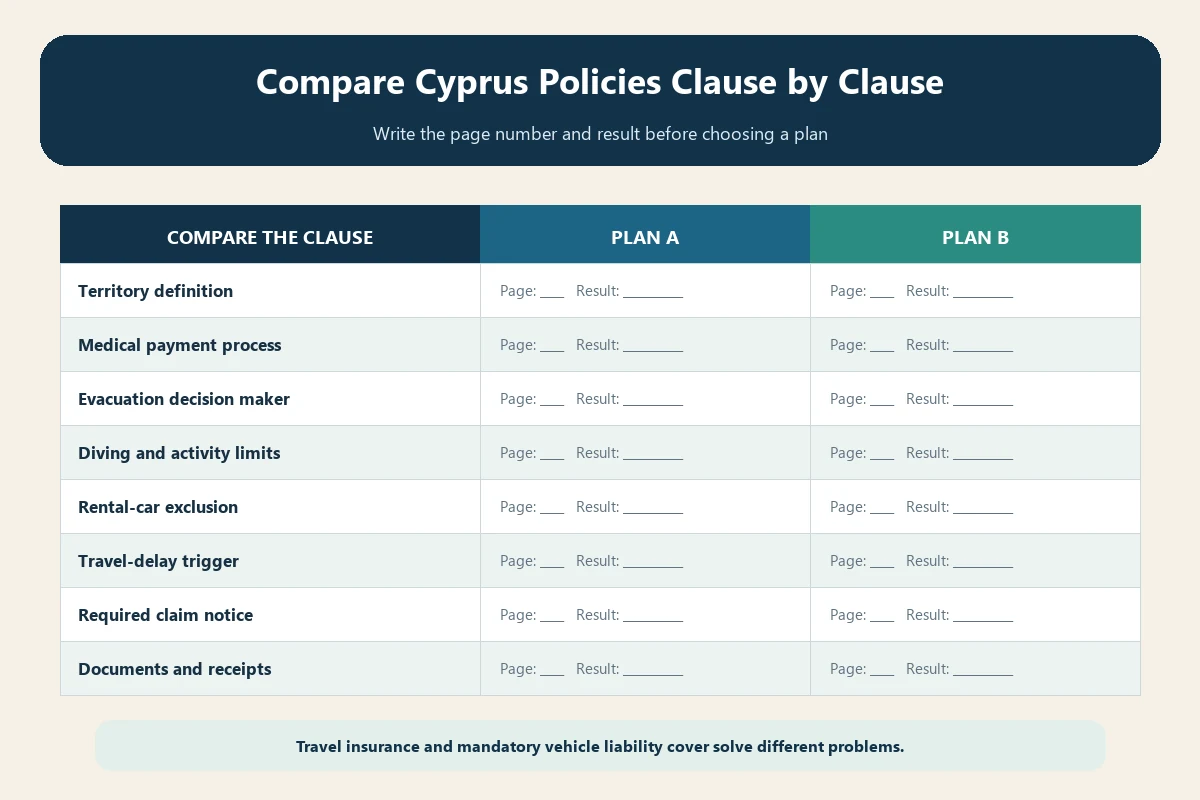
Ask whether the contract covers the Republic of Cyprus only, the entire island, or named geographic areas subject to exclusions. Find language about disputed territories, government warnings, inaccessible providers, sanctions, civil unrest and restricted areas. Request an answer that cites the policy page and endorsement.
Do not infer coverage from a regional label such as “Europe.” The Europe country-exclusions guide provides a territory-verification method for borders and policy exceptions.
Do not use Schengen assumptions for entry
Cyprus is an EU member, but it has not yet joined the full Schengen border-free area as of this review. The European Commission’s 2026 State of Schengen report describes an assessment of Cyprus’s preparedness and further steps rather than completed accession.
Use Cyprus’s current entry rules for the traveler’s passport, purpose and length of stay. Do not count the visit or insurance evidence solely by a Schengen itinerary template. Entry permission and travel-insurance coverage remain separate questions.
Separate travel insurance from vehicle insurance
The State Department states that motor insurance bought in the Republic-controlled area is not valid in the area administered by Turkish Cypriots and that separate car insurance is required before driving north across the buffer zone. Confirm the current crossing and rental-company procedure before committing to the route.
Cyprus’s official road-safety material reminds visitors that traffic drives on the left and that valid insurance for injuries and damage is required. Review the government publication On the Cyprus Roads before pickup.
| Possible expense | Likely first contract to check | Evidence |
|---|---|---|
| Damage to the rental vehicle | Rental waiver, collision cover or card benefit | Agreement, photos, repair and police record |
| Liability to another road user | Locally valid motor liability policy | Certificate, incident report and insurer contact |
| Traveler’s emergency treatment | Travel medical benefit | Diagnosis, itemized bill and payment proof |
| Unused hotel after a covered injury | Trip interruption benefit | Medical restriction and supplier refund statement |
| Towing or replacement car | Rental or roadside-assistance contract | Dispatch record and rental-company authorization |
Do not assume one claim form solves all five. The Europe road-trip insurance guide shows how to coordinate the contracts without confusing their responsibilities.
Test medical payment in each overnight area
The State Department reports that travelers may be expected to pay for care and recommends medical-evacuation coverage. Ask the insurer which providers it can contact, whether direct billing is realistic, how reimbursement works and what happens when assistance networks are limited.
Carry a reasonable payment method and the assistance number offline. For an emergency, follow official local instructions and protect life first. When practical, open an assistance case before a non-emergency transfer or major procedure so that authorization and destination decisions are documented.
Ask who determines medical necessity, who selects the receiving facility and which benefit pays for ground ambulance, inter-hospital transport, air evacuation and repatriation. The evacuation and repatriation guide explains these separate stages even when the destination is outside full Schengen participation.
Travelers with ongoing conditions should also inspect the look-back period, stability definition and waiver deadline. The primary medical coverage guide clarifies payment order and coordination with U.S. health insurance.
Audit diving and coastal activities by name
Cyprus’s official tourism portal advises recreational divers to arrange travel and dive insurance in its responsible-diving guidance. That is a prompt to compare precise terms, not evidence that any general policy covers every dive.
Provide the insurer with certification level, maximum depth, guided or independent status, wreck or cave involvement, breathing equipment and operator. Ask whether hyperbaric treatment, sea rescue and necessary transport are covered and whether a dive-specific policy must respond first.
List snorkeling, personal watercraft, sailing, parasailing and cliff activities separately. The adventure-activity exclusion guide offers an exact-name worksheet that also applies to warm-weather sports.
Build a heat and medication plan
Summer heat can change the safe timing of coastal walks, archaeology visits and inland drives. Check current official warnings, carry water, protect medication from excessive temperature and move demanding activity away from the hottest hours.
Insurance responds to covered losses, not to heat in the abstract. If illness occurs, seek appropriate care and obtain a diagnosis, treatment record and written restriction on travel when relevant. Preserve supplier cancellation terms and refunds for any missed booking.
The summer heat travel insurance guide separates prevention, medical evidence and covered-cause wording.
Plan transport without a rail safety net
Cyprus has no passenger rail network, and rural public-transport options can be limited. A traveler may depend on a rental car, private transfer, intercity bus, domestic road connection or flight. Record the last practical alternative before a major departure.
For separate tickets, leave a generous buffer. Find the policy’s definitions of common carrier, travel supplier, missed connection and reasonable alternative. A taxi or replacement flight is not automatically reimbursable simply because it seems convenient.
If an island ferry or regional sea crossing forms part of a broader itinerary, the Europe ferry travel guide explains carrier evidence, port delays and unused prepaid costs.
Compare policies with two route scenarios
First test a simple Republic of Cyprus itinerary with a rental car, beach hotel and guided recreational dive. Then add an intended crossing into the area administered by Turkish Cypriots, a northern overnight and vehicle use. Ask every insurer the same questions for both versions:
- How does the policy define the covered territory?
- Does a government advisory or crossing change benefits?
- Can assistance arrange medical payment in every overnight area?
- Who authorizes evacuation, and to which appropriate facility?
- Are the exact diving and water activities covered?
- What vehicle losses are expressly excluded from travel insurance?
- Which delay and interruption triggers fit the booked transport?
Save the written response, policy version and endorsement. If the territory answer is ambiguous, change the plan or choose a contract that resolves the ambiguity before payment.
Build a cross-contract claim file
Keep the travel policy, rental agreement, locally valid insurance certificate, cross-border permission, operator bookings and route offline. During an event, note the exact location and governing area, time, assistance calls and instructions. Obtain the required police, carrier, medical or activity-operator report.
File each expense with the appropriate contract and disclose other reimbursements. Retain itemized bills, original receipts, proof of payment and refund statements. A clear chronology is especially important when medical, vehicle and trip-interruption claims arise from one event.
Use the travel insurance claim guide to assemble the timeline and avoid duplicate recovery.
Bottom line
The strongest Cyprus plan answers “where?” before “how much?” Define the policy territory, secure locally valid vehicle insurance, test medical and evacuation logistics, name every activity and document each crossing and provider decision. Those checks turn a general Europe policy into an itinerary-specific protection plan.
