

Travel insurance for Turkey from USA trips should be tested against the exact region, provider and disruption—not purchased from a country label alone. Istanbul, the Aegean coast, Cappadocia and eastern Türkiye create different medical, transport, activity and advisory questions. A useful comparison makes those differences visible before the first nonrefundable payment.
Key takeaways
- Verify the territory and every advisory-related exclusion for the actual route.
- Prepare for private-hospital payment and patient-funded transfers between facilities.
- Ask how earthquakes, wildfire, flood and known-event timing affect each benefit.
- Name ballooning, skiing, diving, hiking and other activities individually.
- Keep official notices, assistance approvals, medical records, refunds and receipts.
Planning information reviewed August 16, 2026. Türkiye’s advisories, natural-hazard conditions, entry procedures, provider practices and policy wording can change. Verify current official information for every travel date and region.
Turn the Türkiye itinerary into regions
List every airport, overnight city, road transfer, cruise port, tour pickup and activity. Mark the provinces rather than writing only “Turkey.” Add the transit countries and any separate tickets. This produces the geographic test that the policy needs to pass.
The U.S. Department of State’s current Türkiye travel information places the country at Level 2 and identifies a Level 4 zone within 10 kilometers of the Syrian and Iraqi borders. It also describes restrictions affecting southeastern travel. The advisory can change, so capture the version used when planning and recheck immediately before departure.
Do not assume a nationwide maximum remains available in every area. Use the country and advisory exclusions guide to locate territorial, war, civil-unrest, terrorism and government-warning language.
Ask how an advisory changes each benefit
An advisory does not automatically answer whether a claim is covered. The policy may address destination warnings, foreseeable events, armed conflict, terrorism, evacuation or cancellation in separate sections. Ask what happens if an advisory level rises before departure, after arrival or for a region not on the booked route.
Check whether cancellation requires a specifically listed covered reason. “I no longer want to travel” is not the same as a covered event. If optional cancel-for-any-reason coverage is considered, verify its early purchase deadline, insured-cost requirement, cancellation cutoff and reimbursement percentage.
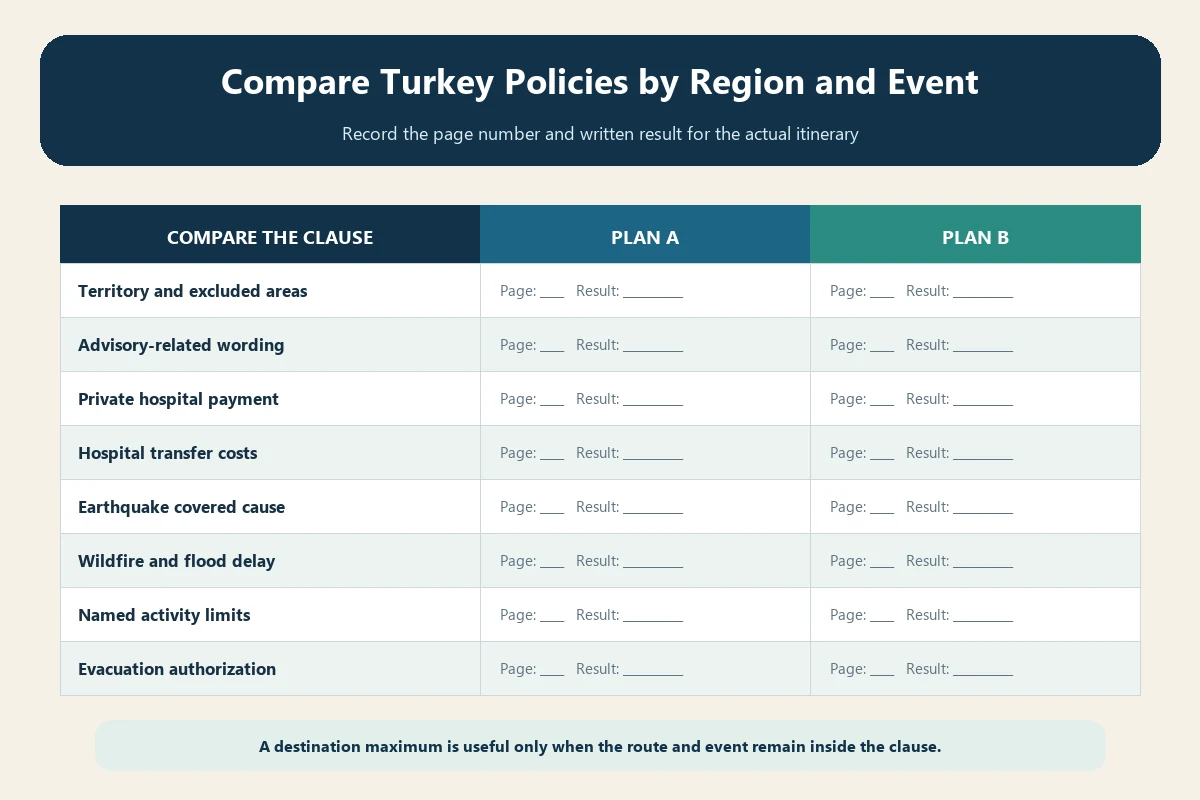
Run the same itinerary through the policy comparison worksheet so that all insurers answer the identical regional scenario.
Plan for hospital payment and choice
The State Department reports that modern private hospitals are available in major cities, while care in smaller cities may be less capable. It also warns that many U.S. plans are not accepted and that patients must cover costs for transfer to or between hospitals.
Ask the assistance company which Turkish facilities it can coordinate with, whether direct billing can be arranged and when the traveler may need to pay first. Confirm the deductible, eligible-provider definition and required itemized documentation. Some hotels and resorts may have exclusive provider arrangements, which can limit the first option presented to a guest.
Türkiye’s official health regulation for international patients states that temporary visitors may use public, university or private facilities for illness and emergencies and describes charging for tourist-health services. Review the Ministry of Health’s English tourist-health regulation alongside the policy rather than assuming emergency access means free care.
The primary medical coverage guide explains the difference between first-payer claims handling and guaranteed cashless service.
Separate local treatment, transfer and return home
A traveler can receive emergency stabilization, then need ground transport to another Turkish hospital, air movement to a regional center or later repatriation to the United States. Each step can have a different medical-necessity standard and authorization rule.
Ask who chooses the receiving facility, what “nearest appropriate” means, whether a companion is included and which benefit pays. Dial 112 for emergency medical services. Protect life first, then contact assistance as soon as reasonably possible and preserve the case number.
The evacuation and repatriation guide provides the same transport-chain analysis even though Türkiye is not a Schengen member.
Audit earthquakes as both safety and contract events
Türkiye experiences earthquakes across the country. AFAD’s official earthquake preparedness guidance advises drop-cover-hold behavior, leaving safely after shaking, avoiding coastal tsunami exposure and keeping essential documents in an emergency kit.
Insurance questions begin with timing. Find the date and time when the insurer treats an earthquake as known or foreseeable. Ask which benefit might respond to a documented airport closure, destroyed prepaid lodging, medical injury, mandatory evacuation or trip interruption. Property damage alone does not guarantee a travel-policy payment.
Keep official closure notices, supplier cancellation terms, refund statements and evidence that the booked service became unusable. A traveler who voluntarily changes an available itinerary may receive a different result from one whose carrier or lodging cancels.
Distinguish wildfire, flood and heat disruption
The State Department also identifies severe wildfires, floods, landslides, storms and heavy snowfall as Turkish hazards. Determine whether weather, natural disaster, mandatory evacuation and common-carrier interruption are defined separately. Note any minimum delay and per-day cap.
During hot, dry conditions, follow official alerts and operator restrictions. Prevention does not create coverage, but ignoring a closure can complicate both safety and the factual record. The summer heat insurance guide separates medical illness from nonmedical discomfort and supplier decisions.
Name every booked activity
| Experience | Clause to find | Evidence to retain |
|---|---|---|
| Cappadocia balloon flight | Aviation, commercial operator and activity exclusion | Operator booking, cancellation and refund |
| Coastal diving | Certification, depth, equipment and rescue terms | Certification, dive log and operator report |
| Mountain hiking | Altitude, marked-route and rescue limits | Route, forecast, closure and coordinates |
| Winter sports | Piste, off-piste and rider requirements | Lift ticket, patrol report and location |
| Boat excursion | Passenger, private-vessel and weather wording | Ticket, manifest and carrier notice |
Use the activity-exclusion audit to get a page-numbered answer for each pursuit.
Build a defensible road plan
The State Department says western and southwestern tourist highways are generally well maintained but other road conditions vary. It cautions about night driving, checkpoints, rural animals and winter conditions. Türkiye’s General Directorate of Highways provides official road and closure information.
Confirm rental territory, additional drivers, license requirements, tolls, winter equipment, roadside assistance, towing and replacement-car rules. Travel insurance does not replace motor liability, collision protection or the rental contract.
The Europe road-trip guide keeps vehicle loss, medical expense and trip interruption in separate layers.
Match transport disruption to the right trigger
A delayed transatlantic flight, canceled domestic connection, closed road and canceled tour have different operators. Record whether tickets are connected or self-booked. Request the carrier’s written cause, rebooking, meals, lodging and refund before calculating the remaining loss.
Locate trip delay, missed connection, cancellation and interruption separately. The benefit comparison guide shows which dates and expenses belong in each file.
Prepare one regional comparison test
Give every insurer the same case: U.S. flights, Istanbul nights, a domestic flight, Cappadocia balloon booking, rental-car coast segment and nonrefundable lodging. Add a hypothetical earthquake closure and a medical transfer from a smaller city.
- Is each province and transit point inside the territory?
- How do current and changed advisories affect benefits?
- Can private-hospital direct billing be arranged?
- Who authorizes inter-hospital transfer and evacuation?
- When does a natural disaster become a known event?
- Are all named activities inside the policy?
- What documents and notice deadlines apply?
Keep the issued policy, endorsement and written answers. The claim filing guide explains how to assemble assistance records, provider bills, carrier notices and refunds into one chronology.
Set a purchase and recheck calendar
Insurance timing starts before the flight. Record the first trip payment, the date each booking becomes nonrefundable and the final payment date. Compare those dates with any deadline for a pre-existing-condition waiver, cancel-for-any-reason option or other time-sensitive feature. If the itinerary changes, ask whether the added cost must be reported and insured within a new deadline.
Create three review points: when the policy is purchased, shortly before the last cancellation deadline and again before departure. At each review, save the itinerary, current advisory, carrier schedule and supplier terms. Check whether an earthquake, wildfire or other event has already been publicly identified, because known-event language can affect later purchases or newly added bookings. Do not assume that buying a second policy after an event will turn an existing risk into a covered one.
During the final review, confirm every traveler’s name and date of birth, the insured trip cost, departure and return dates, assistance number and destination territory. Download the certificate and full wording for offline access. Give a trusted contact the assistance details, but avoid sharing unnecessary medical or passport information. A dated calendar makes it easier to prove what was known, what was purchased and which version of the route the insurer was asked to cover.
Repeat the review after any added domestic flight, tour or nonrefundable hotel. Update the insured amount only through the insurer’s stated process and retain its confirmation.
Bottom line
A strong Türkiye policy is route-specific and event-specific. Verify regional exclusions, private-care payment, medical transfer, natural-disaster timing, road operations and every activity. Those written answers matter more than a generic destination recommendation or a large untested headline limit.
