
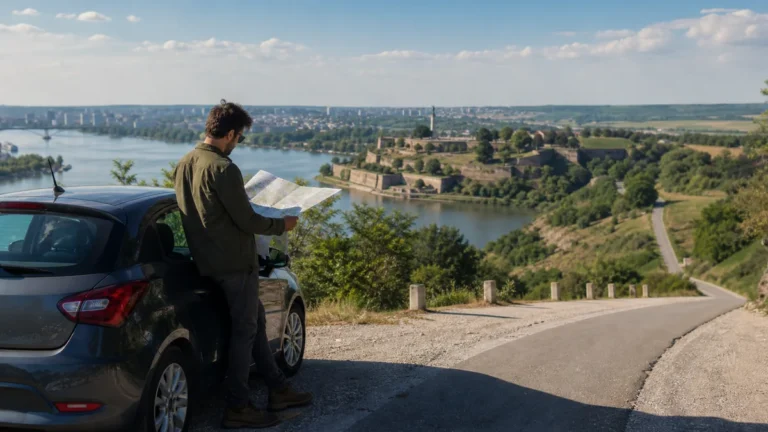
Travel insurance for Serbia from USA trips should connect entry evidence, medical payment and the full Balkan road route. Belgrade city care, a winter drive through southern Serbia and a border crossing into a neighboring country do not create the same logistics. The policy audit should follow the traveler across each of those steps.
Key takeaways
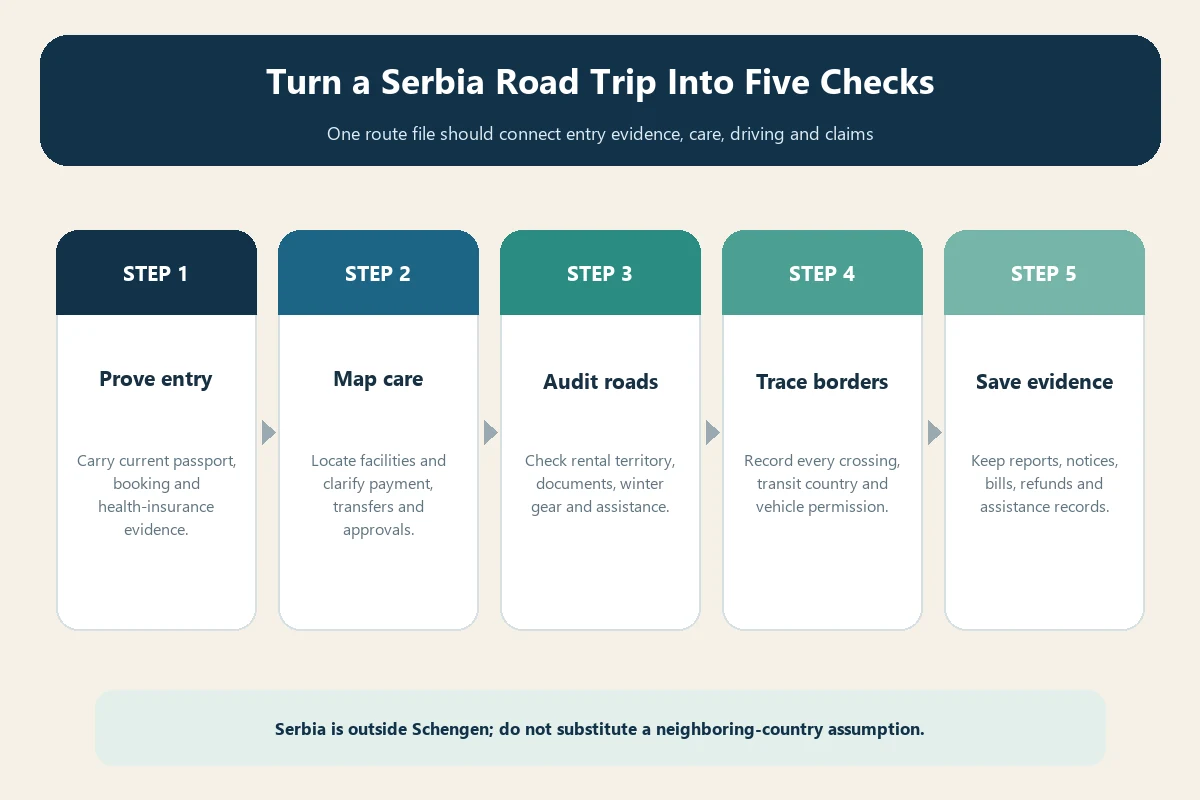
- Carry health-insurance evidence that matches Serbia’s current official entry guidance.
- Plan for direct payment and ask how provider and hospital transfers are arranged.
- Do not apply Schengen territory or border assumptions to Serbia.
- Verify rental permission, driver documents, winter equipment and every crossing.
- Save road notices, border records, medical files, carrier notices and receipts.
Planning information reviewed August 16, 2026. Serbian entry rules, border procedures, road conditions, health practices and policy wording can change. Verify official information for the passport and route immediately before travel.
Build one Serbia evidence file
Start with the U.S. departure, transit airport, Belgrade accommodation, intercity rail or bus, rental-car pickup, rural overnight, border crossing and return. Put the supplier, refund rule and prepaid amount beside every item. Add the first payment date because some optional benefits have early purchase deadlines.
Serbia is an EU candidate country, not an EU member or a Schengen state. The European Commission’s current Serbia enlargement page confirms candidate status. Use Serbian entry procedures rather than treating a neighboring Schengen stamp or policy certificate as a substitute.
For a route through Hungary, Croatia, Bosnia and Herzegovina, Montenegro, North Macedonia or Bulgaria, use the multi-country Europe guide to test every policy territory and transit date.
Use Serbia’s official insurance guidance
Serbia’s Ministry of Foreign Affairs says health insurance is recommended for the full stay with medical-cost coverage of at least EUR 20,000. Its official general entry requirements also state that border authorities may ask for proof of paid health insurance and a policy covering the period of stay, along with other evidence of purpose and accommodation.
Check the rule again for the traveler’s passport, visa status and length of stay. Carry the policy certificate offline and ensure that the country, dates, insured name and medical limit agree with the itinerary.
Entry evidence does not prove that a rental collision, canceled hotel, high-risk activity or evacuation is covered. The full contract controls those questions. Use the country-exclusion checklist to inspect Serbia and every border region separately.
Plan medical payment before choosing a facility
The U.S. Department of State’s official Serbia country information advises travelers to carry overseas medical coverage and notes that the U.S. government does not pay medical bills. Ask the assistance company whether it has a Serbian provider network, when it can arrange direct billing and when the traveler must pay first.
Find the deductible, coinsurance, eligible-provider rule and process for itemized reimbursement. Carry reasonable payment capacity without assuming that a digital insurance card will be accepted at the point of care.
If the plan describes itself as primary, verify what that changes. The primary medical coverage guide distinguishes first-payer processing from cashless treatment.
Ask who controls a hospital transfer
A rural clinic may stabilize a patient but not provide the required specialty. Ask who decides that transfer is medically necessary, whether ground ambulance is covered, which hospital qualifies as appropriate and when movement outside Serbia becomes an evacuation.
Local ambulance is 194, while 112 can coordinate emergencies. Protect life first. Contact the policy’s assistance service as soon as reasonably possible and record the case number, instructions and receiving facility.
Do not combine inter-hospital transfer, air ambulance and return to the United States. The evacuation and repatriation guide provides a clause-by-clause transport audit for non-Schengen routes too.
Convert the road trip into contract questions
The State Department warns that Serbian roads are not always well maintained, particularly in rural and southern areas, and calls for extra winter caution. It identifies a U.S. license plus an international driving permit as the current short-stay driving combination. Confirm this again with the rental company and official authorities.
Serbia’s Automobile and Motorcycle Association publishes a live road-condition and border map covering closures, works, rockfall, slippery roads, winter equipment and crossing waits. Save the relevant notice with date and location when it affects the itinerary.
| Road-trip layer | Contract to check first | Record to keep |
|---|---|---|
| Third-party injury or damage | Locally valid motor liability | Certificate and police report |
| Damage to rental vehicle | Rental waiver, card or collision plan | Agreement, photos and repair assessment |
| Traveler’s medical care | Travel medical benefit | Diagnosis, bill and payment proof |
| Towing or replacement car | Rental roadside assistance | Dispatch and rental authorization |
| Unused prepaid lodging | Trip interruption, if a covered cause applies | Medical or incident proof and refund statement |
The Europe road-trip insurance guide prevents those layers from being mistaken for one broad benefit.
Audit every border crossing
Get written permission before taking a rental car outside Serbia. Confirm the allowed countries, locally valid liability documents, roadside territory, vehicle-return rules and any crossing fee. A green card or rental certificate may solve a vehicle-document issue without expanding the travel policy.
Routes involving Kosovo require special attention to entry sequence. The State Department’s Serbia and Kosovo pages explain that Serbian authorities can refuse a land entry from Kosovo when the traveler did not first enter Kosovo from Serbia. Verify the current route with official border authorities; do not design a circuit from an old forum post.
Record the actual crossing point and operating hours. Border queues can cause delay, but a predictable wait is not automatically a covered event. The policy may require a named cause and minimum duration.
Prepare for rail and bus disruption
Belgrade and other cities have public transport, while intercity rail and bus services connect many destinations. Treat each ticket by its operator and refund rules. If a service is canceled, obtain a written notice, rerouting offer and refund statement before claiming extra costs.
Separate tickets increase missed-connection exposure. The European train insurance guide shows how to document rail responsibility, and the delay and interruption guide helps classify the remaining loss.
Name activities beyond ordinary touring
List skiing, rafting, climbing, cycling, hiking and river excursions by name. Give the insurer the location, season, operator, guide, equipment and difficulty. Ask whether a motorized or competitive version is treated differently and whether search or rescue has a separate cap.
A broad “adventure covered” statement should be replaced with page references. Preserve the operator’s booking description and incident procedure as evidence of the activity actually purchased.
Compare policies with a border-road scenario
Use one case for every quote: U.S. flights, Belgrade nights, an intercity train, rental-car travel through rural Serbia and a crossing into Montenegro. Add a winter road closure and a medical transfer from outside a major city.
- Does the certificate satisfy the current Serbian entry recommendation?
- Are all countries, borders and dates inside the territory?
- How are direct payment and reimbursement handled?
- Who authorizes hospital transfer and evacuation?
- What rental and roadside losses are excluded?
- Which closure or carrier event triggers a travel benefit?
- What notice deadline and original evidence are required?
Save the policy version and the page that supports each result. The policy comparison guide provides a consistent scoring framework.
Assemble the claim chronology
Carry the insurance certificate, assistance number, itinerary, rental agreement, border documents and medical summary offline. During an event, record the location, time, AMSS notice, border message, assistance instruction and provider contact.
Request itemized medical bills, proof of payment, police or carrier reports, original and replacement tickets and supplier refunds. The claim filing guide turns those records into a clear timeline and avoids claiming an expense already reimbursed elsewhere.
Plan winter and rural alternatives
A road plan that works in central Belgrade may fail on a snowy rural segment. Before a winter departure, list the sections where a closure would trap the itinerary between prepaid nights. Record an alternative main-road route, a safe stopping point and the last realistic time to turn back. Verify whether the rental supplies the legally and contractually required tires, chains or other equipment; a photographed item in the trunk is stronger evidence than a verbal promise.
For rural overnights, store the accommodation’s coordinates, the nearest open fuel station and two medical options. Ask the host how emergency access works in severe weather, but confirm important details through current official notices. If the route changes, preserve the road alert and the time of the decision. This helps distinguish a necessary response to a documented closure from a voluntary detour.
Finally, test the financial result. A closed road may produce extra lodging, a missed border slot or an unused booking, yet each expense still needs a covered cause, proof of payment and any required insurer notice. Build safety margin into the schedule instead of treating insurance as permission to keep a fragile connection.
Bottom line
A Serbia plan should prove more than a medical limit. It should match official entry guidance, explain provider payment and transfer decisions, cover every country on the route and coordinate with vehicle and carrier contracts. Those details make the policy usable on a real Balkan road trip.
