
Travel insurance for Mexico is worth buying because U.S. health plans, Medicare and Medicaid generally do not pay for care there, and many Mexican hospitals require payment before treatment or release. Mexico is a foreign destination under a U.S. policy, not an extension of domestic coverage. Test any plan against the booked state, the private-hospital payment pathway, hurricane season on the booked coast and every road or water activity. A resort stay, a border drive and an emergency transfer raise different contract questions, so compare the actual route before treating Mexico as one uniform destination.
Key facts
- Medicare and Medicaid generally do not pay for care in Mexico, and many Mexican hospitals do not accept U.S. insurance.
- The State Department warns that Mexican providers usually require payment before care or before releasing a patient.
- The Atlantic hurricane season runs June 1 to November 30; the eastern Pacific season runs May 15 to November 30 (NHC).
- CDC advises reviewing your health plan and considering travel health and medical evacuation insurance for Mexico.
- Dial 911 for emergencies in Mexico; 078 reaches Ángeles Verdes for mechanical help and tourist information on federal highways.
- Once a storm is named or foreseeable under the contract, newly purchased coverage may not respond to that event.
Key takeaways
- Check advisory and territory wording for every Mexican state on the itinerary.
- Prepare for private-hospital deposits, high charges and limited direct billing.
- Separate ambulance choice, local transfer, medical evacuation and return home.
- Audit hurricane timing, rental-car contracts and every water or adventure activity.
- Keep assistance records, itemized bills, official notices, reports and refunds.
Planning information reviewed August 16, 2026. Mexico’s advisories, health-provider practices, hurricane conditions, roads and policy wording can change. Verify current official information for each state and travel date.
Build the Mexico policy test by state
List every arrival airport, state, resort, road, ferry, excursion, border crossing and separately booked connection. Record the supplier, refund rule and prepaid amount. Add the first trip payment because waivers and optional benefits may have early purchase deadlines.
The U.S. Department of State’s current Mexico travel information applies different advisory levels and restrictions by state and area. Save the version used for planning and recheck before departure. Do not assume that a country-wide policy maximum overrides a territorial or government-warning exclusion.
Verify what the U.S. health plan does in Mexico
Ask the U.S. insurer whether care in Mexico is covered, which providers are recognized, what authorization is required and whether payment is direct or reimbursed later. Medicare and Medicaid generally do not pay for care in Mexico, and many Mexican hospitals do not accept U.S. insurance.
The health insurance abroad guide helps identify network, claim-form, authorization and balance-billing gaps. Obtain the answer for the specific plan rather than relying on a card logo or employer summary.
If a travel policy is described as primary, check what that means for claim order. The primary versus secondary medical guide explains why first-payer processing still does not guarantee admission without payment.
Plan for private-hospital deposits and billing
The State Department warns that Mexican providers usually require payment before care or before releasing a patient. It also reports that private hospitals can charge unexpectedly high prices, and some resorts have exclusive arrangements with providers or ambulances that limit the first options presented.
Before treatment when circumstances allow, ask for the provider name, deposit, proposed procedure and estimated charges. Contact assistance and record the case number. In an emergency, protect life first; documentation follows when reasonably possible.
Ask whether the assistance company can issue a guarantee of payment, negotiate billing or only guide a later reimbursement claim. The assistance line versus claims guide separates real-time coordination from the later coverage decision.
Map ambulance, transfer and evacuation
Dial 911 for emergencies in Mexico. Identify which ambulance serves the resort or remote stop and whether the property has a provider agreement. Ask the insurer what happens if that ambulance transports to a facility outside its coordination network.
A patient may need movement from a clinic to a better-equipped Mexican hospital, an air transfer to a regional center or later transport to the United States. Each step can use different medical-necessity and authorization language. A high evacuation limit does not prove that the traveler chooses the destination.
The remote medical evacuation guide provides a receiving-facility, decision-authority and transport-document checklist.
Distinguish vacation care from medical tourism
Elective dental, cosmetic, bariatric or other planned treatment is not an unexpected vacation illness. Policies often exclude complications from planned procedures or travel undertaken to obtain care. Read that wording before buying a general leisure plan.
The State Department reports serious complications associated with elective surgery in Mexico and recommends verifying provider credentials, facilities, follow-up and legal options. A complication after returning to the United States may involve a different provider and claim pathway.
Disclose the real purpose of travel. Ask for written confirmation about complications, follow-up, medical evacuation and trip interruption. Do not describe a planned procedure as an unexpected emergency.
Audit hurricane timing before buying
Tropical storm and hurricane season affects Mexico’s Atlantic, Caribbean and Pacific coasts. Review the U.S. National Hurricane Center’s official hurricane preparedness guidance and current advisories for the booked coast.
Insurance timing is critical. Once a storm is named or otherwise becomes foreseeable under the contract, newly purchased coverage may not respond to that event. Find the exact known-event wording, purchase date, destination trigger and covered reasons for cancellation, interruption or delay.
The weather-delay insurance guide helps compare carrier cancellation, airport closure, mandatory evacuation and ordinary rain without treating them as the same trigger.
Calculate the remaining hurricane loss
A resort evacuation, canceled airline seat and shortened excursion belong to different suppliers. Request each refund or replacement first. Preserve the official warning, evacuation order, carrier notice, resort decision and refund statement.
Check whether the policy requires a minimum delay, a destination to be uninhabitable or a mandatory evacuation. Note any per-day cap and the definition of reasonable extra expense. A voluntary early departure can produce a different result from an official closure.
Use the delay, interruption and cancellation guide to place expenses on the correct travel dates.
Separate Mexico auto, road and activity coverage from travel insurance
Confirm locally valid motor liability, collision protection, theft terms, additional drivers, permitted roads, towing and replacement-car procedures. A U.S. auto policy or credit-card benefit may not satisfy Mexican legal or rental requirements. Get written answers for the actual vehicle.
| Road-trip expense | Contract to inspect first | Evidence |
|---|---|---|
| Third-party injury or damage | Mexican motor liability | Policy certificate and police report |
| Rental-car damage or theft | Rental waiver or collision plan | Agreement, photos and assessment |
| Towing or breakdown | Rental roadside assistance | Location, dispatch and authorization |
| Traveler medical treatment | Travel medical benefit | Diagnosis, itemized bill and payment |
| Unused prepaid stay | Trip interruption if a covered cause applies | Incident proof and refund statement |
The rental car abroad guide shows where each protection layer ends.
Use official road assistance without assuming coverage
Mexico’s tourism ministry says travelers can call 078 for Ángeles Verdes tourist information and mechanical help on covered federal routes. Its official 078 road-assistance page describes minor mechanical support, route guidance and emergency referral.
Save the rental company’s number, 078 and 911. Record road number, kilometer marker and coordinates. Government roadside help does not replace the rental agreement, motor insurance or a travel-policy benefit, and service reach or hours should be checked for the route.
Name water and adventure activities
Snorkeling, recreational diving, surfing, sport fishing, cenote diving, ziplining, ATV riding and volcano hiking can have different exclusions. Ask about certification, depth, operator, protective equipment, off-road use, altitude and search-and-rescue limits.
The adventure-activity exclusion guide turns a marketing label into an exact-name and page-number test. Keep the booking description, waiver, operator report and location.
A covered activity does not prove that rented equipment, a privately operated vessel or vehicle liability is insured. Match each loss to its own contract.
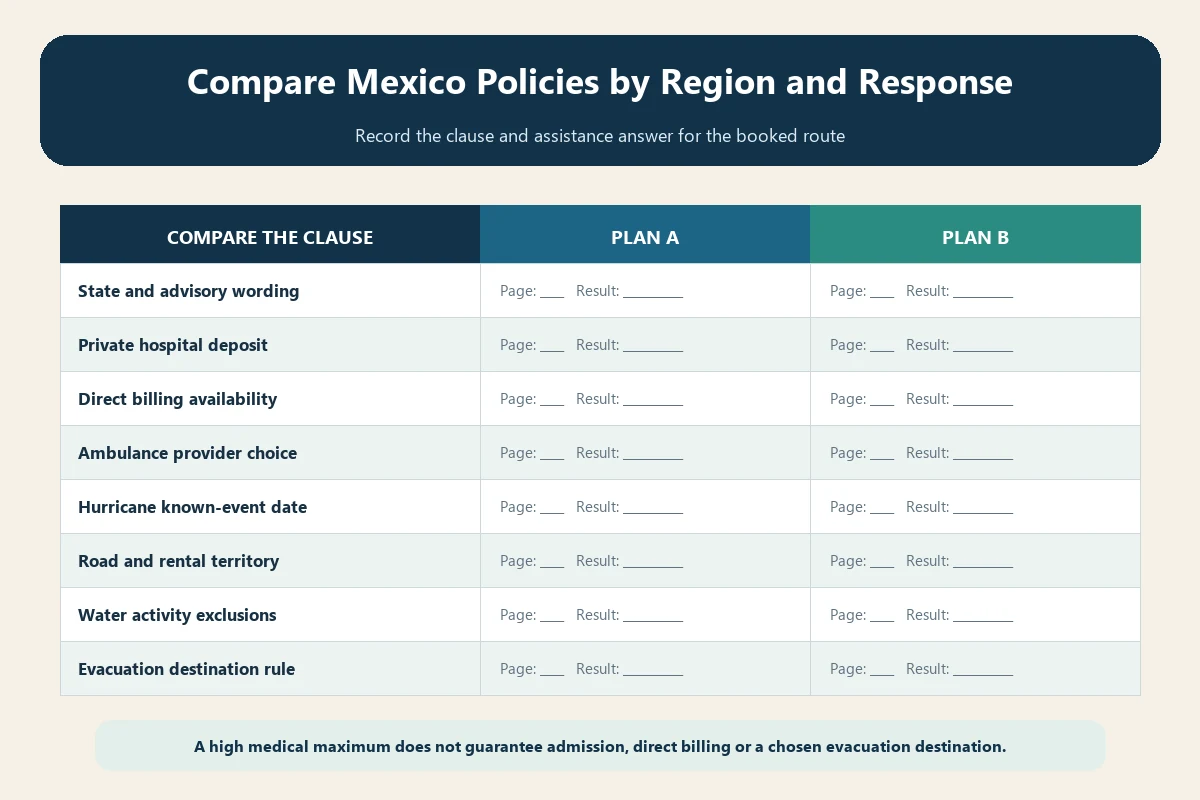
Compare Mexico policies with one scenario and one claim record
Give every insurer the same case: U.S. flights, resort nights, a rental-car segment, two states, a boat activity and a nonrefundable tour. Add a named hurricane, a private-hospital deposit and an authorized transfer toward the U.S. border.
- Are every state, road and activity inside the policy territory?
- How does the current advisory affect each benefit?
- Can assistance arrange hospital payment at the booked destination?
- Who selects the receiving facility and evacuation endpoint?
- When does a hurricane become a known event?
- Which vehicle expenses require Mexican motor coverage?
- What notice deadlines and original records apply?
Require policy page references and save the issued contract. A representative’s broad assurance cannot override an exclusion.
Build a bilingual claim record
Keep the policy, assistance number, itinerary, medical summary, rental documents and emergency contacts offline. During an incident, record names, times, case numbers and instructions. Request medical and operator records before departure when possible.
Preserve the original-language record and obtain a translation only when the insurer requests one. Keep diagnosis, itemized charges, proof of payment, police or ambulance report, carrier notices, refunds and replacement receipts. The claim filing guide organizes them into a defensible chronology.
Prepare for a hospital billing dispute
Before leaving a facility, request an itemized statement, diagnosis, procedure record, payment receipt and the provider’s contact details. Compare the statement with the estimate and note any amount still disputed. Do not sign a document that the traveler does not understand without asking for an explanation or translation.
Send the records to assistance promptly and follow the policy’s claim instructions. Keep written evidence of any guarantee of payment, negotiated amount or provider request. A billing complaint and an insurance claim are different processes: the insurer may decide whether an expense is eligible, while the provider controls its invoice. Preserve both timelines without promising that one will automatically resolve the other.
Bottom line
The strongest Mexico plan is state-specific, provider-specific and season-specific. Verify hospital deposits, assistance capability, evacuation authority, hurricane timing, road contracts and every activity. Those operational answers matter more than a generic recommendation or an untested maximum.
Sources and further reading
- Mexico – Traveler view | Travelers' Health | CDC — CDC advises reviewing your health insurance plan and considering travel health and medical evacuation insurance; emergency care may not meet U.S. standards and trauma centers are uncommon outside urban areas.
- Tropical Cyclone Climatology — The Atlantic hurricane season runs from June 1 to November 30 and the eastern Pacific hurricane season runs from May 15 to November 30.