
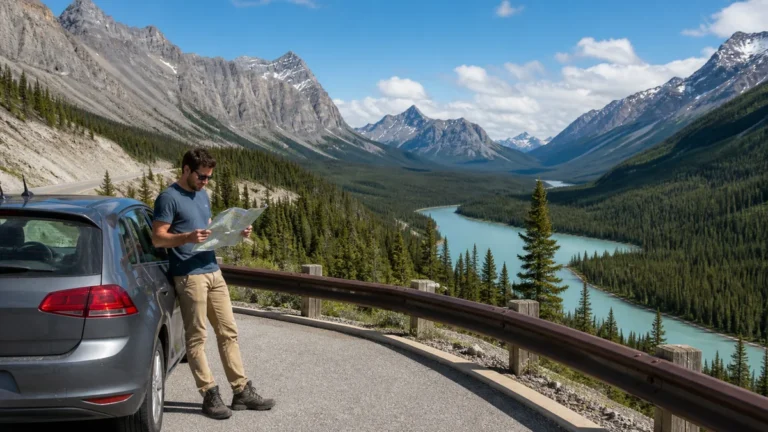
Travel insurance for Canada from USA trips should be built around visitor billing, the U.S. health plan and the distance to appropriate care. A Toronto weekend, Rocky Mountain road trip and Arctic itinerary do not share the same ambulance, provider or return-transport problem. Crossing a nearby border does not make medical coverage automatic.
Key takeaways
- Canadian publicly funded care is for eligible residents, not a free visitor benefit.
- Verify how the U.S. plan treats Canadian providers, reimbursement and authorization.
- Include ambulance and air transport when the itinerary reaches remote regions.
- Audit winter roads, wildfire disruption, rental territory and outdoor activities.
- Keep provincial bills, transport records, official alerts, refunds and assistance approvals.
Planning information reviewed August 16, 2026. Provincial billing, medical access, roads, wildfire conditions and policy wording can change. Verify current official information for the provinces, territories and dates on the route.
Build the route by province and distance
List every province or territory, border crossing, city, national park, remote overnight, road, ferry and prepaid booking. Record the nearest realistic care for each stage and the drive or flight needed to reach it. Add the first nonrefundable payment date.
The U.S. Department of State’s current Canada travel information says the public system does not provide free treatment to non-Canadians and recommends supplemental medical-evacuation coverage. It specifically highlights air ambulance for remote travel such as the Arctic.
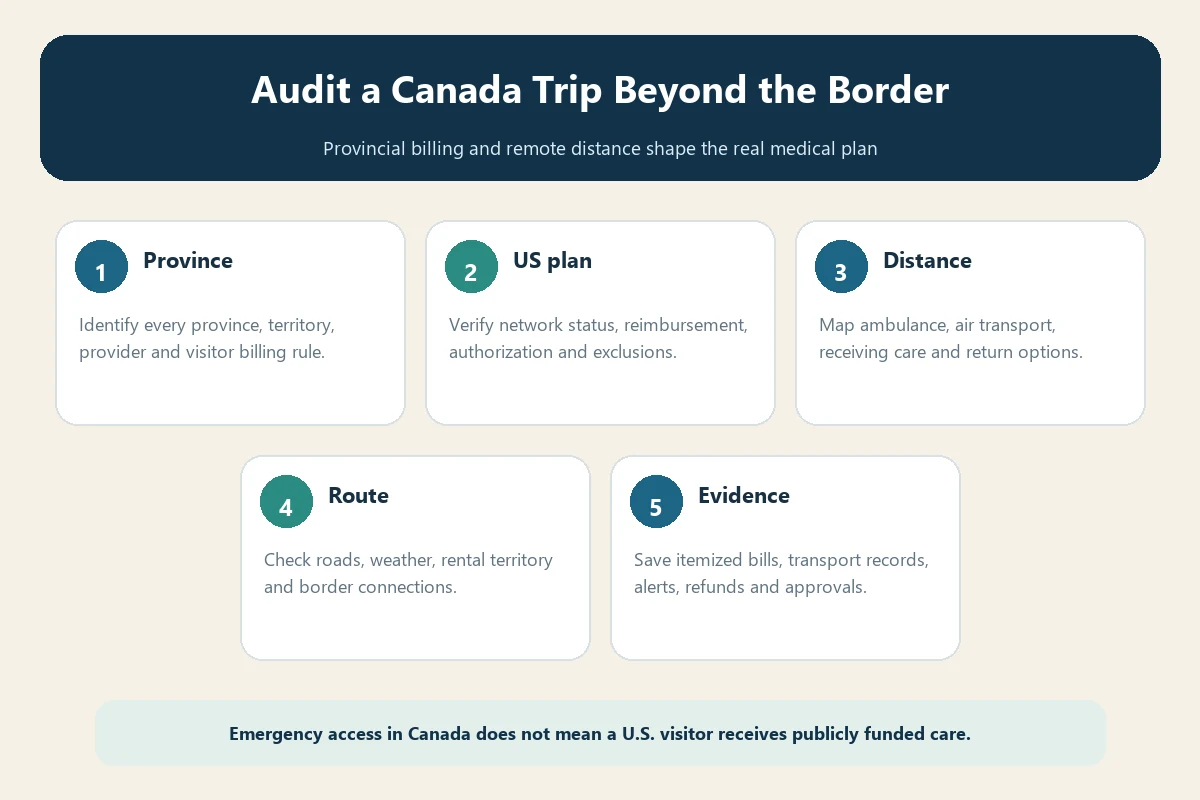
Understand what Canadian public care means for a visitor
Canada’s provinces and territories administer public health insurance for eligible residents. Health Canada’s official public coverage explanation says eligibility is determined by each province or territory. It also notes that services such as ambulances can be highly subsidized for residents but not for visitors.
Emergency access is not the same as free care. Ask the facility how an uninsured visitor is billed, what payment is expected and which itemized records are available. Do not present a U.S. insurance card as a Canadian health card.
The health insurance abroad guide helps identify network, authorization, reimbursement and service gaps before the trip.
Test the U.S. health plan in Canada
Call the U.S. insurer with the plan name and Canadian destination. Ask whether Canadian hospitals are in or out of network, whether the traveler pays first, which claim form is required and whether emergency notification has a deadline. Verify prescription, ambulance and follow-up rules separately.
Medicare and Medicaid work abroad only in narrow circumstances. Employer and individual plans vary. Request the supporting plan document rather than relying on a representative’s general description.
The primary versus secondary travel medical guide shows how claim order differs from provider acceptance. A primary travel benefit may still reimburse after the Canadian provider bills the traveler.
Separate ground ambulance, air ambulance and return home
Call 911 for emergencies. In a city, ground ambulance may reach a nearby hospital. In remote mountains, islands or northern regions, a patient may need a long ground transfer or aircraft to appropriate care. That movement is not automatically the same as repatriation to the United States.
Ask who determines medical necessity, which receiving facility qualifies, whether the insurer must preauthorize movement and how a companion is handled. Confirm whether an air ambulance benefit covers movement within Canada, across the U.S. border or only to the nearest appropriate facility.
The remote evacuation guide provides a decision-authority and transport-chain checklist.
Plan backcountry communication and rescue
Parks Canada warns that cell coverage can be unreliable in remote and backcountry areas. Its official emergency contacts guidance recommends leaving a trip plan with a trusted person and carrying destination-specific emergency information.
Record the trail, permit, party, expected return, weather, communication device and exit options. Ask whether search and rescue has its own sublimit and whether a helicopter used for rescue is classified differently from medically necessary evacuation.
The adventure-activity exclusion guide helps test hiking, skiing, snowmobiling, climbing, paddling and other activities by exact name.
Audit the Canadian road trip
A same-day border crossing can become a multi-day route with long fuel gaps, weak service and rapid weather changes. Confirm the rental territory, roadside provider, towing distance, replacement-car process and permission for unpaved or seasonal roads.
Provincial services provide current conditions. DriveBC publishes British Columbia closures, delays, road conditions, cameras, weather and wildfire layers. 511 Alberta provides official conditions, closures, incidents and winter visibility information. Use the service for each province rather than one national assumption.
The rental car abroad guide keeps motor liability, vehicle damage, roadside help and travel disruption separate.
Match each road expense to its contract
| Expense | First contract to inspect | Record to keep |
|---|---|---|
| Injury treatment | U.S. health plan and travel medical benefit | Diagnosis, bill and payment proof |
| Ambulance or air transport | Medical transport or evacuation clause | Medical necessity and dispatch record |
| Damage to rental vehicle | Rental waiver or collision protection | Agreement, photos and assessment |
| Towing or mechanical failure | Rental roadside assistance | Location, dispatch and authorization |
| Unused prepaid lodging | Trip interruption if a covered cause applies | Incident proof and refund statement |
A travel medical maximum does not pay every road-trip cost. Assign each potential loss before comparing limits.
Prepare for winter roads and closures
Winter requirements and road conditions vary by province, route and vehicle. Ask the rental company which tires, chains or equipment are supplied and permitted. Photograph the vehicle and equipment at pickup. Do not continue past a closure or “travel not recommended” notice.
Save the official road status, time, location and safe alternative. If a closure affects a prepaid booking, request the supplier’s refund or change first. A forecast alone may not satisfy a policy trigger.
The weather-delay coverage guide compares closure evidence, minimum delay and known-event wording.
Distinguish wildfire warning, closure and evacuation
Wildfire smoke can make a trip unpleasant without closing the destination. A road closure, park closure, accommodation cancellation and government evacuation order are different events. Locate each policy definition and note whether the destination must be inaccessible or uninhabitable.
Record the issuing authority, affected location, start time, supplier response and refund. If the itinerary changes voluntarily before an official restriction, the benefit analysis may differ. Protect health and follow official instructions regardless of insurance.
Use the delay, interruption and cancellation guide to classify a loss by when the event occurs.
Review pre-existing conditions and prescriptions
A stable condition, recent medication change or pending test can affect eligibility under the policy’s look-back rules. Check whether a waiver requires purchase within a set period after the first trip payment and whether all nonrefundable costs must be insured.
The pre-existing-condition waiver guide provides a purchase-date and stability checklist. Do not assume a short drive into Canada removes the need for disclosure.
Carry prescriptions in original packaging and verify legality for the border. Bring enough medication for delays and a clinician’s summary for important conditions.
Run one province-to-province comparison
Give each insurer the same case: a U.S. resident drives into Alberta, continues through British Columbia, stays in a national park and books nonrefundable lodging and activities. Add an injury requiring air movement, a wildfire closure and an early return to the United States.
- How does the U.S. plan treat each Canadian provider?
- What must the traveler pay before reimbursement?
- Who authorizes ground or air movement and selects the hospital?
- Does evacuation end at Canadian care or include the United States?
- Are the exact backcountry activities and rescue eligible?
- Which closure can trigger delay or interruption?
- What notice deadlines and records apply?
Require written page references. Save the issued wording, schedule and any endorsement with the trip documents.
Create a cross-border claim chronology
Carry the policy, U.S. health-plan card, assistance number, route, rental contract, medical summary and emergency contacts offline. During an incident, record the province, provider, case number, transfer decision, road or park notice and instruction received.
Collect itemized Canadian bills, proof of payment, ambulance records, medical reports, supplier notices, refunds and replacement receipts. The claim filing guide helps coordinate the U.S. health claim and travel-policy file without duplicating the same expense.
Match the benefit stack to the trip type
A city weekend may need visitor medical reimbursement, ambulance and modest trip-delay protection. A mountain road trip adds rental, towing, weather and rescue questions. An Arctic or fly-in itinerary makes air ambulance, remote assistance and interruption logistics central.
Compare plans using the same trip cost and medical scenario. Record the deductible, payment method, evacuation endpoint and activity limit, then test the weakest stage of the route. Avoid buying the largest package by label alone. The appropriate stack is the one whose definitions and assistance process match the actual distance, providers and bookings.
Repeat the comparison whenever the route adds a province, remote flight or nonrefundable activity.
For family travel, confirm dependent-child return, companion lodging and bedside-visit benefits as separate items. These services can matter when treatment extends beyond the planned border-crossing date.
Bottom line
The best Canada plan treats the border as the start of a new billing and transport system. Verify the U.S. plan, visitor payment, provincial routes, remote air ambulance, weather disruption and activities. A nearby destination can still create a complex medical return when distance and access change.
Original Medicare does not provide general visitor coverage in Canada, but three narrow route and proximity exceptions matter. Use this Medicare Canada emergency coverage map to test the border, Alaska-transit, nearest-hospital, ambulance, and claim rules.