
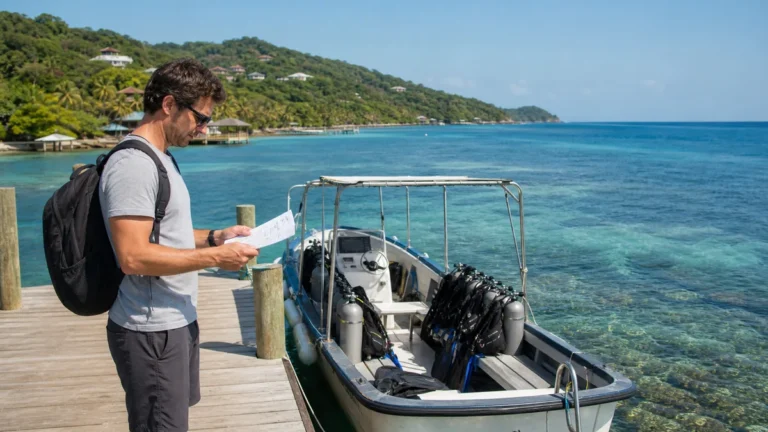
Travel insurance for Honduras from USA trips should follow the traveler from a Bay Islands dive site through island transport to appropriate care. Roatán, Utila, Copán and a mainland transfer do not share one medical or security environment. Check each stage against dive rules, carrier definitions, advisories and evacuation authority.
Key takeaways
- Verify scuba eligibility by certification, depth, supervision and gases.
- Identify currently available chamber and higher-level care before diving.
- Separate dive-boat rescue, island transfer, air ambulance and repatriation.
- Check regional advisory boundaries and unpredictable road disruptions.
- Keep dive logs, operator reports, schedules, bills and authorizations.
Planning information reviewed August 16, 2026. Advisories, operator services, chamber availability, weather, transport and policy wording can change. Verify current official and provider information for the exact island and dates.
Map the Bay Islands and mainland as separate stages
List the international arrival, domestic flight or ferry, island lodging, dive sites, mainland transfers and return connection. Record the latest departure, baggage rules, alternative route and nearest realistic medical facility. Add the first nonrefundable payment date.
The U.S. Department of State’s official Honduras travel information says appropriate treatment is generally available only in or near major cities. It notes that medical resources in beach areas are inadequate and search-and-rescue capabilities are limited. Most overseas providers may require cash payment.
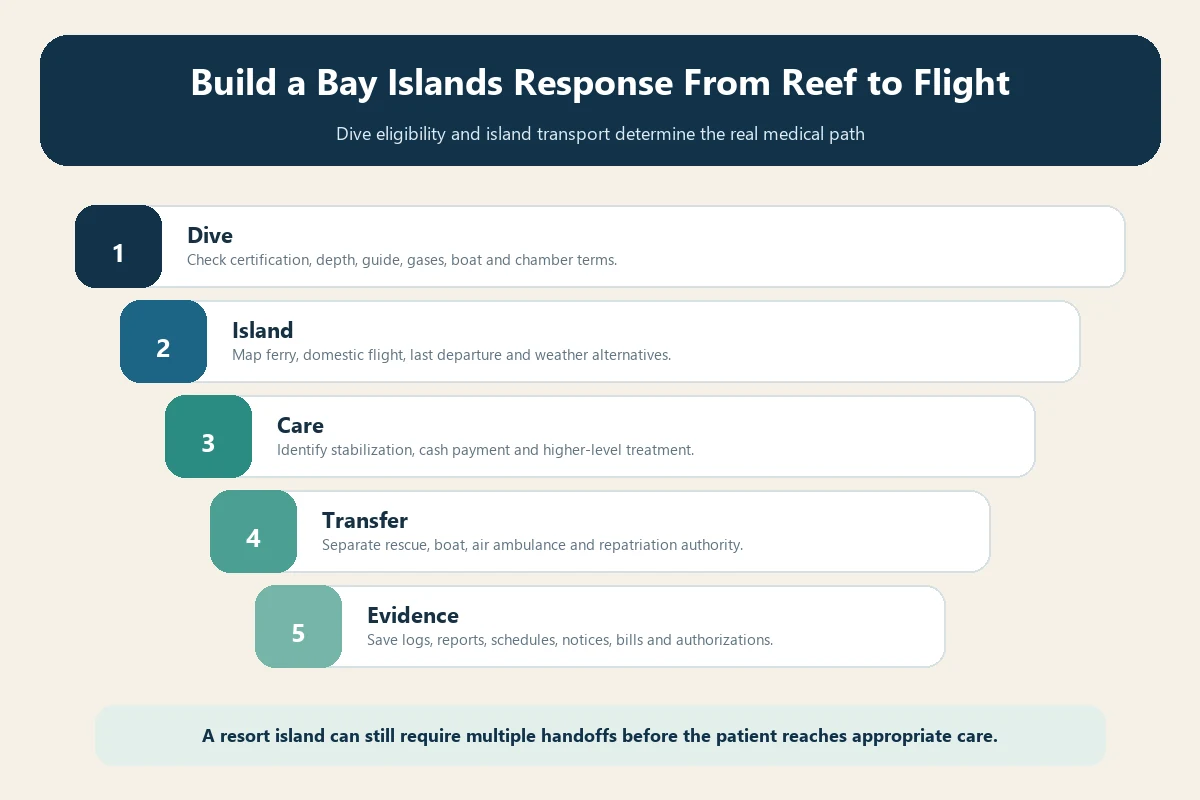
Audit the complete dive profile
Give the insurer the certification, planned maximum depth, supervision, number of dives and whether the trip includes night, wreck, cavern, freediving, rebreather or mixed-gas activity. State whether equipment is rented and whether a liveaboard is involved.
Check exclusions for diving beyond certification, solo activity, technical gases, instruction, paid work, competition and alcohol. Look for separate medical, rescue, chamber and equipment limits. The adventure-activity exclusion guide turns a broad “scuba covered” answer into a documented test.
Follow conservative dive practice and operator rules regardless of coverage. A policy endorsement does not expand training or make unsafe conditions acceptable.
Verify the operator and boat response
Record the operator’s legal name, boat, guide credentials, emergency oxygen, communications, passenger count, pickup dock and cancellation terms. Ask where an injured diver is first landed and who contacts medical providers. Keep the booking page, waiver and safety briefing.
A boat used for a dive tour is not necessarily a common carrier. A medical boat transfer is not necessarily an ambulance benefit. Ask the insurer to classify each possible craft and provide the clause.
Confirm chamber access before the first dive
Chamber status, hours, staffing and acceptance arrangements can change. Ask the operator and assistance company which facility is currently available for a suspected decompression illness, how the patient reaches it and what happens if it cannot accept the patient.
Confirm whether recompression is paid within the medical maximum or a separate benefit. Ask whether oxygen, diagnostic assessment, chamber treatment and later transfer are treated as one incident. Never delay emergency evaluation while trying to decide which benefit applies.
Map higher-level medical care
An island clinic may stabilize a traveler without providing the needed specialty care. Identify the realistic path to a larger facility on the island, mainland Honduras or another country. Ask who chooses the receiving hospital and whether upfront payment is required.
Call the U.S. health plan about foreign emergency treatment, reimbursement, claim forms and authorization. The health insurance abroad guide exposes where provider access and payment differ from benefit eligibility.
Carry a medical summary and prescriptions offline. Keep enough medication in hand baggage for a ferry or flight disruption.
Separate rescue, transfer and repatriation
The response chain can include dive-boat first aid, local emergency transport, domestic aircraft, international air ambulance and later return to the United States. Each stage may need medical necessity and prior approval.
Ask who dispatches transport, selects the receiving facility and approves a companion. Confirm whether evacuation ends at the nearest appropriate facility. The remote evacuation guide provides a decision-authority framework.
Understand primary and secondary claim order
A primary travel medical benefit may review eligible foreign bills before another insurer, while a secondary benefit can require the U.S. plan’s response first. Neither label promises direct payment to a Honduran provider. Ask whether assistance can arrange a guarantee of payment.
The primary versus secondary medical guide distinguishes claim order from provider acceptance. Record the deductible, currency conversion and records required.
Check the advisory by region and route
Honduras has regional security differences. The State Department says the Bay Islands have a greater concentration of resources than some areas, while crime remains a concern. It advises against travel to the Gracias a Dios Department. Check the current advisory and map every mainland transfer.
Search the policy for government advisory, unlawful acts, high-risk area, civil disorder and travel contrary to official advice. Insurance cannot make a restricted route safe or guarantee police response.
Plan for roadblocks and separate tickets
Demonstrations and roadblocks can close roads without a reliable reopening time. Domestic flights, ferries and international tickets may be separate contracts. Record the minimum connection, last departure and backup lodging.
| Problem | First wording to inspect | Evidence |
|---|---|---|
| Dive injury | Medical and scuba eligibility | Dive log, operator report and diagnosis |
| Chamber treatment | Medical or specialty benefit | Clinical recommendation and itemized bill |
| Medical flight | Evacuation authority and endpoint | Medical necessity and approval |
| Ferry cancellation | Common-carrier delay definition | Schedule, notice and refund |
| Roadblock | Delay or interruption covered cause | Official notice, location and timed impact |
Track tropical weather with official sources
Honduras’s disaster authority, COPECO, publishes current information through its official portal. The U.S. National Hurricane Center provides tropical cyclone preparedness and advisories. Save notices for the actual island, port and flight path.
A storm forecast, ferry cancellation, airport closure and mandatory evacuation are separate facts. The weather-delay coverage guide helps connect a dated notice to the policy’s carrier and minimum-delay requirements.
Classify cancellations and missed departures
If a covered event prevents the trip before departure, cancellation may apply. Once travel begins, unused dives or lodging and added transport may fall under interruption. A late ferry may be delay or missed connection, depending on its status and elapsed time.
Ask each supplier for a refund or credit first. The delay, interruption and cancellation guide maps the remaining loss to event timing.
Test assistance with a Bay Islands case
Give each insurer the same scenario: a certified diver develops symptoms after a compliant recreational dive, receives oxygen, needs chamber evaluation and may require transport to higher-level care. Ask who contacts the operator, locates a facility, authorizes movement and helps with payment.
Then test a ferry cancellation that causes a missed separate-ticket flight. The assistance line versus claims guide distinguishes real-time coordination from later reimbursement review.
Compare policies on identical facts
Keep ages, dates, trip cost, certification and itinerary constant. Record exact page references for scuba, chamber care, rescue, evacuation, carrier delay, advisory exclusions and notice.
- Is the planned dive profile explicitly eligible?
- How are chamber treatment and unavailable local capacity handled?
- Who authorizes island, air and international transfer?
- Where may the patient be sent for appropriate care?
- Which ferry, flight or road event can activate a benefit?
- What upfront payment and evidence rules apply?
The policy comparison method is destination-neutral: compare the same loss scenario rather than package labels.
Build the claim chronology
Save the certification, dive profile, operator report, symptoms, coordinates, medical notes, itemized bills, proof of payment, transport approvals, schedules, cancellations and refunds. Record every assistance case number and instruction.
The travel insurance claim guide provides an evidence sequence. Disclose other reimbursement and claim only the eligible balance.
Protect the final dive and flight timeline
Place every dive, surface interval, ferry, domestic flight and international departure on one timeline. Follow certifying-agency, operator and medical advice about flying after diving. Do not schedule the last dive so tightly that a cautious no-fly interval or delayed boat automatically breaks the itinerary.
If symptoms appear, stop diving and seek appropriate evaluation. Record the last dive time, depth profile, symptom onset, oxygen provided and medical restriction. A clinician’s written “do not fly” instruction is different evidence from a traveler’s precautionary preference.
Plan baggage and dive-equipment handoffs
Check whether the domestic aircraft or ferry accepts the packed gear and whether excess-baggage fees are refundable. Photograph owned equipment, serial numbers and condition before transit. Keep regulators, computer, prescriptions and essential documents within the carrier’s permitted hand-baggage rules.
Carrier baggage liability, a dive shop’s rental agreement and travel-policy baggage coverage can overlap without being identical. File the carrier report before leaving the terminal or dock and save any repair estimate or rental replacement receipt.
Prepare for a companion staying behind
Ask how the policy handles a companion if the patient leaves the island or country. Check bedside travel, added lodging, flight changes and dependent return separately. The assistance team may coordinate these services only after the medical transfer is approved.
Store consent, emergency contacts and payment access where the companion can use them. One person should maintain the incident timeline while another communicates with the operator and medical team.
Bottom line
The best Honduras plan connects dive eligibility, a verified operator, current chamber access, island transport and an authorized route to higher-level care. Recheck advisory and weather conditions before every transfer, and document the response from reef to final facility.