
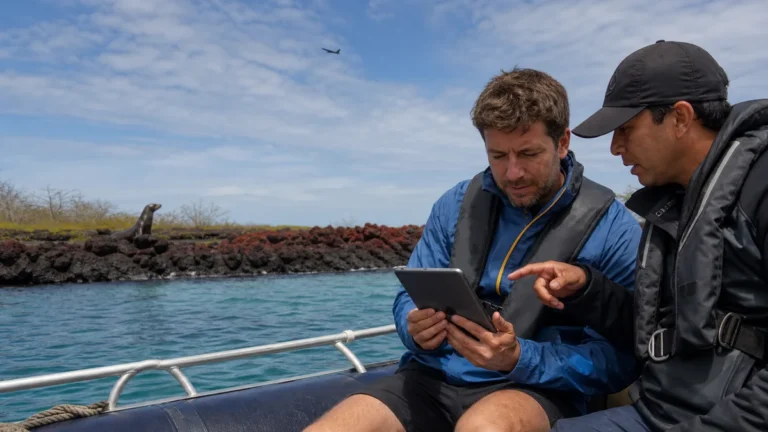
Travel insurance for Ecuador from USA trips should distinguish mainland travel from a Galapagos itinerary. Quito altitude, regional advisory geography, island medical limits, vessel operations and mainland flight connections create separate risks. The most useful policy comparison follows that chain and avoids repeating unsupported entry claims.
Key takeaways
- Verify entry documents on the current official Galapagos checklist.
- Map island care, mainland transfer and possible further evacuation.
- Confirm licensed vessel, activity and communications procedures.
- Audit Quito altitude and current advisory geography separately.
- Protect mainland connections with schedule and refund evidence.
Planning information reviewed August 16, 2026. Entry procedures, fees, advisories, vessels, flights and policy wording can change. Recheck official sources and suppliers for the exact dates.
Verify the insurance claim against the official arrival checklist
Search results and commercial pages sometimes say that all Galapagos visitors must show travel insurance. The current Galapagos National Park arrival information page lists the Transit Control Card and conservation fee but, on the version reviewed, does not list blanket proof of travel insurance.
That does not mean every traveler can ignore insurance documentation. A cruise line, expedition operator, tour contract or future government rule may impose its own requirement. Ask the supplier exactly which document it requires, who issued the rule and what medical or evacuation minimum must appear.
Save the current official checklist and the supplier’s written terms. Do not buy a policy only because an undated snippet claims it is mandatory. Select it because its definitions and assistance process fit the actual Ecuador and Galapagos route.
Read the advisory by location and date
The current U.S. Department of State Ecuador travel guidance is Level 2, Exercise Increased Caution, and contains more specific geographic warnings. Read the full page and test every mainland overnight, road and airport transfer against the current language.
Save the advisory version on the policy purchase date and recheck it before departure. Ask whether a geographic exclusion applies to the exact itinerary and whether a later advisory change can trigger any named benefit. The country exclusions and advisories guide provides the contract questions.
A national level or a warning for one region does not automatically reimburse a voluntary cancellation elsewhere. Policy language, event timing, supplier operation and the affected place all matter.
Build the island-to-mainland care chain
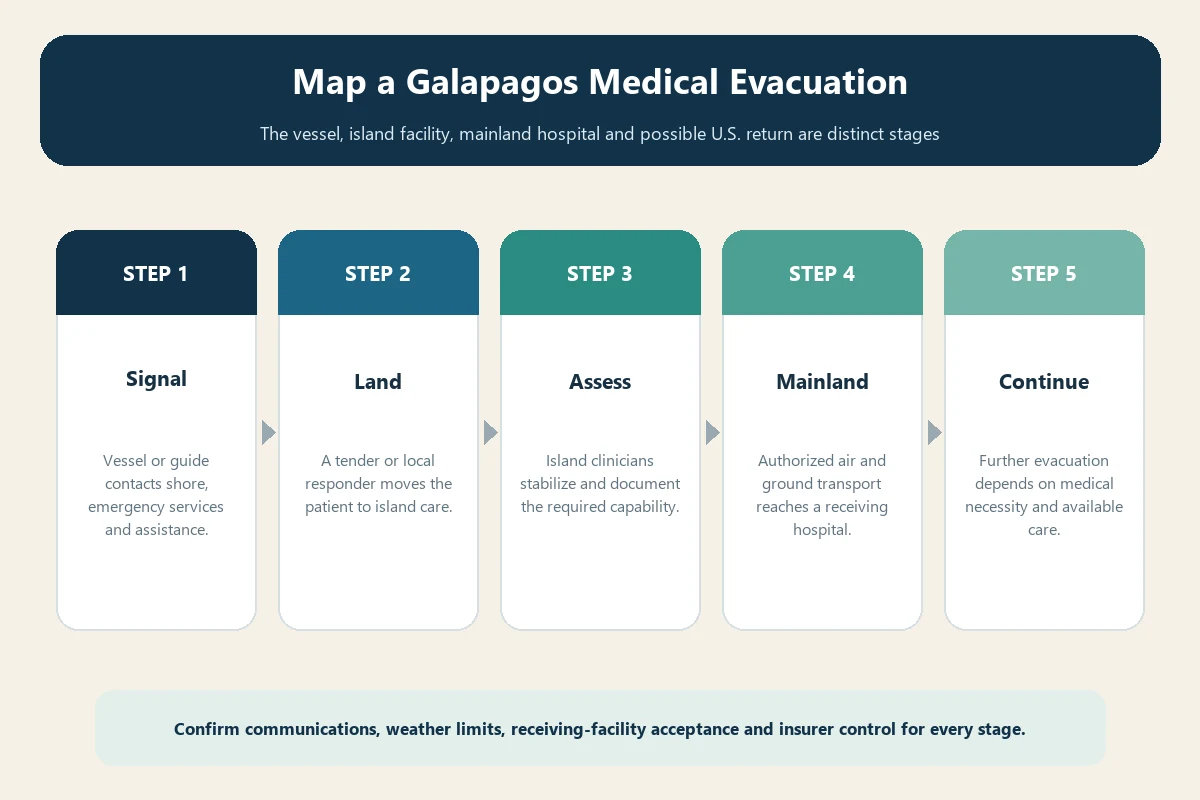
The State Department says the Galapagos has two hospitals, on Santa Cruz and San Cristóbal, and that neither performs major medical procedures. It warns that a seriously ill traveler typically needs evacuation to mainland Ecuador or the United States and says such evacuation can cost more than $60,000.
Do not turn that figure into a universal recommendation. Ask what transport could realistically reach each overnight location, which airport can accept a medical flight, where the patient would first be stabilized and which mainland hospital could receive the case.
The emergency medical evacuation guide separates medically necessary transport to adequate care from a traveler’s preference to return home. Check insurer control, destination language, companion travel, medical escort and repatriation.
Test communications and authorization failures
Official guidance warns that communications may be unreliable in remote Galapagos locations. Ask the vessel or land operator what it uses beyond ordinary mobile service, who makes the emergency call and which shore contact monitors the route.
Ask the insurer how prior authorization works when the traveler cannot reach assistance. Locate the emergency exception, notification deadline and required proof in the certificate. A broad “24/7 assistance” label is not enough.
The assistance line versus claims guide distinguishes coordination from benefit eligibility. Give assistance a realistic test: a traveler becomes ill on a vessel, the captain returns to the nearest island, clinicians stabilize the patient and request mainland transfer. Record who selects transport and confirms the receiving facility.
Audit the vessel as an operating system
The State Department notes that some Galapagos vessels may not meet international safety standards and advises travelers to verify that a vessel is licensed. Ask for the legal operator and vessel names, passenger capacity, license evidence, safety briefing, medical equipment, tender procedure and emergency communications.
Read the cruise or liveaboard contract for route changes, missed embarkation, weather, mechanical failure and medical removal. Determine whether the vessel is treated as a common carrier, tour supplier or charter under the policy. The ferry and vessel insurance guide provides a schedule-and-contract audit that can be adapted to island operations.
Preserve the passenger contract, itinerary, operator notice and final refund or credit. A captain’s safety decision, a port restriction and a traveler’s voluntary choice are different events even when all result in a missed island.
Check diving and water activities by exact facts
Snorkeling, scuba diving, kayaking, surfing and small-boat excursions may have different policy treatment. State the depth, certification, guide, equipment, operator and whether currents or remote sites are involved. Ask about underwater activity, professional participation, alcohol and excluded sports.
The State Department reports limited decompression-chamber options in the islands. A dive operator’s emergency plan should identify oxygen, communications, shore access and the intended receiving facility. Insurance cannot repair an inadequate plan after an incident.
The adventure activity exclusions guide helps compare the exact activity wording. Confirm whether search, rescue and nonmedical extraction have separate limits.
Plan Quito altitude independently
A Galapagos trip may include Quito before or after the islands. Quito is at high elevation, so record the sleeping elevation, arrival time and planned exertion. The CDC’s official high-altitude travel guidance explains gradual ascent and symptoms requiring prompt action.
Discuss personal risks with a clinician. Ask the policy about emergency treatment, pre-existing-condition definitions, physician advice and any activity or elevation threshold. Do not assume a policy selected for marine evacuation automatically answers an altitude scenario.
If a traveler becomes ill in Quito and cannot continue to the islands, document the diagnosis, medical advice and unused supplier arrangements. Trip cancellation applies before departure; interruption generally begins after the trip starts. The timing matters.
Protect the mainland–island flight chain
List the international flight, mainland domestic segment, Galapagos flight, airport transfers and vessel embarkation. Record which are on one ticket, the final departure of the day, baggage rules and the supplier’s missed-embarkation procedure.
Ask whether the relevant airlines and vessel qualify under missed-connection wording. Determine the minimum delay and covered reasons. The delay, interruption and cancellation guide helps classify replacement transport, lodging and unused arrangements.
Build enough buffer for a route where a missed island flight can also miss a sailing. If a schedule changes, obtain the carrier’s rebooking and refund options before buying a replacement. Preserve every original and revised schedule.
Keep biosecurity and insurance documentation separate
The Galapagos system protects the islands through transit controls, baggage inspection and restrictions on products. Follow the current official Park and biosecurity instructions. A confiscated prohibited item is not the same as lost or damaged baggage.
Ask whether baggage benefits exclude government seizure, confiscation, animals, food, professional equipment or valuables. Photograph expedition gear, keep receipts and follow carrier custody rules. Do not pack restricted biological material and expect insurance to reimburse it.
Store passport, Transit Control Card, operator contacts, policy certificate and medical summary in separate secure locations. A companion should know how to reach the insurer and access consent information.
Plan mainland and island medical payment
Official guidance says well-resourced hospitals in Quito, Guayaquil and Cuenca may provide care comparable to the United States, while rural and Galapagos care is more limited. It also warns travelers to be prepared to pay upfront.
Ask the U.S. health plan about overseas care, out-of-network rules, prior authorization and claim forms. Use the health insurance abroad guide to structure the call.
Ask travel assistance whether it can issue a payment guarantee to an island clinic or mainland hospital. Carry secure access to funds. Obtain diagnosis, itemized bill, proof of payment, transport notes and the final reconciliation.
Compare policies with one Ecuador scenario
Use identical ages, dates and prepaid costs. Include Quito, a separately ticketed Galapagos flight, a licensed vessel, guided snorkeling, an island clinic, mainland transfer and a missed U.S. connection.
- Which current itinerary areas are excluded?
- Are the vessel and exact water activities eligible?
- How does assistance operate without reliable mobile service?
- Who authorizes island-to-mainland medical transport?
- Which connection and missed-embarkation benefits apply?
- What records and notification deadlines control reimbursement?
Record the certificate page for every answer. Compare the evacuation definition, not just the dollar limit. A lower-cost plan with unclear island coordination can be less useful than one with precise eligible stages.
Build the claim chronology
Keep the official checklist, supplier requirement, vessel license evidence, passenger contract, route, guide report, medical note, authorization, receiving-hospital acceptance, flight notice, refund and added-expense receipt. Record the original currency and conversion.
The travel insurance claim guide provides a sequence for coordinating suppliers, the U.S. health plan and travel insurer. Label vessel, medical, transport and interruption costs separately and disclose every refund.
Assign an island incident recordkeeper
Choose a companion to record the vessel position, first symptoms, guide decision, shore contact, clinic arrival and every assistance instruction. Store the policy, passport, medication list and consent offline because connectivity can fail.
Keep tender, ambulance, clinic, aircraft and mainland hospital records as separate stages. Note who ordered each move and why the next facility was necessary. This timeline helps the insurer distinguish emergency transport from ordinary itinerary changes and prevents one bundled operator invoice from obscuring eligible costs.
Bottom line
A strong Ecuador plan is built around the real itinerary, not a questionable “mandatory insurance” snippet. Verify current official entry information, vessel safety, island medical limits, mainland connections, altitude and evacuation authority. Then preserve the records needed to prove what happened.
