
Europe travel insurance for ferry travel should be checked for scheduled-sea-transport definitions, weather delays, missed connections, overnight accommodation and medical transport. A ferry cancellation can trigger passenger rights, insurance benefits or both, but each system covers a different part of the disruption. The safest plan is to identify the carrier remedy first and insure only the loss that could remain.
Key takeaways
- Confirm that the policy’s common-carrier definition includes the booked ferry.
- Passenger-ferry rights and travel-insurance benefits are separate.
- Check weather, strike, known-event and missed-connection wording.
- Overnight ferries create both transport and accommodation exposures.
- Keep carrier notices, tickets, refunds and itemized receipts for the claim.
Ferry, cruise or excursion: classify the sailing first
“Boat trip” is not a useful insurance description. Record what was actually booked:
- Passenger ferry: scheduled transportation from one port to another.
- Overnight ferry: scheduled transport with a seat, berth or private cabin.
- Vehicle ferry: passenger transport plus a separately ticketed car or motorcycle.
- Cruise: a packaged voyage in which accommodation and the itinerary are central.
- Excursion or small boat: a sightseeing or activity booking that may not be treated as a common carrier.
The distinction affects carrier rights and policy wording. A benefit written around a scheduled common carrier may include a public ferry but exclude a private tour boat. Cruise-specific missed-connection benefits may not apply to an ordinary island ferry. If the trip is a cruise rather than transportation, use the cruise insurance clause guide.
Understand what the ferry company may owe
The European Union’s ship passenger rights guide says the EU framework usually covers most ferries departing from an EU port and some arrivals operated by an EU carrier. It also lists exclusions, including certain very small vessels, short crossings, historic ships and some excursions.
For a qualifying canceled ferry, the carrier may have to offer reimbursement or rerouting. Qualifying delays can also create assistance or compensation rights. Severe weather and extraordinary circumstances can change parts of that remedy, and cruises are treated differently in several provisions. Routes elsewhere in Europe may be governed by other national rules and the operator’s conditions.
| Problem | Ask the carrier for | Then check insurance for |
|---|---|---|
| Ferry canceled before departure | Rerouting or eligible refund | Unreimbursed delay or onward-connection loss |
| Departure delayed overnight | Information and applicable assistance | Eligible lodging, meals and transport after the waiting period |
| Late arrival misses a train | Alternative-connection information | Missed-connection or delay benefit for the separate onward booking |
| Cabin or sailing not used after rerouting | Refund or ticket adjustment | Remaining insured nonrefundable cost |
| Vehicle or baggage damaged in an incident | Immediate report and carrier claim | Unreimbursed property loss under the correct policy |
The governing EU measure is Regulation (EU) No 1177/2010. Use it and current official guidance to understand the carrier process; use the issued insurance certificate to decide whether a separate benefit applies. Do not assume that a carrier exception automatically becomes an insured event.
Four policy clauses that decide a ferry disruption
1. Common carrier
Find the definition and confirm that it covers a licensed public ferry operating on a published schedule. Then check whether the vessel, operator, route or ticket type creates an exclusion. A charter, water taxi or sightseeing boat may be treated differently.
Save the operator name, vessel or service number, ports, departure time and ticket. A booking platform’s itinerary is useful, but the carrier-issued ticket is stronger evidence of the scheduled service.
2. Trip delay
Trip delay can reimburse reasonable additional expenses only after its requirements are met. Record:
- covered causes, including weather or mechanical breakdown;
- the required delay period;
- daily and total limits;
- eligible meals, lodging and local transport;
- whether the cost must be unreimbursed; and
- the proof required from the carrier.
A severe-weather cancellation may reduce what the carrier owes for accommodation while still requiring the insurance clause to meet its own weather trigger. The weather-delay coverage guide explains why timing and cause evidence matter.
3. Missed connection
A late ferry can cause a missed train, flight, tour or second sailing. The replacement cost is not automatically covered. Check whether the policy protects connections from sea transport, whether both legs must be common carriers, the minimum delay required and whether separate tickets are eligible.
Also build a realistic transfer. Disembarkation, passport control, collecting a vehicle and reaching a different terminal all consume time. The missed-connection guide shows how to test the trigger before relying on the displayed limit.
4. Trip interruption
If the journey has begun and a covered event forces the traveler to abandon the route or return home, interruption may address unused insured arrangements and additional transport. A single canceled ferry more often begins as a delay, not an interruption. Read the covered reasons rather than choosing the benefit by the size of its limit.
Overnight ferries need a two-part check
An overnight ticket can contain both transportation and a cabin or berth. If the sailing is canceled, determine what the carrier refunds or replaces. Then calculate the actual extra cost: perhaps a hotel, meals, ground transport and a new onward ticket.
Do not claim the face value of a cabin as an additional hotel expense if the carrier refunded it. Likewise, a meal included with the sailing is not automatically an insured loss. Claims usually focus on reasonable, documented expenses incurred because of the covered delay, minus refunds and credits.
Record the next viable sailing and the last usable onward connection. On an island route with one sailing per day, the same cancellation can create a much larger loss than on a frequent channel crossing.
Island routes add medical-transfer exposure
Ferry insurance is not only about schedules. A traveler who becomes seriously ill on an island may need to move to a larger hospital. The travel medical and evacuation benefits, not trip delay, govern that transport.
Check who decides that a transfer is medically necessary, whether the assistance company must arrange it and what “nearest adequate facility” means. A normal passenger ferry ticket is not a substitute for medically supervised transport, and a policy evacuation benefit is not a license to choose any destination.
The CDC Yellow Book recommends assessing destination, trip duration, transport and planned activities when identifying medical needs abroad. It also distinguishes travel disruption, travel health and medical evacuation coverage. Use the medical evacuation limits guide to review authorization, destination and transport terms.
For a practical example of island geography, see the guide to Greece travel insurance for islands and ferries. Its scooter, ferry and medical-transfer issues are destination-specific; this page applies the general policy framework to European ferry routes.
Vehicle ferries create a separate insurance problem
A travel policy is not vehicle liability or collision insurance. If a rental car travels on the ferry, read the rental agreement, local motor cover and ferry operator conditions. Confirm whether the rental company permits the vehicle on the route and across every border.
For belongings left in the vehicle, check locked-vehicle and unattended-property exclusions. The ferry carrier’s liability after a maritime incident and a travel policy’s baggage benefit are different. Photograph the vehicle and visible damage, report the incident immediately and keep the carrier’s written response.
Weather, strikes and known events
Ferries are sensitive to wind, sea state, port closures and visibility. A carrier can cancel for safety even when the weather at the departure port looks manageable. Ask for the official reason rather than relying on a forecast screenshot.
Insurance coverage depends on the policy’s covered causes and the moment the disruption became known. A policy purchased after a named storm, published strike notice or announced port closure may exclude losses related to that event. Existing coverage also might not protect a connection that was never realistically achievable.
The European Commission’s maritime passenger-rights page links to current official claim guidance. Use the operator’s current service notice to prove the event and the certificate to prove the insurance response.
What to do when the sailing changes
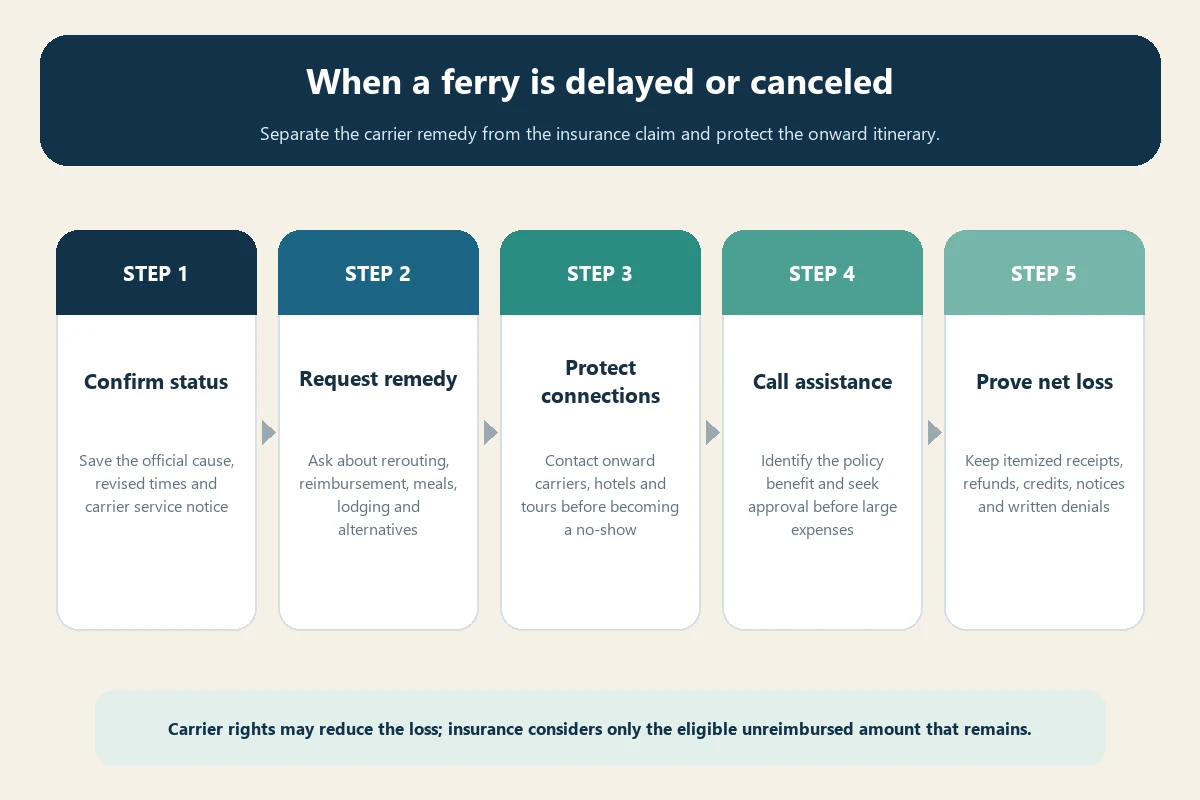
- Confirm the official status and cause. Save the carrier notice and estimated new departure or arrival time.
- Request the carrier remedy. Ask about rerouting, reimbursement, meals, lodging and alternative-connection information.
- Protect the onward trip. Contact the airline, rail operator, hotel or tour before being marked a no-show.
- Contact insurance assistance. Ask which benefit may apply before incurring large replacement costs.
- Document the net loss. Keep itemized receipts, proof of refunds and written denials.
When separate onward tickets are involved, use the separate-ticket claim checklist. It helps distinguish the carrier responsible for the delayed leg from the provider of the unused onward booking.
A ferry-focused purchase checklist
- □ The policy’s common-carrier definition includes my scheduled ferry.
- □ I classified the trip as a ferry, overnight ferry, cruise or excursion.
- □ I checked delay, missed-connection and interruption triggers separately.
- □ The waiting period fits the route’s sailing frequency.
- □ Weather, strike and known-event wording is clear.
- □ Overnight cabin and onward accommodation costs are documented.
- □ Medical and evacuation terms fit every island on the route.
- □ Vehicle and baggage risks have separate, valid coverage.
- □ Trip dates include overnight sailings and delayed arrival time.
- □ I saved carrier conditions, tickets and the state-specific certificate.
Add every port, island and transit to the multi-country Europe insurance worksheet. Then complete the broader Europe trip insurance checklist before checkout.
Frequently asked questions
Does travel insurance cover a ferry canceled by weather?
It can cover eligible unreimbursed expenses if the policy lists the weather event, the ferry meets the common-carrier definition and the delay satisfies the waiting period. The carrier’s own weather exception does not automatically establish insurance coverage.
Will insurance pay for a hotel after an overnight ferry is canceled?
Possibly, under trip delay, after considering assistance or reimbursement supplied by the carrier. Check the minimum delay, covered cause, daily limit and requirement that the expense be reasonable and unreimbursed.
What if a late ferry makes me miss my flight?
Ask the airline to protect the booking, then check the policy’s missed-connection and trip-delay terms. Separate-ticket protection, minimum delay and common-carrier definitions are critical.
Are EU ferry rights available to a US tourist?
Qualifying rights generally depend on the route, port, carrier and service rather than the traveler’s nationality. Confirm the current Your Europe guidance and the ferry operator’s conditions for the exact sailing.
Planning Croatian island stops? Use the Croatia travel insurance guide for U.S. travelers to check ferries, private-boat exclusions, island medical access and mainland evacuation.
Planning Estonia in winter? Use the Estonia travel insurance guide for U.S. visitors to check rental cars, icy roads, medical payment and Baltic ferries.
Adding Denmark to the route? Read the Denmark travel insurance guide for U.S. travelers to audit medical access, cycling, ferries and Nordic connections.
Adding Budapest or a Danube sailing? Use the Hungary travel insurance guide for U.S. visitors to check medical payment, river disruption, thermal activities and rail links.
Planning Latvia by road or ferry? Read the Latvia travel insurance guide for U.S. visitors for winter equipment, rural care, sailing disruption and evidence checks.
Adding Malta, Gozo or a planned dive? Use the Malta travel insurance guide for U.S. visitors to audit island transport, activity depth, provider payment and medical transfer.
Heading beyond Stockholm? The Sweden travel insurance guide for U.S. travelers explains visitor medical charges, remote northern transfers, winter driving and archipelago connections.
Combining the Bay of Kotor with mountain roads? Read the Montenegro travel insurance guide for U.S. visitors for boat, rescue, medical-payment, border and driving checks.
Adding the Galapagos to an Ecuador itinerary? Read the Ecuador travel insurance guide for island care, licensed vessels, mainland connections and evacuation.
Planning Hong Kong during typhoon season or with ferry side trips? Read the Hong Kong travel insurance guide for hospital deposits, storm signals, supplier shutdowns and territorial checks.
Considering scooters or Thai islands? Read the Thailand travel insurance guide for licensing, helmets, hospital payment, ferries and monsoon evidence.
