
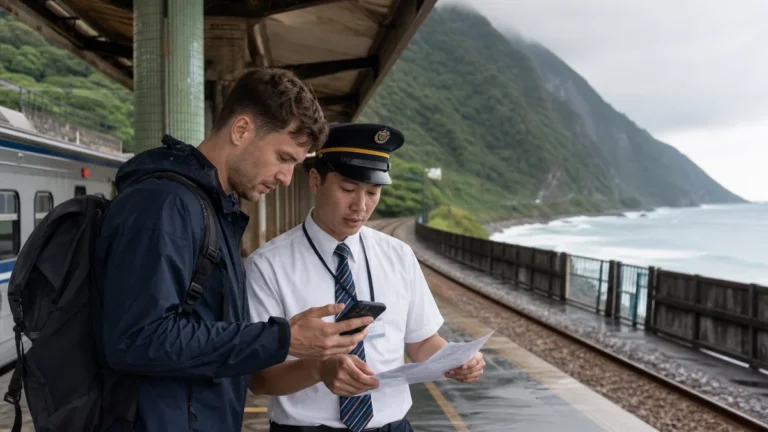
Travel insurance for Taiwan from USA trips should connect disaster alerts to the exact rail, road, flight, ferry and medical consequences on the itinerary. An earthquake warning protects life, but a claim still depends on what closed, what the supplier refunded and which policy trigger applies.
Key takeaways
- Prepare for cash medical payment even when reimbursement is available.
- Save Central Weather Administration alerts with place and issue time.
- Audit east coast and offshore routes separately from a Taipei stay.
- Record each transport operator and supplier decision after a disaster.
- Prioritize shelter, high ground and official instructions before claims.
Planning information reviewed August 16, 2026. Advisories, disaster systems, transport operations, medical practices and policy terms can change. Recheck official and supplier information for the travel dates.
Divide Taiwan into route dependencies
Start with Taipei, west-coast high-speed rail, east-coast rail or road, mountain areas and any offshore island as separate segments. List the operator, ticket, hotel, tour and last workable connection for each.
A traveler who can remain safely in Taipei after a localized event has a different loss from someone whose Hualien hotel closes or whose island ferry stops. The policy should be tested against both scenarios.
Use the delay, interruption and cancellation guide to classify added lodging, replacement transport and unused arrangements.
Check how medical care will be paid
The U.S. Department of State Taiwan destination information says Taiwan hospitals and doctors do not accept U.S. health insurance and that most overseas care providers only accept cash payments.
Ask the travel insurer whether direct billing exists at named facilities or whether the traveler pays first. Confirm the deductible, authorization process, claim form, translation standard and currency evidence. Keep secure payment capacity for a reasonable deposit or bill.
The health insurance abroad guide structures questions for the U.S. plan. The local payment obligation remains separate from which policy reviews first.
Use the current advisory as a planning baseline
The current State Department Taiwan travel advisory identifies natural-disaster risks including earthquakes, tsunamis, typhoons, flooding and extreme heat. It recommends checking evacuation assistance, medical insurance and cancellation coverage.
An advisory recommendation is not a minimum legal insurance requirement. It also does not set one universal coverage limit. Compare the itinerary, prepaid exposure and medical-payment process against the actual certificate.
Save the advisory version used for planning, then recheck it before departure. If it changes, record the date and exact language instead of relying on a screenshot without context.
Build a disaster information stack
Taiwan’s government publishes a current directory of disaster information services. It links weather, earthquake, transport, landslide, marine and cell-broadcast resources from responsible agencies.
Choose the services that match the route. Store the hotel address, planned refuge, emergency contacts and essential links offline. A traveler on the east coast may need different road and landslide information from someone staying only in Taipei.
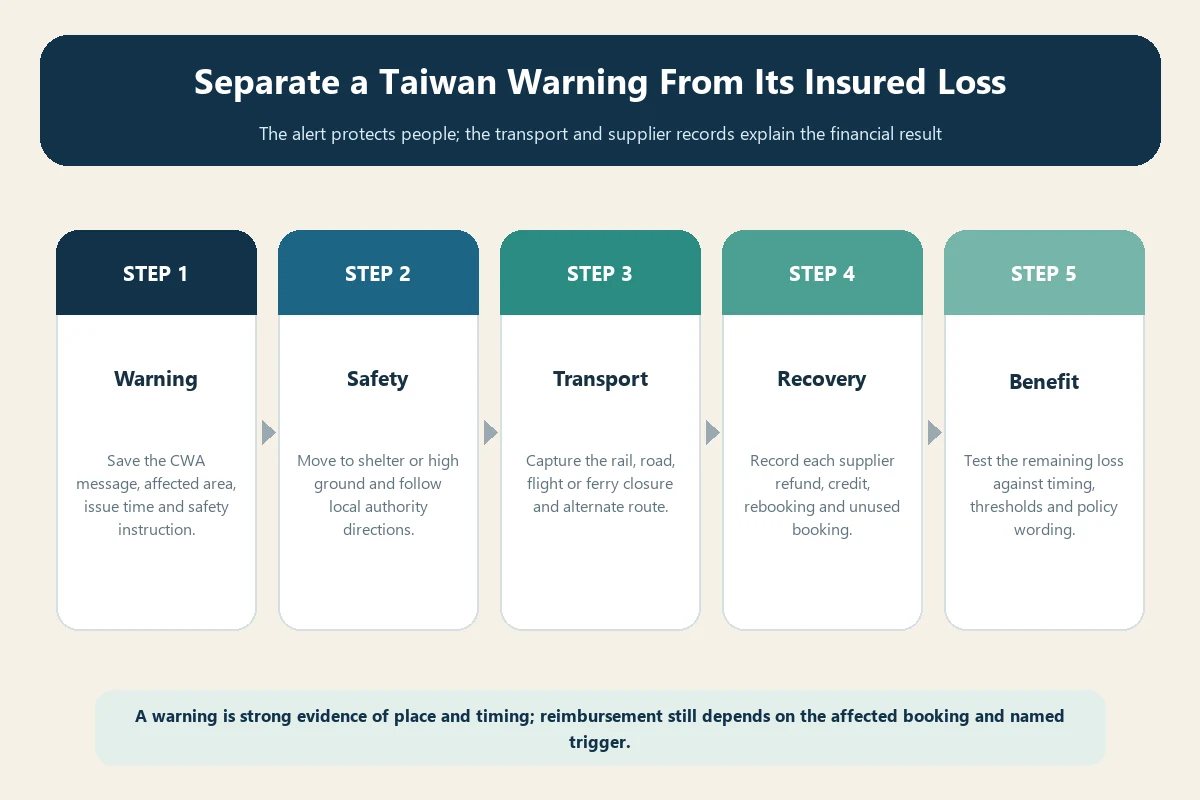
When an event occurs, save the official message, affected area, issue time and instruction. Then save the operator and supplier records that show how the itinerary changed.
Understand what an earthquake alert proves
The Central Weather Administration maintains an official earthquake public warning record. Messages identify the affected area and advise people to drop, cover and hold on when strong shaking is expected.
The warning supports place and timing. It does not show that every railway, road or hotel closed. Obtain the inspection stop, closure, evacuation order, cancellation or no-refund decision for the exact booking.
If the traveler changes an unaffected route voluntarily, coverage may differ. Ask how the policy defines natural disaster, uninhabitable accommodation, mandatory evacuation and destination inaccessibility.
Follow tsunami instructions before calling insurance
On a coastal route, identify high ground and local refuge instructions before travel. If authorities issue a tsunami warning, move immediately and follow official directions. Do not wait for a carrier, hotel or insurer to authorize life-safety action.
After reaching safety, record the warning, movement, shelter and supplier decisions. A home contact can monitor airline and rail updates while the traveler conserves battery.
Insurance may later evaluate added lodging, transport or unused arrangements. The evidence should show why the expense was reasonable and how it connects to a covered trigger.
Track typhoon development and purchase timing
State Department destination information identifies May through November as typhoon season. Unlike an earthquake, a storm develops over time. Build a chronology from first trip payment and policy purchase through forecast, official warning, carrier decision and traveler action.
The weather-delay guide explains known-event timing. A policy bought after the storm becomes foreseeable may exclude losses from that storm.
Ask whether the policy requires a minimum delay, common-carrier stoppage, accommodation closure or mandatory evacuation. A warning alone may not satisfy every benefit.
Audit the east coast as an access chain
For Hualien, Taitung or mountain access, list rail, road, hotel and activity separately. An earthquake or heavy rain may stop one transport corridor, limit access for inspection or cause a tour operator to cancel while accommodation remains usable.
Obtain the operator notice and alternate route. Record whether the hotel refunds, holds the booking or offers a credit. Identify the last safe connection and the cost of waiting versus rerouting.
The medical evacuation planning guide also helps test care beyond urban centers. Road access and receiving-facility availability can control the transfer.
Separate high-speed rail from other transport
High-speed rail, conventional rail, metro, buses and separately ticketed flights can have different refund rules. Ask whether each service qualifies as a common carrier under the policy and how delay is measured.
Keep the original timetable, delay or cancellation record, replacement ticket and refund. If one delay causes a missed flight, preserve evidence for both bookings. Do not combine them into an unexplained claim total.
The strongest file shows the original connection was feasible and the replacement cost was reasonable after available refunds.
Treat offshore islands as a ferry or flight chain
For Penghu, Green Island, Orchid Island, Kinmen or another offshore stop, document the exact flight or ferry, port access, island lodging and activity. Weather can stop marine transport even when the main island itinerary continues.
Ask what happens when the outbound crossing operates but the return does not. Check extra-night, missed-connection and unused-booking rules. Verify whether the whole island route falls within the policy territory.
The ferry travel insurance guide provides a method for separating sailing cancellation, port closure and onward loss.
Test medical evacuation by decision maker
Ask who determines medical necessity, appropriate receiving facility and transport method. Confirm whether prior authorization is required when reasonably possible and whether a companion is included.
A high limit does not guarantee a helicopter, aircraft or immediate bed. Weather, terrain, local responders and receiving-facility acceptance can control movement. Distinguish search and rescue from medical transport.
Keep the treating clinician’s recommendation, assistance notes, transport record and receiving-facility documentation. These records explain why a transfer occurred.
Check activities and seasonal closures
Give the insurer exact hiking, cycling, diving, surfing or mountain plans. Include route, elevation, guide, equipment and season. Ask about rescue, nonmedical extraction and activities undertaken after an official closure.
The adventure activity exclusions guide helps compare definitions. Follow park, marine and local-authority instructions.
If an operator cancels, preserve its reason and recovery offer. A usable reschedule or credit reduces the final loss even when the event is covered.
Use assistance as a coordinator
Ask whether the assistance team can locate an appropriate facility, interpret, arrange a transfer and communicate with a hospital about payment. Test the international calling method before departure.
The assistance line versus claims guide explains that coordination and coverage decisions are different. Record every representative, time, instruction and case number.
In an emergency, prioritize care and local instructions. Notify the insurer as soon as reasonably possible and explain why advance contact was not practical if that occurred.
Compare policies with one Taiwan scenario
Use the same ages, dates and prepaid costs. Include Taipei, an east-coast rail segment, an island ferry or flight, a nonrefundable activity, an earthquake warning and a clinic bill requiring payment.
- What must the traveler pay before or after treatment?
- Which alert, closure or supplier action can trigger coverage?
- How are rail, road, flight and ferry delays classified?
- Who authorizes inter-facility transport or evacuation?
- Are the planned activities and territories eligible?
- What claim deadlines and translation rules apply?
Read the certificate and endorsements. Ignore universal price claims and fixed limits in generic search results. The decision should reflect route access, prepaid exposure, health-plan coordination and policy wording.
Assemble the claim by booking
Keep official warnings, rail or ferry notices, hotel decisions, original tickets, replacement receipts and refunds. For medical care, preserve diagnosis, itemized bill, payment proof, discharge instructions and assistance notes.
The travel insurance claim guide explains how to disclose supplier and health-plan recoveries. Record the Taiwan dollar amount and actual conversion.
Label each cost by person, date, location and reason. The file should let a reviewer trace the disaster to the affected booking and final unreimbursed amount.
Rehearse an offline coastal response
Before travel, practice opening the saved route, refuge and policy contacts without mobile data. Assign one companion to follow local instructions and another to document transport and supplier updates only after everyone is safe.
Keep a small charging bank and paper contact card accessible. The purpose is not to predict a disaster; it is to prevent a dead battery or failed connection from blocking a safety decision or the evidence needed later.
Bottom line
A strong Taiwan plan connects official disaster information to route-specific transport, medical payment and supplier evidence. Protect life first, verify how each segment actually changed and preserve the records needed to test the remaining loss against the policy.
