
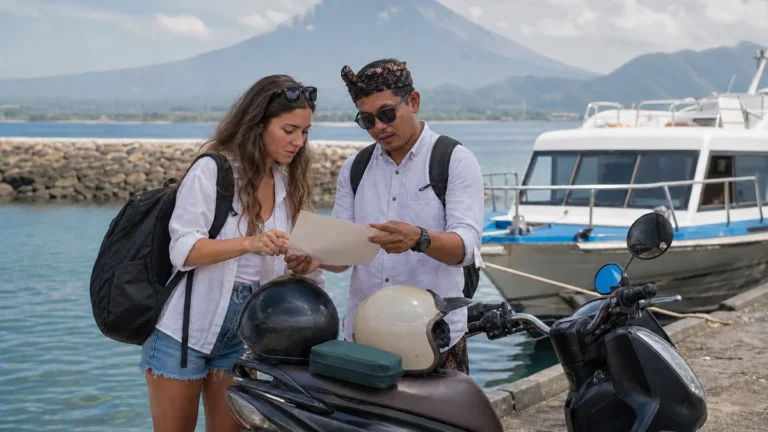
Travel insurance for Indonesia from USA trips should be tested against volcano alerts, lawful scooter use, island transport and limited remote response. An official alert, tour closure, canceled flight and medical transfer are different facts; a strong policy comparison maps each one.
Key takeaways
- Follow current official volcano and regional guidance by location.
- Do not treat rental availability as lawful or insured scooter use.
- Prepare for cash, large hospital deposits and patient-funded transfers.
- Verify diving, rescue and recompression treatment separately.
- Document every ferry, airline, tour and hotel decision.
Planning information reviewed August 16, 2026. Advisories, entry rules, volcano activity, weather, medical access and policy terms can change. Recheck primary sources and suppliers for the travel dates.
Map Indonesia as a chain of islands
List Jakarta, Bali, Lombok, Java, Sumatra, Sulawesi or other planned regions separately. Add domestic flights, ferries, fast boats, drivers, scooters, treks, dives and nonrefundable hotels. Record the last workable connection and a safe alternate for every island change.
The route determines access and claim exposure. Use the delay and interruption guide to distinguish an added hotel from the unused remainder of an island itinerary.
Check current advisory geography first
The current State Department Indonesia travel guidance identifies natural-disaster risks and higher-risk regions, including places where U.S. government emergency assistance is limited. Match the province and route rather than using a country headline.
Ask the insurer how territorial, unrest and government-advisory exclusions are measured. Save the guidance that applied at purchase, departure and event. Insurance cannot make a prohibited or officially discouraged route safe.
Use the official volcano alert, then the supplier record
The Government of Indonesia’s MAGMA Indonesia service publishes volcano information and alert status. Save the volcano, level, affected radius, issue time and authority instruction for the travel dates.
Then obtain the airline, airport, hotel or tour decision. An alert can restrict a zone without closing every airport or island. The weather-delay guide explains timing and supplier evidence, which remain relevant even when the cause is geologic rather than meteorological.
Check purchase timing before a named event
Ask when a volcano, earthquake or storm becomes known under the policy and whether benefits exclude an event after that point. Save the quote, certificate and purchase timestamp. Buying after widespread reporting may not protect against that existing event.
Do not change the event date or describe a voluntary itinerary change as an official closure. Compare the certificate’s wording for cancellation, delay and interruption using the same known facts.
Treat a scooter license as the first eligibility gate
Record the driver, license accepted by Indonesian authorities, vehicle class, engine size, passenger status and roads. Ask the rental operator for registration, contract and local liability information. A shop handing over keys does not prove lawful authority.
Send the exact facts to the insurer and ask how local-law violations affect accident medical, evacuation and liability benefits. If the accepted license cannot be established, choose a licensed driver, taxi or other transport.
Audit helmet and road exclusions
Official guidance says motorcycle helmets are required and describes difficult traffic conditions. Ask the insurer about certified helmets, alcohol, unpaved roads, off-road use, racing and commercial activity. Preserve a written response and the certificate page.
The activity exclusions guide provides a comparison method. A high medical limit cannot repair an excluded or unlawful activity.
Prepare for cash and large hospital deposits
State guidance says Indonesian providers often require payment or sizable deposits before service or admission, and cards may not be available. Ask whether assistance can issue a guarantee to a suitable facility and what documentation it needs.
Keep secure payment capacity. Request diagnosis, treatment detail, local amount and proof of payment. The health insurance abroad guide structures the separate U.S. plan call.
Plan movement to major-city care
Official guidance says an injured traveler may need to reach a major city and first responders may not reach remote areas. For each island, identify a plausible stabilization point, transport to a higher-care facility and communications that work after hours.
Ask who determines medical necessity, receiving hospital and vehicle or aircraft. The evacuation planning guide separates extraction, local transport, higher care and repatriation.
Distinguish rescue from medical evacuation
A volcano trek, surf break or remote waterfall incident may require nonmedical extraction before an ambulance can begin. Ask whether search and rescue has its own benefit, limit or exclusion.
Record guide qualifications, communications, turnaround rules and access for responders. A large evacuation limit cannot create a rescue team, reopen a road or secure a receiving bed.
Audit diving and recompression access
State guidance notes limited hyperbaric-chamber locations. Give the insurer certification, planned depth, dive type, operator, equipment and location. Ask how recompression treatment, boat rescue, evacuation and missed diving are treated.
Verify the operator’s oxygen, communications and emergency plan. A chamber shown on an old map is not proof of current operation or availability. Ask assistance how it verifies a facility when care is needed.
Test every ferry and fast-boat link
List the operator, harbor, vessel, departure, baggage rule and onward booking. Ask which services meet the policy’s common-carrier definition. Tour boats, charter craft and scheduled ferries can be treated differently.
Preserve cancellations, alternate crossings and refunds. The ferry insurance guide offers a stage-by-stage method after the Indonesia policy wording is confirmed.
Review destination health and medicine rules
The CDC publishes current Indonesia traveler health guidance. Review it with a clinician for the exact islands, season, activities and health history.
State guidance warns that medicines legal in the United States may be illegal in Indonesia and calls for supporting documentation. Insurance cannot override customs or drug law. Verify ingredients and declarations before packing.
Create a volcano disruption timeline
Start with the policy purchase and first trip payment. Add the official alert, operator message, airport action, hotel response, replacement decision and each refund. Use local times and preserve the original files.
Separate a closed trek from an operating hotel and a delayed domestic flight. One geologic event can produce different outcomes across islands. Claims are easier to review when each cost is connected to the supplier that controlled it.
Compare one Indonesia scenario
Use identical ages, dates and prepaid costs. Include Bali, another island, a lawfully licensed scooter, guided volcano trek, diving, an alert, ferry cancellation and hospital deposit.
- When does the event become known?
- Which scooter and activity exclusions apply?
- What official or supplier action triggers benefits?
- How is care funded?
- Who authorizes island transfer?
- Which refunds reduce the claim?
Read the certificate. Generic Indonesia or Bali prices do not establish legal riding, remote access or geologic-event eligibility.
Use assistance and record authority
Store 118 or 119, the policy number and assistance line offline. Record every representative, instruction, time and case number. Give a companion medicines, allergies and consent information.
The assistance versus claims guide explains why coordination is not final coverage approval. Necessary emergency care should not wait for ideal paperwork.
Build the final evidence ledger
Keep the official alert, activity contract, license, helmet evidence, carrier notice, medical record, deposit, transfer authorization, receiving record, refunds and replacement costs. Label currency, location, traveler and purpose.
The claim filing guide explains payer reconciliation. Record rupiah and actual conversion instead of applying a later web rate to every payment.
Rehearse the safer alternative
Price a licensed driver, non-volcano route, later boat and mainland hotel before travel. If the legal, alert or access test fails, the alternative should be practical while ordinary transport is still operating.
Share the route and check-in schedule with a home contact. Store documents offline. The best decision may be changing an exposed segment, not buying a higher limit that cannot overcome an exclusion or closed route.
Plan for ash, airport and accommodation decisions
Volcanic activity can affect airspace, airport operations, roads and outdoor tours on different timelines. Save the official alert and airport or airline notice separately. Ask the hotel whether access remains safe, whether it is operating and what refund or date-change options it offers.
If a flight is canceled, compare the airline’s replacement with a new carrier before buying. Record why the chosen route was safe and reasonable. Do not assume that changing islands by boat is appropriate when marine conditions, port capacity or road access are uncertain.
Keep masks, medicine and ordinary contingency supplies as personal preparedness unless a policy provision applies. A traveler purchasing supplies after an alert should not combine them with an eligible airline or hotel loss without checking the certificate.
Build an offline island response card
List the lodging coordinates, local emergency numbers, guide, boat operator, nearest practical care and insurer contact on paper and offline devices. Include a short description of the route that can be read over a phone when map sharing fails.
Give the home contact the same version and a missed-check-in rule. Include the passport name, policy number, allergies and a local person who can confirm the route. Test that the saved phone numbers work from an international handset and keep a paper copy away from the primary bag. A communication plan does not guarantee rescue, but it reduces delay caused by missing location, traveler or medical information.
Bottom line
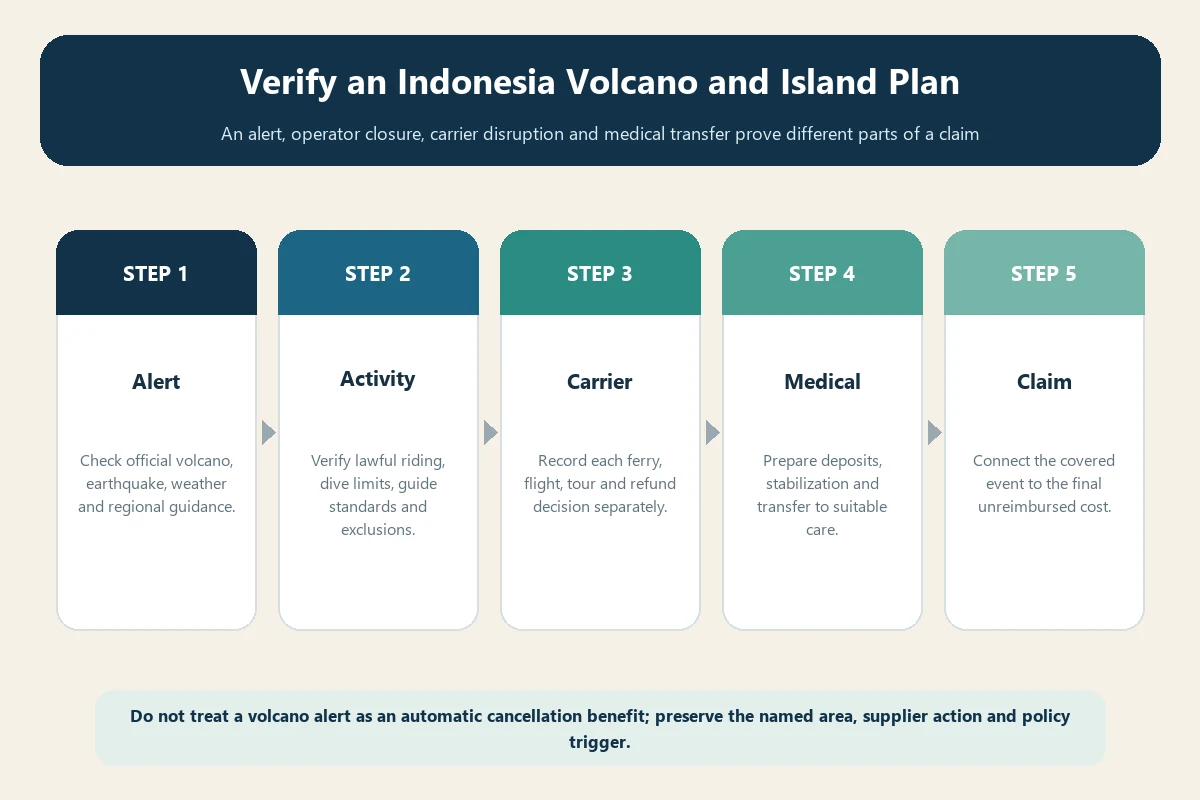
A strong Indonesia plan separates official alerts, lawful activities, supplier decisions and medical access. Map every island, prepare for deposits and remote transfer, then preserve the timeline connecting a covered event to the unreimbursed cost.