
Should a travel insurance claim include original documents or copies of receipts? Requirements vary by insurer, administrator, benefit, document, jurisdiction, and submission channel. Many claims begin with readable scans or copies, while a carrier may later request an original, certified copy, notarized record, wet signature, unused ticket, or physical form.
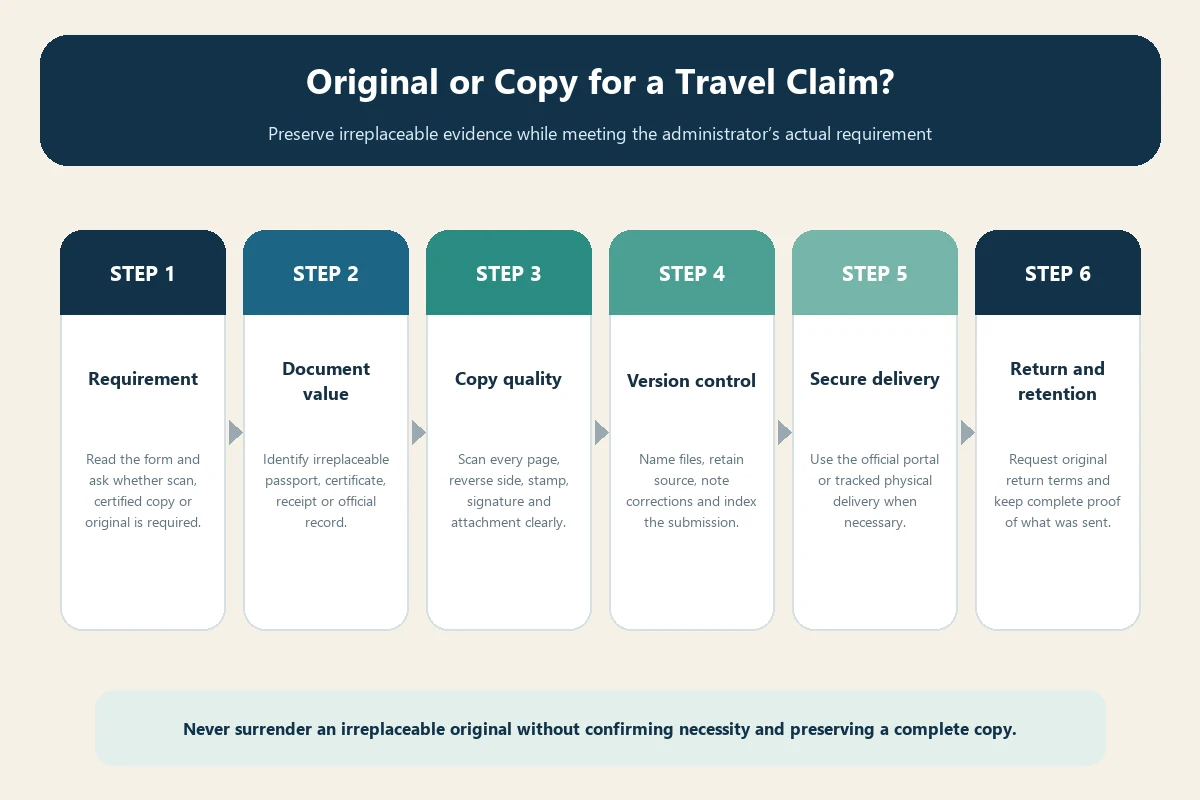
Never mail an irreplaceable passport, medical record, death certificate, police record, or receipt merely because a generic checklist says “original.” Ask for the exact requirement, acceptable alternative, return process, and secure address. Preserve a complete copy and chain of custody before sending anything physical.
Key takeaways
- Follow the current claim instructions and issued policy, not a generic rule.
- Start with clear, complete copies when permitted and retain the originals.
- Distinguish original, certified copy, notarized copy, and ordinary scan.
- Use tracked delivery and a document manifest for required physical records.
- Never send the only copy without written instructions and a recovery plan.
Why the wording is confusing
“Original receipt” can mean the merchant-issued record rather than a self-created summary, even when a digital copy is accepted. “Certified copy” means an authorized issuer or process attests to the copy. “Notarized copy” can describe a signature or copy process under local rules. These terms are not interchangeable.
Ask whether the insurer needs the physical paper, a scan of the original, a provider duplicate, or a certified record. Get the answer tied to the claim number and document.
Read the benefit-specific checklist
Cancellation, interruption, delay, medical, baggage, evacuation, and accidental death claims can have different proof. A portal can accept digital receipts for meals while a death benefit requests a certified death record. A foreign hospital can issue only stamped paper while the insurer accepts a scan.
Use the administrator’s current claim checklist, but compare it with the certificate. If instructions conflict, request written clarification before the deadline.
Ordinary copies
A good copy is complete, legible, in color when color conveys information, correctly oriented, and includes the entire page. It should show the issuer, date, amount, currency, traveler or patient, page numbers, signatures, stamps, QR codes, and reverse side when relevant.
Do not crop the merchant, remove handwritten notes, enhance a number, or combine two documents into one apparent original. Add an index outside the source pages.
Born-digital originals
Many records have no paper original. An airline e-ticket receipt, portal EOB, email, card statement, digital boarding pass, or online invoice can be the authoritative electronic record. Download the native PDF or complete email rather than relying only on a screenshot.
Preserve sender, headers, URL or account context, issue date, booking number, and digital signature when available. Do not print and rescan unless the submission system requires it; that can reduce metadata and quality.
Certified copies
Death, marriage, birth, court, guardianship, police, consular, or probate records may require certified copies for a particular benefit or payee. The issuing authority determines how certification works. A photocopy stamped by an unrelated person is not automatically certified.
Ask whether the insurer will accept a secure electronic certified record, an issuer copy, or a scan during initial review. Order enough official copies for insurers, banks, providers, courts, and family needs without surrendering the last one casually.
Notarization
Notarization generally verifies a signature or other act under applicable rules; it does not prove that a receipt is authentic, an expense is covered, or a medical statement is accurate. Do not pay for notarization unless the form, insurer, or law requires it.
Remote online notarization, foreign notarization, apostille, and consular acknowledgment have jurisdiction-specific rules. Ask what the recipient accepts before arranging them.
Wet signatures and electronic signatures
A claim form, authorization, assignment, affidavit, or beneficiary form may request a signature. Confirm whether a compliant electronic signature is accepted or a wet-ink original is necessary. Do not paste an image of a signature onto a form without authorization.
Keep the signed final version, audit record, and delivery confirmation. Never send a blank signed form.
Original receipts
Paper receipts fade and can be lost. Scan them immediately with the full merchant, items, tax, tip, currency, date, and payment details. If a carrier requires the paper, mark the back only if permitted and record its unique features.
For a missing receipt, request a merchant duplicate and follow our alternative proof guide. Do not recreate a receipt.
Medical records and bills
Providers can often issue duplicate itemized bills and records. Ask whether the insurer needs a provider-certified copy, direct transmission, or ordinary scan. Keep clinical records, itemized bills, receipts, and EOBs separate.
For overseas care, use our foreign medical document guide. Preserve original-language records and attach the required translation; do not replace them with the translation.
Passports and identity documents
Insurers can request identity or travel evidence, but sending an original passport is rarely a casual step. Ask whether the identity page and relevant stamps can be copied through a secure portal. Redact unrelated identifiers only with permission.
If a physical identity document is explicitly required, verify the legal entity, address, custody, return method, insurance, and processing time. Consider qualified advice before surrendering it.
Unused tickets and vouchers
Some claims historically requested original unused tickets or coupons to prove they were not used. Modern carriers often use electronic ticket status. Ask whether a ticket-use record, cancellation statement, or e-ticket receipt is accepted instead.
A physical voucher can have monetary value. Do not mail it without confirmation of how its value, custody, and return will be handled.
Police and carrier reports
Airline baggage reports, police records, delay letters, and incident reports can be issued digitally or on paper. Submit the official record with case number and issuer. A traveler’s typed summary is not the report.
If the authority retains the original, ask for a certified or official copy and document the request date. Protect the claim deadline while it is pending.
Death and estate records
A claim after death can require certified records and authority documents. The named beneficiary, estate representative, and expense payer can need different proof. Follow our claim after a traveler’s death guide.
Never send the only certified death or court record without a documented return process. Ask whether a certified electronic copy or issuer verification is available.
Create a digital master archive
Before submission, scan both sides, use stable filenames, preserve native files, and create a manifest with issuer, document, date, pages, original location, submission date, and return status. Back up the encrypted archive in a second secure location.
Do not store medical, identity, and bank records in a public share link. Limit access and use strong authentication.
Physical submission protocol
- Obtain written confirmation that the physical original is required.
- Ask whether a certified or high-quality copy is acceptable.
- Scan and inventory every page and distinguishing feature.
- Use the exact verified claims address and claim number.
- Include a manifest, not unrelated originals.
- Use trackable delivery appropriate to the document value.
- Confirm receipt, imaging, custody, and return date.
- Record the returned document’s condition.
Document return is a separate transaction
When the claim team says an original will be returned, ask who sends it, by which service, to what verified address, with what tracking, and after which processing step. Update address changes through the authenticated portal and confirm the document has been imaged before return.
Inspect the package when it arrives and compare it with the manifest. Report missing pages or damage promptly. A claim decision does not prove every original was returned, and a returned original does not prove the claim file retained a complete readable copy.
Do not mix originals from multiple claims
Use separate envelopes or clearly divided manifests when instructed. Identify every insured, benefit, and claim number. A shared family receipt can be copied into each relevant file while the original stays in controlled custody unless the carrier directs otherwise.
When an original is lost in transit
Contact the carrier and delivery service immediately, preserve tracking, and ask for the claims document-custody procedure. Notify the issuing authority if identity or certified records are exposed. Request a duplicate and protect other deadlines.
For identity documents or suspicious access, follow official fraud and identity-theft guidance. Do not wait for the mailing investigation before telling the adjuster which claim evidence is now unavailable.
Version control after correction
If a provider issues a corrected invoice, keep the original version and label the new issuer-provided version. Explain the change. Never alter the source page and call it corrected.
Use our supplement and correction guide and the indexed workflow in our claim documentation guide.
Deadline protection
Do not delay notice because the insurer has not answered whether it wants a paper original. Submit allowed copies and identify the question. Calendar the physical-document due date separately from notice, proof, and appeal.
Our deadline guide explains how to preserve the claim while records are pending.
FAQ
Should I mail original receipts?
Only when current claim instructions require it and after preserving copies, verifying the address, and arranging tracked custody.
Is a scanned PDF an original?
It can be the authoritative born-digital record or a copy of paper. Ask what the insurer means and accepts.
Does notarization make a document true?
No. It authenticates a specified act or signature process, not coverage or factual accuracy.
Will the insurer return documents?
Do not assume it. Obtain the return procedure in writing before sending irreplaceable records.
Bottom line
Use high-quality copies and native digital records when permitted, and retain originals. When physical or certified documents are required, verify the exact need, preserve a complete archive, use tracked delivery, and confirm custody and return. “Original” should be a defined claim requirement, not a reason to risk irreplaceable evidence.
Sources
- Travel Guard — Required Claim Documents
- Travel Insured International — Claims Center
- NAIC — What to Know About Travel Insurance
- New York DFS — Travel Insurance
- California Department of Insurance — Travel Insurance Guide
- USPS — Extra Services and Tracking
Reviewed August 16, 2026. This article is general educational information. Document, certification, custody, and return requirements vary by claim and jurisdiction.