

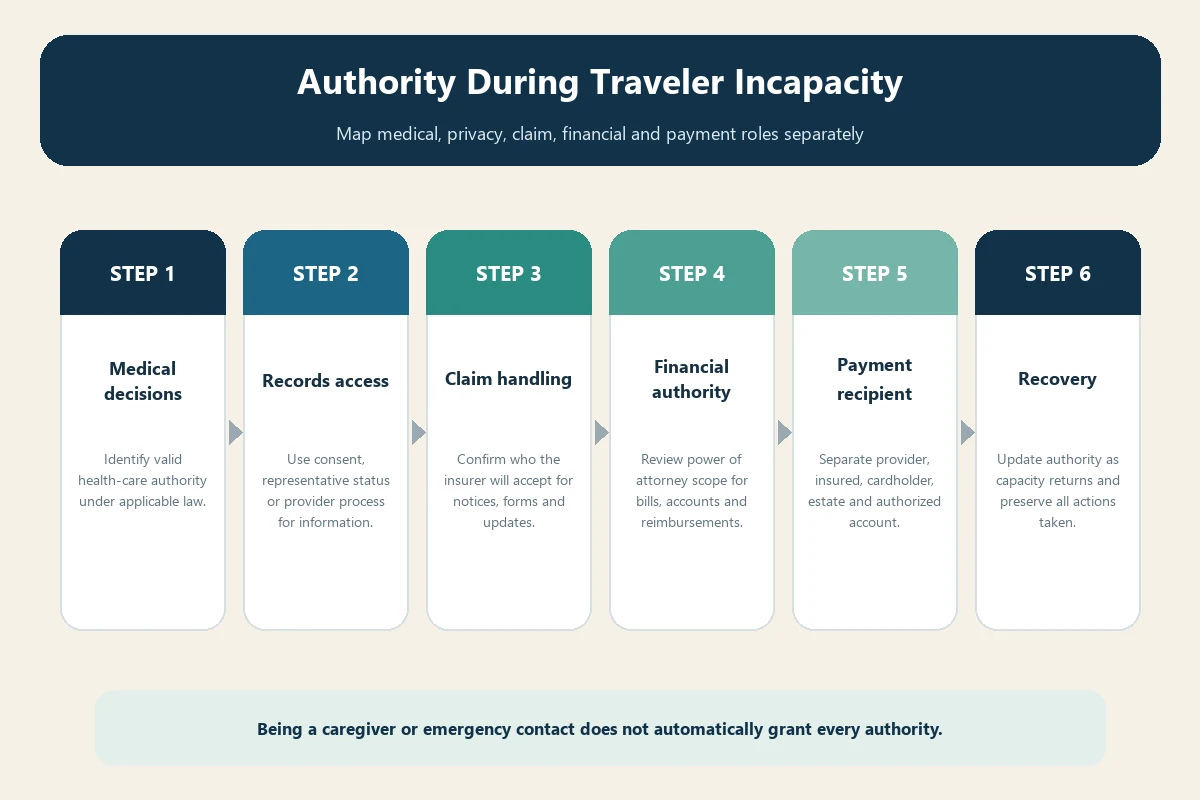
A travel insurance claim for an incapacitated traveler can require several forms of authority. A health care proxy may make treatment decisions, a durable financial power of attorney may handle money, a guardian may have court-defined powers, a family member may be an emergency contact, and the insurer can require its own authorized-representative form.
Do not assume one document covers every task. Map who can consent to care, obtain medical records, speak with assistance, sign the claim, appeal, direct payment, and manage provider balances. Authority depends on the document, triggering conditions, law, policy, and institution.
Key takeaways
- Medical, privacy, claim, financial, and payment authority are separate questions.
- Verify whether a power of attorney is effective, durable, limited, or springing.
- Ask the insurer and provider what proof each accepts.
- Document incapacity and urgent actions without delaying necessary medical care.
- Reconfirm authority when capacity returns or the traveler dies.
Incapacity is task-specific
A traveler can be unable to speak after sedation yet still have capacity later. Another can understand medical choices but not manage complex finances. Legal standards and clinical assessments vary. Do not label someone permanently incapable based only on age, diagnosis, language, or a stressful event.
Ask which decision must be made and who determines capacity for that purpose. Record the time, condition, evaluator, and any recovery.
Emergency care comes first
Seek necessary medical care and follow local emergency procedures. A companion can call the assistance number, provide identification, and explain that the insured cannot participate. Record the case number and why the traveler could not give notice personally.
Insurance coordination should not delay stabilizing treatment, but preauthorization and assistance requirements still need attention as soon as reasonably possible.
Emergency contact
An emergency contact can receive information allowed by the institution and help locate documents or family. The designation does not automatically authorize consent, records, claim settlement, bank access, or legal decisions.
Tell the insurer which role the person has. Do not let a customer-service label become the only proof of authority.
Health care proxy or medical power
A health care agent can make medical decisions within the document and law when the required conditions apply. That authority does not automatically allow the agent to move money, sign an insurance settlement, or receive a claim payment.
Foreign hospitals can require local forms or recognition procedures. Carry the original-language or translated authority record recommended for the destination, but confirm actual acceptance with the provider.
Financial power of attorney
A financial power of attorney can authorize specified banking, contract, claim, or insurance actions. “Durable” commonly means authority can continue after incapacity; “springing” can require a triggering determination. State and document rules vary.
Read the powers, effective date, successor agents, co-agent rules, signatures, notarization, expiration, and restrictions. Ask whether the insurer accepts the document or requires its own form.
Power of attorney is not guardianship
A power of attorney is granted by a principal with capacity. Guardianship or conservatorship is created through a legal process with court-defined authority and duties. Institutions can require certified orders and proof the appointment remains active.
Do not present one as the other. For disputed capacity, family conflict, or emergency appointment, obtain qualified legal advice.
Insurer authorized representative
The carrier can have a form allowing another person to receive claim information or act in the process. It may be narrower than a power of attorney and can exclude settlement, banking, medical decisions, or appeal.
Ask who may sign for the incapacitated insured and which authority must accompany the form. Keep the approval notice and any expiration or revocation.
Medical-record authority
HIPAA-covered U.S. providers recognize personal representatives under applicable law, with exceptions. A travel insurer’s claim authorization is a separate disclosure tool. Foreign hospitals apply their own privacy and representation rules.
Use our medical records authorization guide. Ask for the minimum relevant records and secure transmission.
Assistance case versus claim file
The assistance company can coordinate treatment, evacuation, guarantees, or family communications. Its authorization to speak with a companion does not necessarily open every reimbursement claim or authorize the companion to settle it.
Create linked case and claim logs. Identify which team holds medical operations, benefit decisions, documents, and payment.
Signing claim forms
Use the capacity instructed by the insurer, such as agent under power of attorney, guardian, or authorized representative. Do not sign the insured’s name as though the insured personally signed. Attach the required authority record.
If a form includes sworn statements, notarization, assignment, release, or banking instructions, confirm the representative can perform that act. Use our proof-of-loss and notarization guide.
Recorded statements and interviews
An incapacitated traveler may be unable to provide a recorded statement. Tell the insurer promptly, provide medical support for the current limitation, and ask whether the interview can be postponed, adapted, or answered by a representative for facts within that person’s knowledge.
A representative should not invent the traveler’s memory. Follow our recorded statement guide.
Provider payment and deposits
A caregiver or agent may pay a hospital deposit. Record the payer, source of funds, authority, invoice, currency, and expected refund. If insurance pays the provider directly, obtain a final ledger and prevent duplicate payment.
An assignment of benefits can redirect payment but is not the same as power of attorney or a guarantee of payment.
Using the traveler’s bank account
Do not use online banking credentials merely because the traveler is incapacitated. Banks apply their own authority and security procedures. Present recognized documentation and keep agent transactions separate and auditable.
Never share passwords or one-time codes with an adjuster or caller. Verify ACH or wire changes through official channels.
Trip interruption for a companion
A companion can incur new transportation, lodging, or escort expenses when the insured is hospitalized or evacuated. Coverage depends on the certificate, relationship, necessity, limits, and assistance coordination. Separate the companion’s costs from the patient’s medical claim.
Preserve physician or assistance recommendations, original itinerary, unused arrangements, new tickets, and payment evidence.
Evacuation decisions
The treating clinician, assistance medical team, provider, transport operator, receiving facility, patient, and legal representative can have different roles. A health care agent’s preference does not automatically create insurance authorization or airline acceptance.
Use our medical evacuation claim document guide to record medical need, authorization, route, transport, and invoice separately.
When an institution rejects the document
A hospital, insurer, bank, or assistance company can reject a document because it is incomplete, expired, not effective, missing a trigger, outside the granted powers, improperly executed, unclear, superseded, or not recognized in that jurisdiction. Ask for the reason and accepted alternative in writing.
Do not alter the authority document or pressure an employee to ignore procedure. Contact the issuing lawyer, court, notary, or appropriate adviser. If the insurer has its own representative form, determine whether the traveler can sign it, an existing agent can execute it, or a court appointment is needed.
Agent duties and recordkeeping
A financial agent or guardian can have duties to act for the traveler, avoid self-dealing, keep funds separate, and maintain records under applicable law. Claim reimbursement should be traced to the expense payer and used consistently with the authority.
Keep invoices, receipts, bank entries, insurer payments, provider refunds, and agent decisions in a dedicated ledger. Do not mix the traveler’s funds with the caregiver’s account merely for convenience. Obtain legal or accounting guidance where the authority imposes fiduciary duties.
Caregiver communication log
- traveler condition and capacity status;
- medical provider and authorized decision maker;
- assistance case and claim numbers;
- representative documents submitted and accepted;
- records requested and received;
- payments, deposits, guarantees, and balances;
- deadlines and promised actions; and
- capacity recovery, revocation, replacement, or death.
When capacity returns
Tell providers and insurer when the traveler can resume participation. Ask whether the traveler must ratify submissions, sign new authorizations, update banking, or provide a statement. Do not keep using an emergency workaround after it is no longer valid.
Preserve the transition in writing. The traveler can correct facts without erasing the representative’s legitimate earlier actions.
If the traveler dies
Authority under a power of attorney commonly ends at death, and estate or beneficiary rules apply. Stop using the document until authority is confirmed. Follow our claim after death guide.
Foreign document recognition
A U.S. power of attorney or guardianship order may need translation, notarization, apostille, authentication, local counsel, or institution review abroad. Do not assume the document is automatically recognized. Ask the hospital, bank, consulate, and insurer what each requires.
Protect deadlines while recognition is pending. Submit available authority and request a written alternative.
Privacy and family conflict
Use one recognized contact where possible, but do not conceal information from another person with equal authority. Co-agents, successor agents, separated spouses, or disputed guardians can create conflicting instructions.
The insurer can freeze changes or request legal clarification. Obtain counsel rather than pressuring staff to choose a relative.
Claim checklist
- Issued policy and insured traveler identity.
- Current capacity issue and supporting record.
- Task-specific authority documents.
- Provider, assistance, and insurer acceptance.
- Separate medical, trip, evacuation, and financial evidence.
- Secure records and payment instructions.
- Deadline calendar and communication log.
- Plan for recovery, revocation, replacement, or death.
FAQ
Can a caregiver file the claim?
Possibly, if the insurer accepts the caregiver’s authority for that task. Caregiving alone is not always legal authority.
Does a medical power of attorney control insurance money?
Not automatically. Medical and financial powers are distinct.
Can the agent sign the traveler’s name?
Use the representative signature format the insurer and law require; do not impersonate the insured’s signature.
What happens when capacity returns?
Update the insurer and provider and ask what authorizations, statements, or payment instructions the traveler must resume.
Bottom line
Incapacity does not create one universal representative. Separate medical decisions, health records, assistance, claim rights, finances, and payment. Verify the operative document and accepted proof for each task, document urgent actions, protect privacy and deadlines, and update every party when authority changes.
Sources
- Federal Long Term Care Insurance Program — Powers of Attorney
- HHS — Personal Representatives
- HHS — Family Members and Friends
- U.S. Department of State — Your Health Abroad
- NAIC — What to Know About Travel Insurance
- American Bar Association — Power of Attorney
Reviewed August 17, 2026. This article is general educational information, not legal, medical, banking, guardianship, or coverage advice.