
A travel insurance claim affidavit or notarized proof of loss is not automatically required for every claim. “Proof of loss” can describe the documents establishing the event and amount, a signed claim form, or a specific formal statement required by the policy or insurer. An affidavit, declaration, certification, and notarization serve different functions.
Ask for the exact form, policy provision, signature standard, deadline, acceptable notary or witness, and submission method. Do not copy a property-insurance or online template into a travel claim. A notary verifies a specified signing act under applicable rules; the notary does not decide whether the loss is covered or the facts are medically correct.
Key takeaways
- Proof of loss can mean an evidence packet or a formal signed statement.
- Notarization is not universal and does not prove coverage.
- Use the insurer’s current form and issued policy when a sworn statement is requested.
- Correct errors transparently; never alter an executed document.
- Protect the proof deadline while arranging signatures, records, or foreign notarization.
What proof of loss means
In an ordinary travel claim, proof of loss can include the claim form, itinerary, receipts, medical records, carrier reports, supplier refunds, EOBs, and a chronology. Together they establish the insured, event, benefit, amount, and net loss.
Some policies or adjusters can require a particular proof-of-loss form or sworn statement. The form may request the time, cause, interest, amount, other insurance, recoveries, payees, and declaration that information is true. Follow the actual request.
Proof of loss versus notice of claim
Notice tells the insurer that a potentially covered event occurred. Proof supplies the facts and evidence to evaluate it. One does not automatically replace the other. Emergency notification or preauthorization can also be separate.
Use our notice versus proof-of-loss guide to calendar each requirement. Arranging a notary does not extend the deadline unless the carrier confirms it.
Affidavit
An affidavit is a written statement made under oath or affirmation before an authorized official under applicable rules. Its content, jurat, signer identification, and execution can vary by jurisdiction. A self-labeled “affidavit” without proper execution may not satisfy the request.
Do not include facts outside the affiant’s personal knowledge. Identify estimates, information received from others, and attached records. Legal conclusions such as “the insurer owes coverage” are not a substitute for facts.
Declaration or certification
A declaration can be a signed statement made under a specified penalty or certification without traditional notarization when permitted. A claim form can also contain a fraud warning and certification. The exact language and governing law matter.
Do not replace a requested notarized affidavit with an unsworn declaration unless the recipient confirms acceptance or applicable law clearly permits it. Conversely, do not pay for notarization when the form only requires a signature.
What notarization does
A notary performs an authorized notarial act, such as acknowledging a signature or administering an oath, under the governing jurisdiction’s rules. The notary can verify identity and complete a certificate. The required act must match the document.
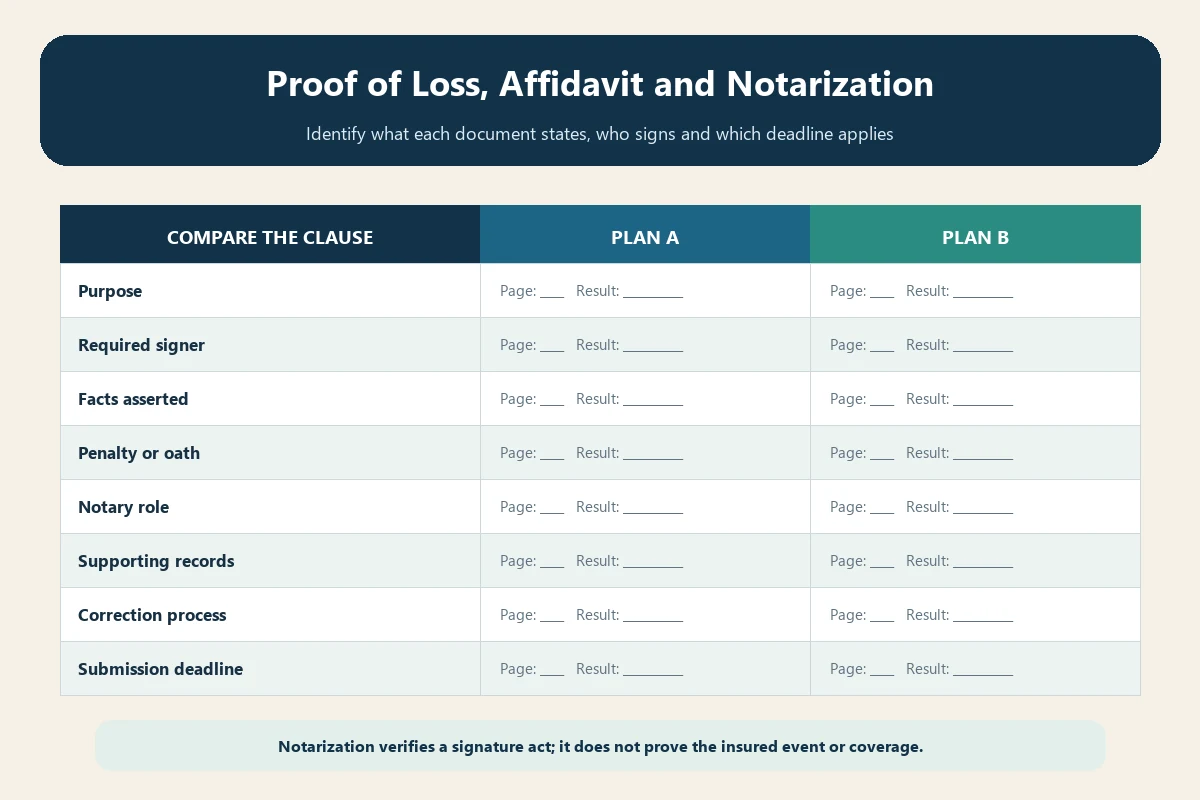
Notarization does not certify that a medical diagnosis is correct, a receipt is genuine, an expense is reasonable, or a policy covers the claim. The insurer still evaluates evidence and contract terms.
Acknowledgment versus jurat
An acknowledgment generally concerns the signer acknowledging execution. A jurat commonly involves signing or affirming the truth under oath before the notary. Names and procedures vary. The notary cannot choose legal wording for the claimant in place of authorized legal advice.
Ask the insurer which act and certificate are required. Do not leave the notarial block blank and expect the notary to guess the claim requirement.
Certified copy versus notarized copy
A certified copy can come from the record issuer or another authorized process. A notarized copy can describe a different act and may not be accepted for vital, court, consular, or public records. Death certificates, probate orders, and police records often have issuer-specific copy rules.
Use our original document and certified-copy guide. Ask the insurer whether a scan of a certified copy is enough for initial review.
Read the form before the appointment
Check claimant name, insured, policy, claim, trip, event date, benefit, currency, amount, other insurance, refunds, payees, exhibits, signature capacity, notarial certificate, and blanks. Resolve errors before signing. Bring acceptable identification and any representative authority.
Do not sign early if the required act must occur in the notary’s presence. Do not let another person sign the insured’s name unless legally authorized and the form permits that capacity.
Minors, incapacity, and representatives
A parent, guardian, agent, executor, administrator, trustee, or other representative may need to sign in a stated capacity. The insurer can require proof of authority. A family relationship alone may not be enough.
Power of attorney, guardianship, estate, and beneficiary authority are different. After a traveler’s death, follow our deceased traveler claim guide.
Foreign execution
A claimant abroad may use a local notary, U.S. consular service where available, or another authorized process, depending on the document and recipient. Appointment availability, identity requirements, language, local law, apostille, authentication, and fees can apply.
Ask the insurer which foreign acts it accepts before arranging one. U.S. embassies and consulates provide limited notarial services under current rules; they do not decide private insurance coverage.
Apostille and authentication
An apostille or authentication addresses the origin of certain public documents for international use. It is not ordinary notarization and is not automatically required for a travel claim. The destination jurisdiction, document issuer, and recipient determine the process.
Do not obtain an apostille merely because the claim involves foreign travel. Ask which exact document needs it and why.
Remote online notarization
Remote notarization can be permitted under some jurisdictions and rejected or unavailable under others. The signer location, notary commission, identity proof, platform, audiovisual record, document type, and recipient acceptance matter.
Obtain written confirmation from the insurer before relying on remote execution. Use a verified provider and protect the identity documents and recording.
Translations
If the document or attached evidence is in another language, ask whether the affidavit, translation certification, or notarial certificate must be translated. The translator should not silently change claim facts. Keep the source and translation page-matched.
A translator’s certification is different from notarization. A notary may verify the translator’s signature without verifying linguistic accuracy.
Missing receipts and affidavits
An affidavit can explain a missing receipt, but it does not automatically replace objective proof. Combine it with merchant requests, bank statements, order history, photos, warranties, carrier reports, or provider records. Use our claim without receipts guide.
State why the receipt is missing, attempts to retrieve it, who paid, amount, currency, date, and attached corroboration. Never ask a notary to turn a reconstructed receipt into an “original.”
Loss calculations
A formal proof can require the amount claimed, but the loss can change through refunds, credits, another insurer, currency conversion, or corrected bills. Identify pending amounts and use a reconciliation exhibit. Do not hide uncertainty.
If a refund arrives after signing, notify the insurer and supplement the claim. A sworn statement should not freeze the accounting at an outdated amount.
Corrections after signing
Do not use correction fluid, overwrite numbers, remove pages, or substitute an exhibit in an executed form. Contact the insurer and ask whether it needs a corrected form, amendment, or supplemental statement.
Preserve the original version, explain the error, execute the replacement correctly, and use our supplement and correction workflow.
Submission and custody
Scan the complete executed document, including notarial certificate, seals, attachments, backs, and page numbers. Submit through the verified channel. If a paper original is required, use tracked delivery and retain a manifest.
Confirm receipt and readability. A portal upload can strip a seal or crop a page. Keep the signed original secure until the claim and all review periods are complete.
Fraud warnings
Claim forms can contain warnings about false statements. Accuracy matters. Review numbers and dates before signing, distinguish estimates, and correct mistakes promptly. Do not let a preparer, provider, or family member insert facts without review.
If the form raises legal exposure or the insurer requests an examination under oath, obtain qualified counsel.
Deadline problems
If notarization, vital records, translation, incapacity, or foreign location threatens the deadline, give notice immediately, submit available proof, document the obstacle, and request a written extension or alternative. Do not assume impossibility automatically excuses delay.
Keep appeal and legal-action dates separate. A notary appointment after the deadline does not preserve them.
Questions to ask the insurer
- Is a specific proof-of-loss form required?
- Must it be sworn, notarized, witnessed, or only signed?
- Which notarial act and jurisdiction are accepted?
- Can a representative sign, and what authority is needed?
- Are electronic signatures or remote notarization accepted?
- Must foreign records be apostilled, authenticated, or translated?
- Is a scan sufficient, or must the physical original be sent?
- What is the deadline and approved alternative if execution is delayed?
FAQ
Does every proof of loss need notarization?
No. Use the policy and specific claim instructions. Proof can be an evidence packet or a formal signed form.
Does a notary prove my claim is true?
No. The notary performs a defined identity, acknowledgment, or oath function; the insurer evaluates facts and coverage.
Can I use an online notary?
Only if the governing rules and insurer accept it for that document and signer location.
Can an affidavit replace a receipt?
It may explain the gap but often needs independent corroboration. Acceptance is claim-specific.
Bottom line
Proof of loss, affidavit, declaration, certification, and notarization are not synonyms. Identify the exact required form and signing act, use authentic evidence, protect originals, disclose changing amounts, and preserve deadlines. Notarization validates a process—not insurance coverage.
Sources
- NAIC — Unfair Claims Settlement Practices Act
- NAIC — Travel Insurance Model Act
- U.S. Department of State — Notarial and Authentication Services
- California Secretary of State — Notary Public
- New York Department of State — Notary Public
- FEMA — Proof of Loss Example
Reviewed August 17, 2026. This article is general educational information, not legal or notarial advice. Execution requirements depend on the form and jurisdiction.
