

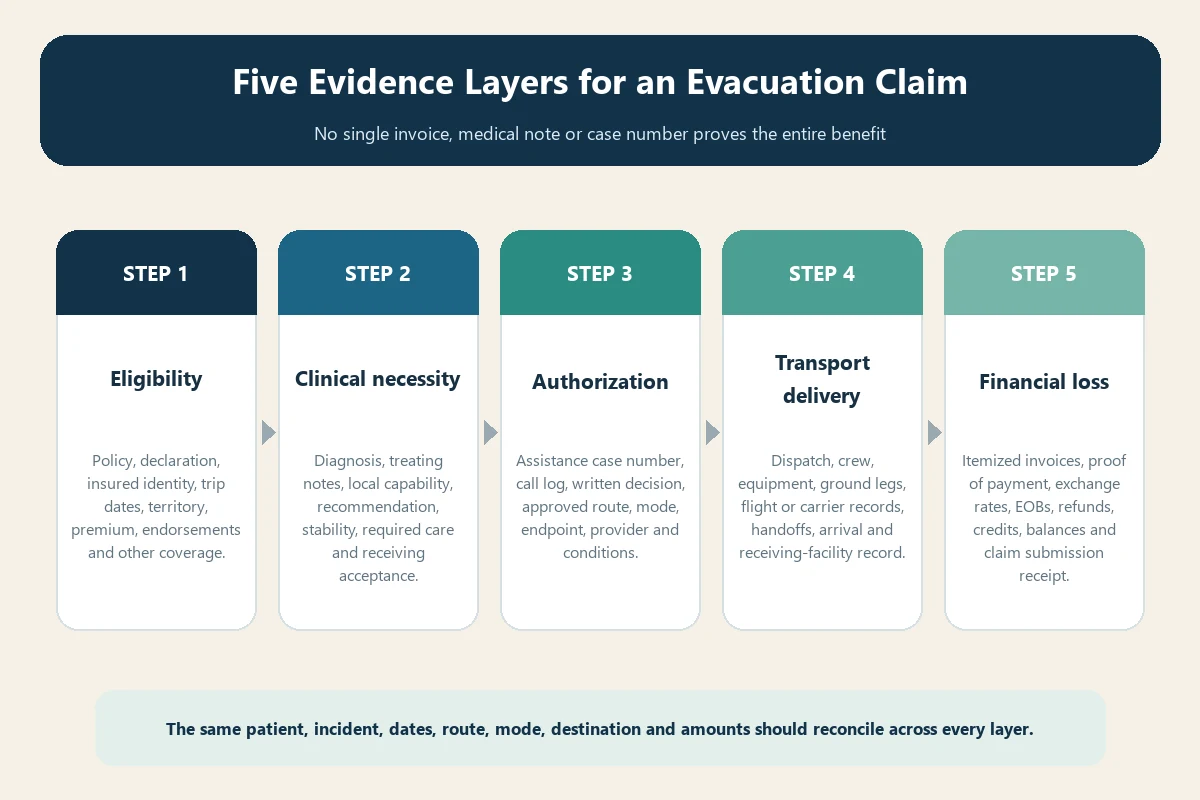
Medical evacuation claim documents must prove five different things: the person and trip were eligible, a covered medical condition required transport, the assistance company authorized the correct route and mode, the transport occurred, and the claimant incurred an eligible financial loss. A doctor’s letter proves only part of that chain. An air-ambulance invoice proves a service was billed, not that the policy approved it.
This guide organizes the case file before, during, and after transport. It is educational, not medical, insurance, legal, privacy, billing, aviation, or claims advice. Follow urgent clinical instructions first, contact the policy’s assistance line as soon as safely possible, and use the issued certificate and claim instructions for the actual submission.
Key takeaways
- Preserve the issued policy and declaration, not only a benefit summary.
- Clinical necessity, coverage authorization, and carrier or provider acceptance are separate decisions.
- Record the assistance case number, timestamps, approved route, mode, endpoint, and conditions.
- Obtain itemized invoices and proof of payment for every transport segment.
- Reconcile other-insurance EOBs, refunds, credits, and unpaid balances without claiming the same loss twice.
Reviewed August 16, 2026. “Medically necessary,” “appropriate facility,” “approved in advance,” “coordinated,” “proof of loss,” “primary,” “secondary,” and “reasonable expenses” are certificate-specific terms.
Build five evidence layers
| Layer | Question it answers | Typical proof |
|---|---|---|
| Eligibility | Was this person, trip, place, and date insured? | Policy, declaration, identity, itinerary, premium |
| Clinical necessity | Why was transport medically required? | Diagnosis, notes, capability gap, recommendations |
| Authorization | What did the assistance company approve? | Case number, call record, written decision, conditions |
| Delivery | What transport actually occurred? | Dispatch, route, crew, equipment, handoff, arrival |
| Financial loss | What eligible amount was incurred and by whom? | Invoices, payment, EOB, refunds, credits, balances |
The general travel-insurance claims guide covers shared claim principles. A medical evacuation adds a more demanding authorization and transport chain. The documents should tell one consistent story about the patient, incident, timing, route, mode, destination, providers, and cost.
Layer 1: preserve the governing contract
Save the certificate or policy, schedule of benefits, declaration, application, endorsements, riders, state-specific notices, premium receipt, assistance card, and any later amendment. Record the insurer, underwriter, administrator, assistance provider, policy number, certificate number, effective dates, insured person’s full name and date of birth, home country, destination, covered area, and plan option.
A web comparison, quote screenshot, brochure, or wallet card can help identify the product but may not contain the controlling definitions and exclusions. Keep the version delivered when the policy was purchased. If the portal later changes, the claim reviewer still needs the issued form.
Prove the insured trip and location
Collect the itinerary, airline or cruise records, entry and exit evidence, accommodation, tour or work assignment, and receipts showing when and where the traveler was abroad. If the policy covers a defined trip, preserve the initial trip deposit and purchase timing. If it is a travel medical plan, preserve the coverage dates and any extension confirmation.
Record the incident address, treating facility, sending facility, planned receiving facility, and final destination. A mismatch between the itinerary and actual location is not automatically fatal, but it needs an accurate explanation supported by travel records.
Layer 2: document the medical occurrence
Request emergency department notes, history and physical, consultation notes, diagnosis, test results relevant to transport, operative notes, medication list, vital signs, nursing notes when needed, admission and discharge summaries, and treating clinician contact details. For an injury, include the accident, police, ship, resort, tour, or workplace report if one exists.
Travel Guard’s current required-document page lists treatment, ER, admission and discharge records, itemized bills, receipts, payment evidence, injury reports, and sometimes other-insurance EOBs for emergency medical expense or evacuation claims. It is a carrier-specific checklist, not a substitute for another plan’s instructions.
Show why local care was not enough
A complete clinical file explains the care the patient needed, what the current facility could provide, what capability was unavailable, and why the proposed destination could supply it. Record specialist, surgery, imaging, blood product, intensive care, dialysis, neonatal, burn, trauma, psychiatric, isolation, medication, or other needs only as the case requires.
Identify whether the planned move was to the nearest appropriate facility, a higher level of care, a home-country hospital, or another endpoint named in the certificate. The international hospital-transfer guide explains why a receiving bed, clinician-to-clinician handoff, and border permissions can be part of feasibility.
Separate recommendations from decisions
Preserve the treating clinician’s recommendation, including date, time, clinical reason, urgency, stability, precautions, equipment, escort, and proposed level of care. Then preserve the assistance medical team’s assessment and the insurer or administrator’s benefit decision. If an airline or transport provider performs a separate acceptance review, preserve that too.
The medical evacuation approval guide maps these roles. A treating doctor can establish clinical need but usually cannot bind the insurer to a benefit. An insurer can authorize coverage but cannot force a carrier, aircraft operator, border authority, or receiving hospital to accept the case.
Layer 3: preserve pre-authorization evidence
Record the first assistance call with date, time zone, caller, number used, agent, case number, patient location, condition reported, and instruction received. Continue a call log for every update. Save portal messages, emails, letters, secure-upload receipts, recorded reference numbers, and any written summary of a phone decision.
The pre-authorization guide suggests recording the approved benefit, route, mode, endpoint, provider, maximum, dates, conditions, family responsibility, and what requires renewed approval. Ask the company to correct any inaccurate summary promptly.
Capture the route and mode decision
The file should show why the assistance team selected ground ambulance, commercial flight with or without escort, scheduled-airline stretcher, helicopter, fixed-wing air ambulance, boat, or a combination. Record cabin configuration, oxygen, monitoring, medications, mobility, infection precautions, crew qualifications, ground legs, connections, weather, airfield, border, visa, and receiving-facility constraints as applicable.
The fit-to-fly clearance guide details the time-sensitive clinical and carrier records for a scheduled flight. For dedicated transport, preserve the medical manifest or equivalent operational record that the provider is authorized to share.
When self-arrangement is unavoidable, document the reason
Do not assume urgency waives authorization. If communication fails or an immediate lifesaving move occurs before contact is possible, document the emergency facts, attempts to reach assistance, clinician orders, available alternatives, reason delay was unsafe, provider selected, route, and notification made as soon as practical. Ask the insurer which evidence its emergency exception requires.
One 2026 IMG sample contract illustrates why this matters: it combines company approval and coordination requirements with broad cooperation and record-access provisions. It is one plan-specific example. Read the issued certificate rather than assuming reimbursement from the existence of an emergency.
Layer 4: prove the transport delivered
Collect dispatch confirmation, provider contract, pickup and departure times, sending-facility handoff, ground ambulance records, aircraft or carrier details, crew and escort service description, medical equipment and supplies, route, diversions or delays, arrival, receiving-facility acceptance, and final handoff. The record should distinguish planned from actual transport.
If a segment was canceled or redesigned, preserve the reason, cancellation charge, credit, replacement approval, and revised itinerary. The evacuation cost breakdown shows why each ground, air, clinical, coordination, and contingency component needs its own evidence.
Layer 5: obtain itemized financial proof
Request itemized invoices from the transport organizer, air or ground provider, medical escort, hospital, pharmacy, oxygen supplier, airport service, and other billed parties. Each should identify the patient, dates, service, quantity, unit price, currency, taxes or fees, payments, credits, and balance. A credit-card charge without an itemized bill is incomplete.
Keep receipts, canceled checks, bank or card statements, wire confirmations, exchange-rate evidence, direct-payment statements, deposit refunds, cancellation credits, and proof showing who actually paid. Separate medical treatment bills from evacuation transport when the policy has different deductibles or limits.
Reconcile primary, secondary, and other coverage
If the travel policy is secondary or excess, the administrator may request an Explanation of Benefits or denial from a U.S. health plan, employer plan, Medicare, another travel policy, credit-card benefit, cruise line, carrier, tour operator, or responsible party. If no other coverage exists, it may request a statement to that effect.
Show every refund, credit, settlement, write-off, direct payment, and unpaid amount. Do not claim both the gross invoice and a net amount after a provider credit. If a family member paid, identify whether reimbursement is requested by the insured, payer, estate, or provider under the policy’s payment clause.
Use medical authorization forms carefully
An insurer may need a signed authorization to obtain records directly from hospitals, clinicians, pharmacies, or other insurers. Travel Guard’s current authorization form illustrates categories of medical, billing, imaging, employment, and insurance information that may be requested, plus signature and revocation fields.
Use the form provided for the actual claim. Confirm the patient or lawful representative, scope, recipients, purpose, expiration, exclusions, and secure return method. Do not send unrequested records or sensitive information through an insecure channel simply because more paperwork feels safer.
Create a master document index
- Number each file by layer, date, source, and short description.
- Keep the original filename and a readable copy; never alter clinical or official records.
- Track requested, received, submitted, accepted, deficient, replaced, and final status.
- Record which claim question each document answers.
- Log every secure upload, email, fax, portal event, and postal tracking number.
- Maintain a missing-items list with owner and deadline.
- Separate originals, certified copies, translations, and working notes.
- Back up the encrypted case file with access limited to authorized people.
Respond to deficiencies as a reconciliation problem
If the reviewer asks for more information, identify the precise gap: eligibility, diagnosis, medical necessity, local capability, approval, actual route, invoice detail, payment, other insurance, or claimant authority. Answer with the smallest complete packet and a cover note that maps each attachment to the request.
Do not generate a new clinical opinion or edit an invoice. Ask the original provider to clarify or correct its own record. If the assistance call summary conflicts with a written authorization, provide both and ask for the administrator’s formal interpretation.
Distinguish insurance evacuation from government evacuation
The State Department’s 7 FAM 360 medical-evacuation chapter describes an official government process with its own authority, documentation, and repayment instruments in eligible cases. It is not evidence that a private travel policy approved a benefit. Keep government forms, insurer records, and provider invoices in separate sections, then document any coordination.
The CDC insurance page also distinguishes travel health, medical evacuation, and trip protection. Label every expense by the benefit being claimed so a flight, hospital bill, companion cost, or changed booking is not placed under the wrong provision.
The practical conclusion
Strong medical evacuation claim documents form a traceable ledger, not a paper pile. Preserve eligibility first, then clinical necessity, assistance authorization, delivered transport, and the net financial loss. Each layer should identify the same patient, incident, dates, route, mode, endpoint, providers, and amounts.
Start the file when the assistance case opens, not after the traveler returns. That makes it easier to correct a misspelled name, missing authorization, vague invoice, absent receiving acceptance, or inconsistent route while the people who created the record can still fix it. The goal is a case a reviewer can follow without guessing.
Claims involving several people or long-lived records need clear ownership and authority. Use how a caregiver documents authority for an incapacitated traveler’s claim to assign each role, expense, document and decision without duplication.
A death-related claim requires both loss evidence and proof that the signer may act. Follow the deceased traveler estate claim guide to separate authority, expenses, benefits, and payment instructions.
