
A travel insurance claim name mismatch correction should begin by identifying what is actually inconsistent. A missing middle name, married surname, airline formatting rule, transliteration, policy typo, invoice abbreviation, and entirely wrong insured person are not the same problem. Do not edit source records or assume a corrected claim form silently fixes the policy.
This U.S.-focused guide shows how to build an identity bridge across the policy, passport or ID, booking, proof of payment, medical or carrier records, claim form, and payment instructions. Coverage depends on the policy and facts; the insurer must decide whether a change is administrative or material.
Make a discrepancy matrix before contacting the insurer
Create one row for each document and columns for full displayed name, date of birth, address, policy or account number, document date, issuing organization, and the exact difference. Preserve capitalization, punctuation, spaces, suffixes, and transliteration as shown.
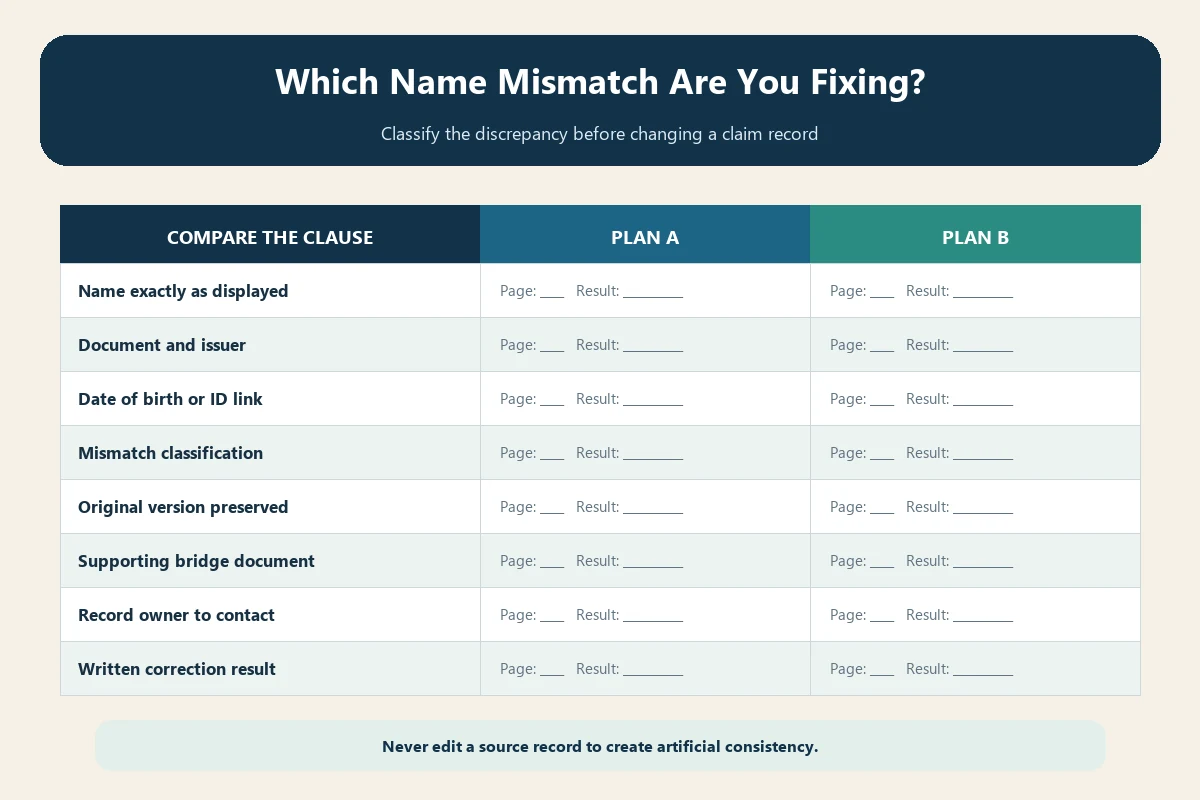
Add a final column labeled “requested action”: explanation only, policy endorsement, claim-profile correction, supplier correction, identity evidence, or payee update. One global “change my name” request can accidentally modify the wrong record.
Also record which organization controls each entry. An insurer cannot rewrite a passport, a bank cannot amend a policy, and a claimant cannot correct a hospital’s clinical record. Send a narrowly framed request to the record owner, retain its response, and give the claims administrator the resulting bridge. If an organization refuses to alter a historical record, ask for a dated letter confirming the person, transaction, and reason the displayed name remains unchanged.
Classify the mismatch into one of five types
- Formatting difference: omitted middle name, no space, shortened field, reordered name, or punctuation.
- Minor typo: transposed letter or data-entry error where other identifiers consistently identify one person.
- Legal name progression: marriage, divorce, adoption, or court-ordered change.
- Transliteration difference: the same name rendered differently from another alphabet.
- Identity conflict: another person was named or the policy may cover a different traveler.
The fifth category deserves immediate written review. It may concern eligibility or who was insured, not merely spelling.
Preserve the original policy and every version
Download the policy schedule, certificate, purchase confirmation, and any endorsement before requesting a change. Record the purchase date and effective date. If the insurer issues a corrected schedule, keep the original and correction notice together; do not delete the earlier version.
Use our original-versus-copy guide to protect irreplaceable records. A version trail shows what was entered, when the discrepancy was reported, and what the insurer changed.
Ask whether the policy or only the claim profile is wrong
A portal can display an account nickname while the issued policy remains correct. Conversely, correcting the online claimant profile may not amend the insured name. Ask the insurer to identify the authoritative record and confirm the result in writing.
State the exact current entry, requested entry, reason, supporting document, and whether the loss has already occurred. Never backdate a correction or describe a different traveler as a spelling mistake.
Build a legal name-change chain
For marriage, divorce, or a court order, link the former and current names with the relevant certified record. U.S. Customs and Border Protection advises travelers using documents in a prior name to carry proof of name progression, such as a marriage certificate, divorce decree, or court document.
Submit only what is relevant and use the insurer’s secure channel. If several changes occurred, create a simple chronological cover page: name A, event and date, name B, later event and date, current name C.
Do not manufacture consistency
Never overwrite a foreign invoice, boarding pass, medical record, card statement, or carrier letter to match the policy. Keep the source intact and attach a discrepancy note. An English translation should reproduce the original name and may add a translator’s note about alternate spellings.
Our foreign medical bill guide explains how to preserve originals and translations. The goal is traceability, not visual uniformity.
Connect the booking to the insured traveler
An itinerary shows what was booked, but not always who traveled. Combine the e-ticket receipt, carrier flown-status record, boarding pass, lodging folio, passport stamps where relevant, and payment evidence. Use matching dates, route, reservation number, and date of birth when names differ.
Follow the itinerary and boarding-pass evidence guide. Do not submit unrelated identity documents merely to increase volume.
Separate purchaser, policyholder, insured, claimant, and payee
One person may buy coverage for another, a parent may file for a child, an executor may act for an estate, and a provider may receive direct payment. A different purchaser name is not automatically an insured-name error.
Label each role on the cover page and cite the policy schedule or authority document. For a deceased insured, use our estate claim guide; for a living person lacking capacity, use the caregiver authority guide.
Handle a wrong insured person as a material issue
If the schedule names person A but the trip and loss concern person B, disclose that fact immediately. Provide the original application, purchase receipt, traveler list, ages, and communications. Ask whether the insurer treats the issue as an application correction, cancellation, reissue, underwriting question, or coverage dispute.
Do not submit the claim under A’s identity to obtain access and later replace the documents with B’s. That creates a misleading record and may complicate review.
Correct the claim form transparently
If the claim form is still a draft, enter the accurate name and attach the discrepancy note. If it was submitted, send a dated correction that identifies the affected field, original entry, corrected entry, reason, and attachments. Ask the administrator to confirm that both the claim system and policy record have been reviewed.
Generali’s U.S. claim portal, for example, uses a policy number to route a claimant and requires identity verification before payment setup. Procedures vary, so follow the instructions for the actual administrator and product.
Match medical, carrier, and supplier evidence by more than name
Use date of birth, service date, patient or reservation number, address, route, provider, and transaction amount to support the connection. A provider statement explaining its naming convention can be stronger than a claimant-created annotation.
For shared bookings, allocate each traveler’s costs using our family claim expense guide. A group invoice should not cause every expense to be assigned to the lead passenger.
Verify the payment name separately
Approval does not guarantee successful disbursement. Ask for the exact approved payee and compare it with the bank-account title or check-delivery record. Do not use another person’s account simply because that person coordinated the claim.
An iTravelInsured alternate-payee form warns about inconsistent beneficiary names and account identifiers. The correct process may require a formal alternate-payee authorization, not an informal email. Verify any payment request through an official channel using our claim payment security guide.
Use primary evidence for common scenarios
| Scenario | Useful evidence | Requested result |
|---|---|---|
| Missing middle name | Policy, ID, DOB, booking number | Written identity confirmation |
| Marriage or divorce | Old ID, current ID, certified linking record | Documented name progression |
| Transliteration | Original, translation, passport, provider confirmation | Alias or spelling note |
| Policy typo | Application, receipt, ID, prompt correction request | Endorsement or written decision |
| Wrong insured | Application trail, traveler list, purchase communications | Formal eligibility review |
| Payee mismatch | Approval, bank title, authority or alternate-payee form | Correct secure disbursement |
Write a concise discrepancy statement
Use factual language: “The policy schedule displays ‘Ana M Lopez’; the passport displays ‘Ana María López.’ Both show date of birth X. The airline omitted accents and the middle name. Attached are the unchanged records. Please confirm whether an endorsement or claim-file notation is required.”
Avoid conclusions such as “obviously the same person” or “harmless typo.” Let the insurer evaluate materiality while you provide the strongest bridge.
Track deadlines while a correction is pending
Do not wait for every record to be corrected before giving notice. Open the claim, disclose the discrepancy, submit available proof, and ask how to supplement. Record notice, proof-of-loss, supplier, medical-plan, appeal, and payment deadlines separately.
The main travel claim filing guide provides a complete submission workflow. Save the portal receipt and every correction confirmation.
Escalate a denial by addressing the stated reason
If the insurer denies or closes the file, request the precise policy language and factual basis. Determine whether the decision concerns identity, eligibility, late correction, misrepresentation, missing proof, or payment verification. A targeted response is stronger than resending the same documents.
Use the claim denial review guide. For a complaint about handling, identify the underwriting insurer and relevant state insurance department; the department does not rewrite the contract or decide every factual dispute.
Final correction checklist
- Preserve every original and policy version.
- Classify the discrepancy before asking for a change.
- Distinguish formatting, typo, legal progression, transliteration, and wrong person.
- Label purchaser, insured, claimant, representative, payer, and payee.
- Use official linking records and secure delivery.
- Correct each system explicitly and obtain written confirmation.
- Protect deadlines and keep a complete submission receipt.
A successful name-mismatch correction does not make every document look identical. It preserves the source records, explains why they differ, proves which person and trip they describe, and directs each correction to the organization that owns the record.
