

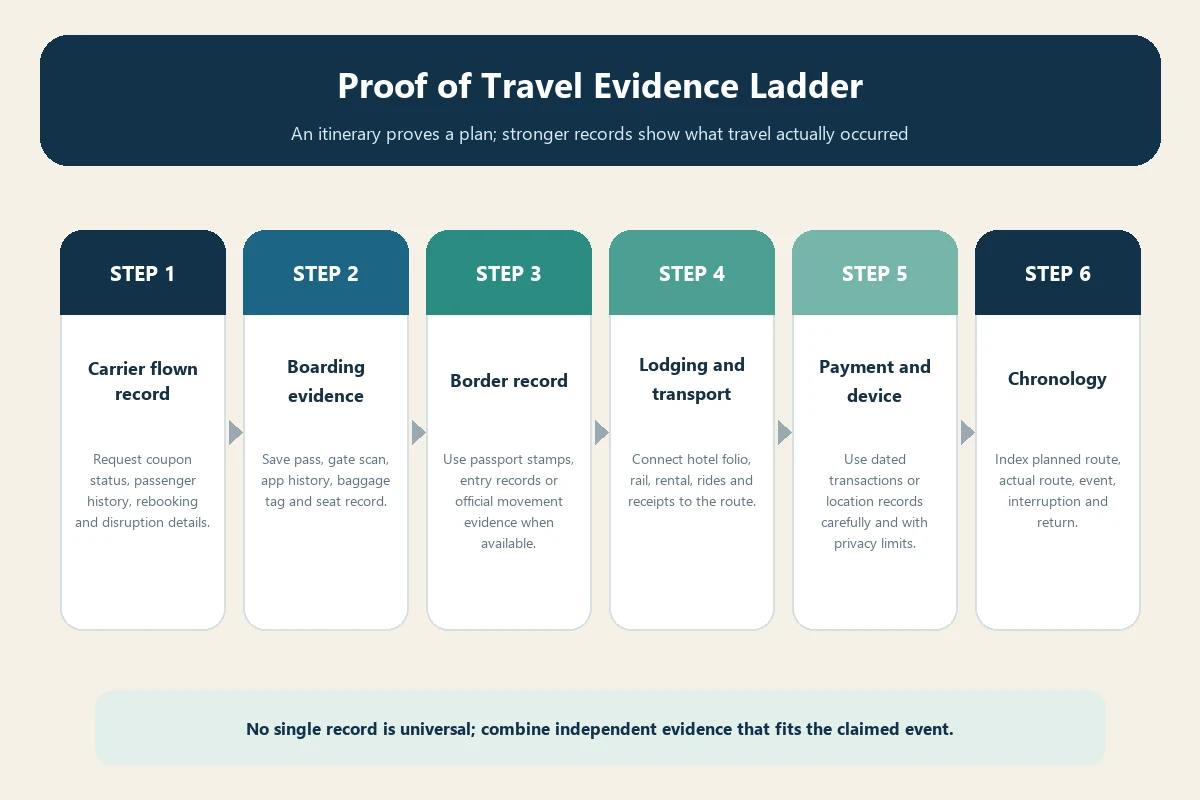
A travel insurance claim proof of travel itinerary boarding pass request asks two different questions: what was booked, and what actually happened. An itinerary or e-ticket receipt usually proves planned transportation. A boarding pass can show check-in and a flight segment, but it may not conclusively prove the passenger boarded. Strong claims combine carrier records with lodging, border, payment, event, and timeline evidence.
The required proof depends on the benefit. Cancellation can mean the trip never began. Interruption requires evidence that travel began and ended early. Delay, baggage, medical, and evacuation claims need records tying the traveler to the place and time of the event.
Key takeaways
- An itinerary shows scheduled plans; it is not always proof of completed travel.
- Ask the carrier for an e-ticket receipt, passenger record, flown-coupon history, or travel verification.
- Use passport or border records carefully; they may show entry but not every domestic segment.
- Build a dated segment table rather than sending an unsorted pile of confirmations.
- Protect the claim deadline while waiting for carrier or government records.
Why the benefit changes the proof
Trip cancellation occurs before departure under the policy definition, so proof may focus on prepaid arrangements and confirmation that they were canceled or unused. Trip interruption occurs after the trip begins, requiring evidence of the departure, the covered event, unused arrangements, and changed return.
Travel delay can require the scheduled and actual carrier times plus the reason. Baggage delay needs the carrier report and time the bag was returned. Medical treatment proves the traveler was at a provider, but the policy may still request itinerary evidence that the treatment occurred during covered travel.
Itinerary versus e-ticket receipt
An itinerary lists planned flights, trains, cruises, tours, or lodging. An e-ticket receipt normally adds passenger name, ticket number, fare, taxes, form of payment, issue date, and segment status. Submit both when available.
A reservation can be changed, canceled, refunded, or never ticketed. Verify that the document belongs to the insured traveler and the trip. A tour brochure without passenger name or payment is weak individualized proof.
What a boarding pass proves
A boarding pass identifies a passenger, carrier, flight, date, airport pair, and boarding group or seat. A mobile pass can disappear after travel, so save it before the trip ends. Paper passes fade; photograph them with the full document visible.
Issuance of a boarding pass usually shows check-in, but edge cases exist: a passenger can miss boarding after receiving it, be offloaded, or change flights. When actual travel is disputed, request the carrier’s flown status or travel verification.
Ask the carrier for stronger records
Contact the airline, rail line, cruise line, or tour operator and request the record it uses to confirm actual carriage. Names vary: flown-coupon status, passenger name record history, travel verification letter, final itinerary, onboard folio, embarkation record, or ticket usage statement.
Provide the traveler name as booked, confirmation and ticket numbers, travel dates, route, loyalty number, payment details, and current identification. Keep the request, case number, response, and any identity-verification instructions.
Retrieve digital records quickly
Search email, calendar, wallet apps, airline and hotel accounts, travel-agent portals, credit-card travel portals, and cloud photo backups. Export complete emails or PDFs rather than isolated screenshots. Keep sender, date, booking number, passenger, route, and status visible.
Do not alter an old itinerary to reflect what occurred. Preserve the original plan, then add the rebooking, cancellation, or interruption record so the change is auditable.
Passport stamps and border records
A passport stamp can corroborate entry or departure, but practices vary and some borders use electronic records. A stamp may not show domestic travel, a cruise port, or the precise covered event. Copy the identity page and relevant stamp only through the secure channel requested, and protect unrelated personal information as permitted.
Eligible non-U.S. travelers can review I-94 arrival/departure information through U.S. Customs and Border Protection. U.S. citizens or travelers seeking other records may need a different carrier or government process. Do not assume an I-94 record exists for every person or segment.
Hotel and lodging evidence
A final hotel folio can show guest name, property, check-in, checkout, room charges, and payment. It supports presence but does not prove the transportation used. Vacation-rental messages, access logs, tourist taxes, and host receipts may help when a conventional folio is unavailable.
A prepaid booking confirmation alone shows an intended stay. Ask for a final folio or host confirmation that the guest checked in, left early, or did not arrive.
Medical and emergency records
A hospital record, pharmacy receipt, ambulance report, assistance case, or police report can place the traveler at the event location and time. Pair it with the travel segment and insured dates. Our foreign medical bill guide explains how to preserve clinical, billing, translation, and payment records.
Medical documents contain sensitive information and should not be used more broadly than necessary. Review any medical-record authorization and use secure transmission.
Payment records
Card and bank statements can corroborate transactions at airports, hotels, hospitals, tolls, and restaurants. They usually do not prove who used the card or what happened. Pair them with itemized supplier records and explain payments made by a companion.
For foreign transactions, retain the original currency and final posting. Use our currency exchange claim guide rather than rewriting amounts.
Phone location and photographs
Dated photos, ticket-wallet history, and device location records can provide supporting context, but privacy and reliability matter. Metadata can be missing, changed by editing or messaging, or expose unrelated people and places. Do not treat a map screenshot as conclusive carrier proof.
Use such records only when relevant, explain the source, preserve originals, and ask the insurer what format it accepts. Redact unrelated information only as permitted and without changing the claimed evidence.
Cruise proof of travel
Keep the booking confirmation, passenger contract, embarkation pass, onboard account, port records, excursion receipts, medical-center record, disembarkation statement, and changed transportation. A cruise itinerary lists scheduled ports, but weather or operational changes can alter the route.
If the claim turns on a missed port, quarantine, early disembarkation, or ship delay, request the cruise line’s event-specific letter. A marketing itinerary is not proof the ship reached each port.
Road trips and independent travel
An independent road trip may have no single ticket. Build a route chronology with lodging folios, fuel or charging records, toll statements, rental documents, park reservations, medical records, and dated confirmations. Explain use of a privately owned vehicle and identify each traveler.
A self-created itinerary is an index, not independent proof. Link each segment to authentic records. If plans were informal, say so instead of inventing reservations.
Travel agents and booking portals
When a travel agent, employer portal, tour company, or credit-card platform issued the booking, the carrier may not show the original payment or complete itinerary in the traveler’s account. Request the agency invoice, passenger ticket numbers, supplier confirmations, payment allocation, change history, and final refund status. Identify whether the agency acted only as an intermediary or collected the funds.
Ask for records for the specific insured traveler, especially in a group booking. A group leader’s invoice can prove the package total without showing each participant’s cost or actual travel. Pair it with the passenger manifest, rooming list, ticket-use record, and proof of the traveler’s contribution. If the agent has closed, preserve returned messages and contact the underlying suppliers directly.
Build a segment table
Use one row per travel segment with scheduled departure and arrival, actual status, traveler, supplier, confirmation number, cost, proof of payment, proof of use, and disruption record. Add claim-document filenames. This lets the adjuster see planned versus actual travel.
For an interruption, include the last completed segment, unused segments, covered event, new return, and arrival home. Follow our trip interruption guide.
When the boarding pass is missing
- Download the e-ticket receipt and final itinerary.
- Check the airline or loyalty account for completed activity.
- Request a flown-status or travel-verification record.
- Add luggage tags, lounge receipt, hotel folio, or border record as corroboration.
- Explain why the boarding pass is unavailable.
- Submit before the deadline and supplement the carrier response later.
The same alternative-evidence principles appear in our claim without receipts guide.
Carrier disruption letters
For delay or cancellation, ask the carrier to identify the flight or service, scheduled and actual times, cancellation or delay, reason when available, rebooking, and final use or refund status. A generic airport weather screenshot may not prove what happened to the insured segment.
U.S. DOT consumer resources explain passenger rights and complaint channels, but the travel policy independently determines insurance coverage. Preserve both carrier and insurer deadlines.
Protect deadlines while proof is pending
Open the claim, submit the itinerary and available evidence, identify the requested carrier or government record, and provide the request date. Use our notice and proof-of-loss guide. Waiting for a historical travel record does not automatically pause the insurer’s clock.
FAQ
Is an itinerary enough?
It proves planned arrangements, but actual-use proof may be needed. Add ticket status, boarding, lodging, or other records.
Can an airline reissue a boarding pass?
Some provide travel verification or ticket-use history instead. Ask the carrier for its available completed-travel record.
Does a passport stamp prove the whole trip?
No. It can corroborate a border crossing but may not show route, domestic segments, cost, or the covered event.
What if I drove my own car?
Use a segment chronology supported by lodging, toll, fuel, reservation, and event records.
Bottom line
Proof of travel is strongest when planned and actual records agree. Preserve the itinerary, then add carrier ticket-use status, boarding evidence, border or lodging records, payments, and event documents. Build a segment-by-segment chronology and protect deadlines while official verification is pending.
Sources
- U.S. DOT — Fly Rights
- U.S. DOT — File an Air Travel Complaint
- U.S. Customs and Border Protection — I-94
- CBP — Records and FOIA
- NAIC — What to Know About Travel Insurance
- New York DFS — Travel Insurance
Reviewed August 16, 2026. This educational guide does not replace policy terms, carrier records, government eligibility rules, privacy advice, or an insurer’s claim decision.