
If your travel insurance claim check expired before deposit, do not alter its date or repeatedly present it. Preserve the payment details, confirm that the original was never paid, and ask the verified insurer or claim administrator for its check-reissue procedure.
A date printed on a check, a “void after” notice, a bank’s stale-check policy, and the claimant’s underlying right to an approved benefit are related but different issues. This U.S.-focused guide explains how to document, replace, trace, and escalate an old claim check. It is general information, not legal, banking, tax, accounting, or insurance advice.
What an expired or stale claim check means
The Consumer Financial Protection Bureau says checks more than six months old are called stale checks. A bank or credit union may choose to honor one, but federal law does not require it to do so, and state requirements differ. Review the official CFPB stale-check answer.
The check itself may print a shorter “void after 90 days” or similar notice. Do not assume that passing that date automatically erases the approved claim, and do not assume a teller’s willingness to accept the item guarantees final payment. The issuing bank can still return it, and the insurer may already have placed a stop-payment order or transferred the funds to a state.
| Status | Meaning to verify | Next record |
|---|---|---|
| Outstanding | Issued but not shown as paid or void | Issuer’s payment ledger |
| Stale or expired | Too old under a notice or bank policy | Check copy and rejection notice |
| Stopped or voided | Issuer directed that it not be paid | Stop-payment date and reason |
| Returned | Deposit was reversed or rejected | Bank return code and statement |
| Paid | Issuer’s record shows negotiation | Check image, endorsement, and trace |
| Escheated | Funds may have been reported to a state | Holder report or state property record |
Do not change or destroy the original
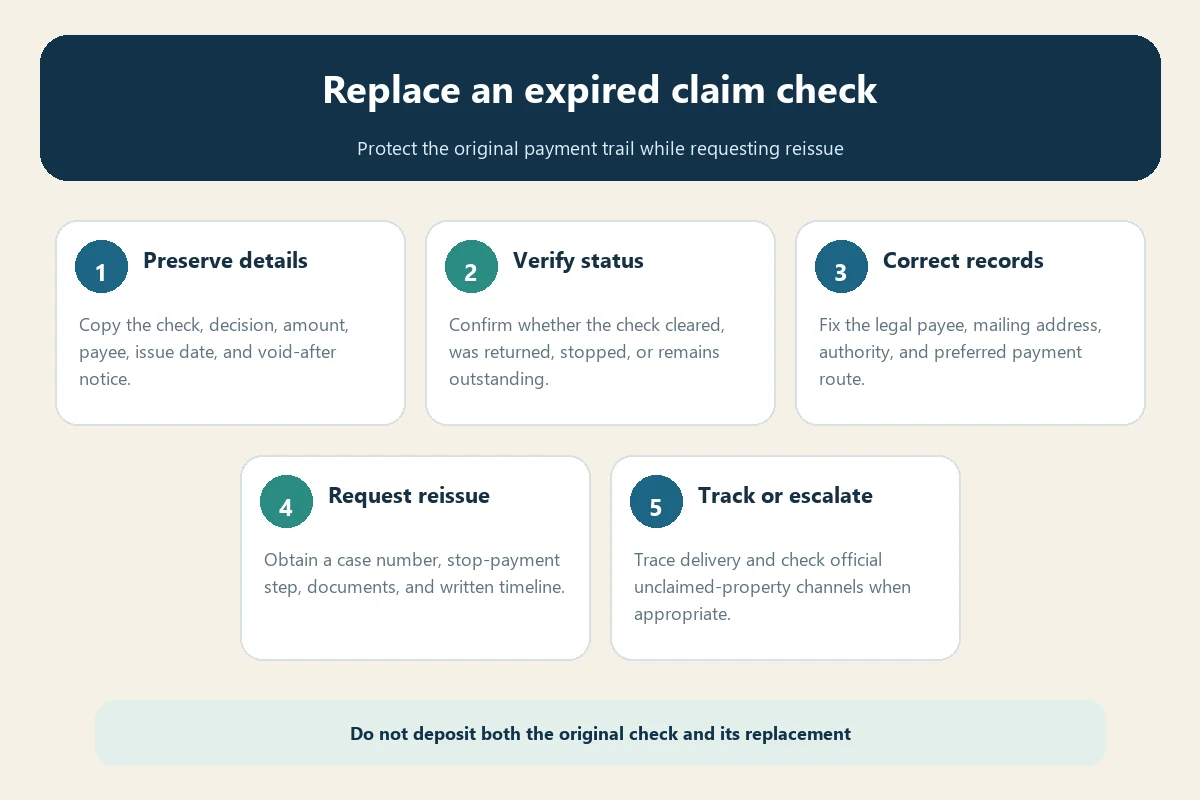
Do not overwrite the date, remove a payee, add an endorsement for someone else, edit the amount, or mark the check void unless the issuer instructs you in writing. Do not mail the only original without first making a clear front-and-back copy and recording delivery.
Capture the check number, amount, currency, issue date, payee, issuer, issuing bank, claim or memo reference, address used, security features, and any expiration wording. Save the claim approval, explanation of benefits, payment email, envelope, bank rejection, and account statement showing any attempted deposit and reversal.
Confirm whether the check was ever paid
Ask the claim administrator’s payment unit to check its ledger, not merely the claim screen. Obtain written confirmation whether the item is outstanding, stopped, voided, returned, cleared, replaced, or reported as unclaimed property. Record the representative, date, reference number, and exact answer.
If the issuer says the check cleared but you did not receive the money, request a trace and a copy of the paid item, including endorsement or deposit information available through its investigation process. Do not immediately characterize the event as fraud; a joint payee, provider, prior deposit, mobile-deposit duplication, estate account, or posting error may require investigation. If the image shows an unfamiliar endorsement, ask the bank and issuer for their unauthorized-endorsement or forgery procedure promptly.
Contact the correct payer through a verified channel
The legal insurer, third-party claim administrator, payment vendor, or program sponsor may have issued the check. Use the policy, official website, or authenticated portal to identify the correct contact. Do not send a check image, bank statement, Social Security number, or new account details to an address found only in an unexpected message.
The travel claim payment scam guide explains how to validate a requester, domain, payment vendor, changed instructions, and suspicious recovery fee. A legitimate reissue should not require gift cards, cryptocurrency, remote access to your device, or repayment of an unrelated “overage.”
Submit a complete reissue request
Ask for the exact form and submission method. A useful written request includes:
- claimant and policyholder names;
- policy, claim, and payment reference numbers;
- check number, issue date, amount, currency, and payee;
- why the original cannot be negotiated;
- confirmation that it was not deposited or transferred;
- current legal payee and verified delivery address;
- requested replacement method;
- copy of the check and bank rejection, if available;
- request number, assigned unit, and expected completion date.
Ask whether the original must be returned or destroyed, whether a lost-check affidavit or indemnity form is required, and whether the issuer will place stop payment before replacement. Read any affidavit carefully; do not certify that a check was lost if you still possess it or that it was never presented if your bank attempted deposit.
Understand stop payment and the replacement sequence
An issuer may need to confirm nonpayment, place a stop, wait for an internal control period, and obtain approval before producing a replacement. Ask which step is pending and whether the reissue retains the original claim amount and decision.
Once a replacement is authorized, do not deposit the original. If the old check later appears or a delayed deposit posts, notify the issuer and your bank immediately. Negotiating both items can create reversal, collection, or repayment problems.
Fix payee and address problems before reissue
A replacement that repeats the original defect wastes time. Compare the proposed payee with the claimant’s legal name and account ownership. Check for a former surname, spelling error, deceased claimant, minor, joint payee, medical provider, attorney, estate, assignment, or lienholder.
For a changed residence, use the claim address-change guide to update mailing and residency records through a verified channel. Ask whether the payment file and claim file are separate systems. Request written confirmation of the exact address and payee that will appear on the replacement.
If the payee is wrong, follow the claim name-mismatch guide. Do not endorse the check to an unintended person as a shortcut. Banks and issuers can impose different requirements for third-party or joint checks.
Choose check or electronic replacement deliberately
The administrator may offer another paper check, ACH, virtual card, digital wallet, or another disbursement route. Compare identity verification, fees, limits, expiration, delivery time, account ownership, reversal rights, foreign-account eligibility, and the ability to obtain a trace.
The claim payment method guide provides a check-versus-transfer review. If changing methods, use only the payer’s authenticated workflow and confirm that the change applies to this payment—not every future claim or policy transaction.
Track the replacement as a new payment event
Obtain the replacement issue date, amount, payee, method, and trace or check number. For mail, confirm the service, destination, sender, and estimated arrival. For ACH, confirm the last four digits of the destination account without exposing full credentials in ordinary email.
Maintain a simple timeline: original issuance, delivery or non-delivery, deposit attempt, bank return, first reissue request, documents submitted, stop-payment confirmation, replacement approval, dispatch, receipt, deposit, and final cleared date. “Mailed” is not the same as received, and “deposited” is not the same as finally cleared.
Reconcile the replacement with the claim decision
Check that the replacement matches the approved net payment. A reissued check should not silently change the deductible, benefit classification, currency conversion, offset, or partial-payment status. If the amount differs, ask for a revised written calculation before depositing it.
Use the partial claim payment guide when the check covers only some line items. Reissue of one expired payment should not be recorded as resolution of a separate unpaid or appealed amount unless the decision supports that conclusion.
When the claimant is deceased or cannot act
A check payable to a deceased claimant, estate, minor, incapacitated traveler, or dissolved business can require evidence of legal authority and a different payee. Do not sign the claimant’s name or deposit into an unauthorized personal account.
The deceased traveler estate claim guide explains how claimant, beneficiary, estate, executor, and payee roles can differ. Ask the issuer and qualified local adviser which documents and account title apply.
Check unclaimed property if significant time passed
After a state-specific dormancy period, an uncashed payment may be reported to a state unclaimed-property program. The claim administrator should tell you whether and when that occurred, the state, holder name, report year, and property reference. If the funds were transferred, the state—not the insurer’s ordinary check desk—may control the recovery process.
USAGov’s unclaimed-money guide says state governments hold most unclaimed money and identifies insurance policies as a common source. It recommends searching the official program for states where you lived. The National Association of Unclaimed Property Administrators directory links to official state programs. Searches through official state sites are free; avoid paying an unsolicited finder before checking them yourself.
Escalate a stalled reissue with evidence
If the promised date passes, send a concise status request with the claim number, original check, reissue reference, submission date, documents received by the company, pending step, and requested completion date. Ask for a supervisor or payment-resolution unit when front-line staff cannot see the disbursement record.
If internal escalation fails, identify the insurance regulator that has jurisdiction over the insurer and policy. The NAIC state insurance department directory links to official departments. Provide the policy, approval, check copy, bank response, reissue requests, delivery proof, and timeline. The regulator can explain its complaint process but does not replace private legal advice.
Bottom line
When a travel insurance claim check expires, protect the original evidence before seeking a replacement. Verify that it never cleared, identify the true payer, obtain stop-payment and reissue steps in writing, correct the payee and address, and track the new payment through final clearance. If the money is old enough to have left the issuer, use official state unclaimed-property channels rather than losing the approved benefit to an incomplete search.
