
You may be able to withdraw a travel insurance claim after filing, but do not treat withdrawal as a delete button. The administrator may retain the claim record, stop its review, cancel pending payment, mark the file withdrawn or closed without payment, and require a new claim if you later change your mind. Procedures vary by insurer and policy.
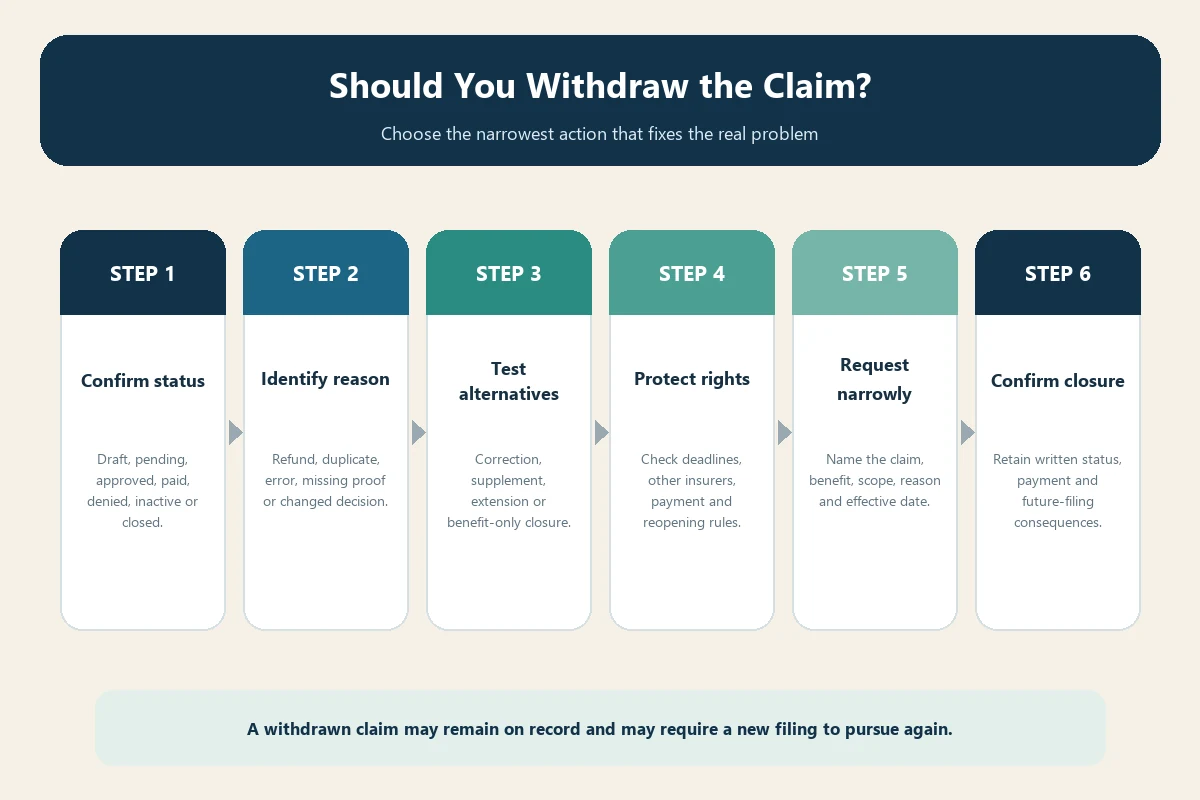
Before requesting withdrawal, identify why you want to stop and whether a correction, supplemental document, temporary extension, or simple status clarification would solve the problem. Obtain the consequence in writing before authorizing closure.
Withdrawal is not policy cancellation
Withdrawing a submitted claim asks the administrator to stop pursuing that loss. Canceling a policy ends or refunds coverage under separate policy terms. Canceling a trip concerns the supplier booking. These actions have different deadlines and effects.
Some plan refund or free-look rules change after a claim has been filed. Do not ask to “cancel everything.” State the policy number, claim number, benefit, loss date, and exact action requested.
Confirm the current claim status first
Download the portal page or request written status. A claim can be draft, submitted, pending documents, under review, approved, partially paid, denied, closed, inactive, or withdrawn. The remedy changes at each stage.
Use our claim status follow-up guide to identify the owner of the next action. Do not withdraw merely because a generic “closed” label appears; ask why it closed and whether a response or appeal remains available.
Write down the reason you are considering withdrawal
- The loss is fully refunded by the supplier.
- The amount is below a deductible or not worth pursuing.
- The claim was opened under the wrong policy, traveler, trip, or benefit.
- A duplicate claim was filed.
- Documents are temporarily unavailable.
- You disagree with a medical-record or interview request.
- The insurer has already approved or issued payment.
- You want to preserve a different remedy or coordinate another payer.
Each reason calls for different questions. A supplier refund may require an updated net-loss statement; a wrong benefit may be corrected; missing documents may justify supplementation; an issued payment needs reconciliation.
Do not withdraw a correctable claim by mistake
A typo, wrong upload, omitted receipt, incomplete form, or newly received refund can often be corrected within the existing file. Send a dated correction that identifies the original entry, accurate fact, reason, and replacement evidence.
For additional evidence or expenses, use our supplement and reopen guide. Ask whether the claim can remain open while a provider, supplier, or other insurer responds.
Distinguish a duplicate from a second benefit
One incident can support separate medical, interruption, delay, baggage, or evacuation reviews. Two claim numbers do not automatically mean one is duplicate. Ask the administrator to map each number to the insured person, policy, trip, event, and benefit.
If a true duplicate exists, specify which file should remain authoritative and request that all documents and correspondence be associated with it before the duplicate closes.
Update a claim after a supplier refund
A full cash refund may eliminate the claimed net loss, while a partial refund, restricted voucher, or refund for only one traveler may not. Send the original cost, cancellation, refund date, method, amount, credit restrictions, and remaining loss.
Use the supplier refund statement guide. Ask the adjuster whether it will close the benefit at zero, continue another benefit, or require a formal withdrawal.
Protect every deadline before stopping review
Withdrawal may not pause or restart notice, proof-of-loss, appeal, legal-action, supplier, chargeback, or health-plan deadlines. Calendar the earliest deadline and ask whether reopening or a new claim would be time-barred.
Do not rely on a phone statement that “you can always refile.” Obtain the relevant policy provision and administrator procedure in writing. Our notice and proof-of-loss guide separates the major claim deadlines.
Ask whether withdrawal is reversible
XCover’s help center, for one product workflow, says a claimant can request withdrawal in its Claims Center and that a withdrawn claim cannot be reopened; a new claim is required. That example proves why you must check the actual administrator’s rule before acting.
Other systems may permit reactivation, supplementation, reconsideration, or a new claim. Ask which path applies, whether the original notice date is preserved, and which documents remain attached.
Check for pending or completed payment
Before withdrawing, ask whether payment is approved, scheduled, initiated, mailed, settled, stopped, or returned. A withdrawal request sent after release may not prevent deposit. Do not cash or spend funds while asking the administrator to reverse the claim.
Follow our claim payment method guide for stop, trace, return, and reissue records. If payment already arrived, request written return instructions through a verified channel.
Consider other insurers and recovery rights
Travel insurance can coordinate with health plans, airlines, credit-card benefits, suppliers, and other policies. Withdrawing one claim does not automatically resolve duties to disclose another payment or preserve recovery documents.
Ask whether another payer needs the denial, EOB, closure letter, or proof that no payment was issued. A voluntary withdrawal may be less useful than a formal coverage decision when secondary coverage requires one.
Do not use withdrawal to conceal an error
If submitted information was inaccurate, correct it promptly and transparently. Withdrawal may stop the payment request but does not necessarily erase the record or remove an obligation to return an overpayment. Preserve the original and corrected facts.
For a name discrepancy, use our name mismatch correction guide. For duplicate recovery or a later refund, tell the administrator exactly what changed.
Verify who may authorize withdrawal
The insured, claimant, parent or guardian, executor, attorney-in-fact, or another accepted representative may have different authority. A family contact who uploaded documents might not be able to surrender another person’s claim.
Ask which signature and authority record are required. For an estate, use the deceased traveler estate guide; for incapacity, use the caregiver authority guide.
Prepare a precise withdrawal request
Include the insured name, policy number, claim number, loss date, benefit, current status, reason, scope, and requested effective date. State whether you intend to withdraw the whole claim or one benefit only. Ask the administrator not to interpret the request as policy cancellation.
Example: “Please withdraw only the trip-delay benefit under claim 123 because the airline reimbursed all claimed expenses on August 10. Do not cancel the policy or close the separately pending medical-expense benefit. Please confirm payment status and whether this withdrawal can be reversed or requires a new claim.”
Use the authenticated claim channel
Submit through the portal, secure message, verified email, fax, or mailing address stated by the administrator. Cover-More USA directs claimants to its claim system for filing, status, and correspondence; use the actual channel tied to your product.
Save the request, timestamp, delivery receipt, representative, and reference number. A phone call without written confirmation leaves the scope uncertain.
Review access and authorizations after closure
Withdrawal does not automatically revoke a medical-record release, representative authorization, portal delegate, or recurring supplier consent. Ask which permissions remain active, how they expire, and whether a separate revocation is needed. Do not demand deletion of records the administrator must retain, but request correction of inaccurate contact details and removal of unnecessary delegate access. Save the response with the closure confirmation so future correspondence is not sent to an outdated representative or insecure destination.
Require a written closure confirmation
The response should identify the claim and benefit, withdrawal date, payment amount if any, outstanding documents, whether the file remains on record, whether it can reopen, and whether a new filing deadline applies. Ask for clarification if it says only “closed.”
Do not assume a zero-dollar closure means denial or that a denial means withdrawal. Those dispositions can affect appeals and secondary claims differently.
What if the claim was closed for inactivity?
Inactivity closure is not necessarily voluntary withdrawal. Ask for the missing-items list, response deadline, decision status, and reactivation procedure. Submit a concise explanation and the available evidence rather than filing multiple new claims without instruction.
If the administrator has issued a formal denial, review the stated provision and appeal route with our claim denial guide.
Keep the record after withdrawal
Retain the policy, claim form, submission receipt, evidence index, correspondence, withdrawal request, closure confirmation, refund records, and any payment return. A future provider bill, supplier correction, other-insurance request, or dispute can make the history relevant.
Our claim record retention guide explains why withdrawal alone does not determine a safe destruction date.
Final decision checklist
- Current status and every open benefit are confirmed.
- The problem cannot be solved by correction or supplementation.
- Supplier refunds and other payers are reconciled.
- Deadlines and reopening consequences are written down.
- Pending payment has been checked.
- The requester has authority.
- The request defines exact scope and effective date.
- Written closure confirmation will be retained.
Allianz’s trip-cancellation claim checklist illustrates that submitting a claim begins a document process after supplier cancellation. Stopping that process should be equally deliberate and documented.
Bottom line
Withdraw a travel insurance claim only after distinguishing it from policy cancellation, correction, inactivity, denial, and partial-benefit closure. Confirm deadlines, payment, other coverage, authority, and reversibility first. Then send a narrow written request and keep a closure record that states exactly what happened.
