

Travel insurance for Belgium from USA trips should solve two practical problems: how a traveler will pay for unexpected medical care and how a tightly connected rail itinerary will recover from disruption. Brussels, Bruges, Ghent and Antwerp are easy to combine, but separate tickets and cross-border connections can create gaps that a generic “Europe plan” does not explain.
Key takeaways
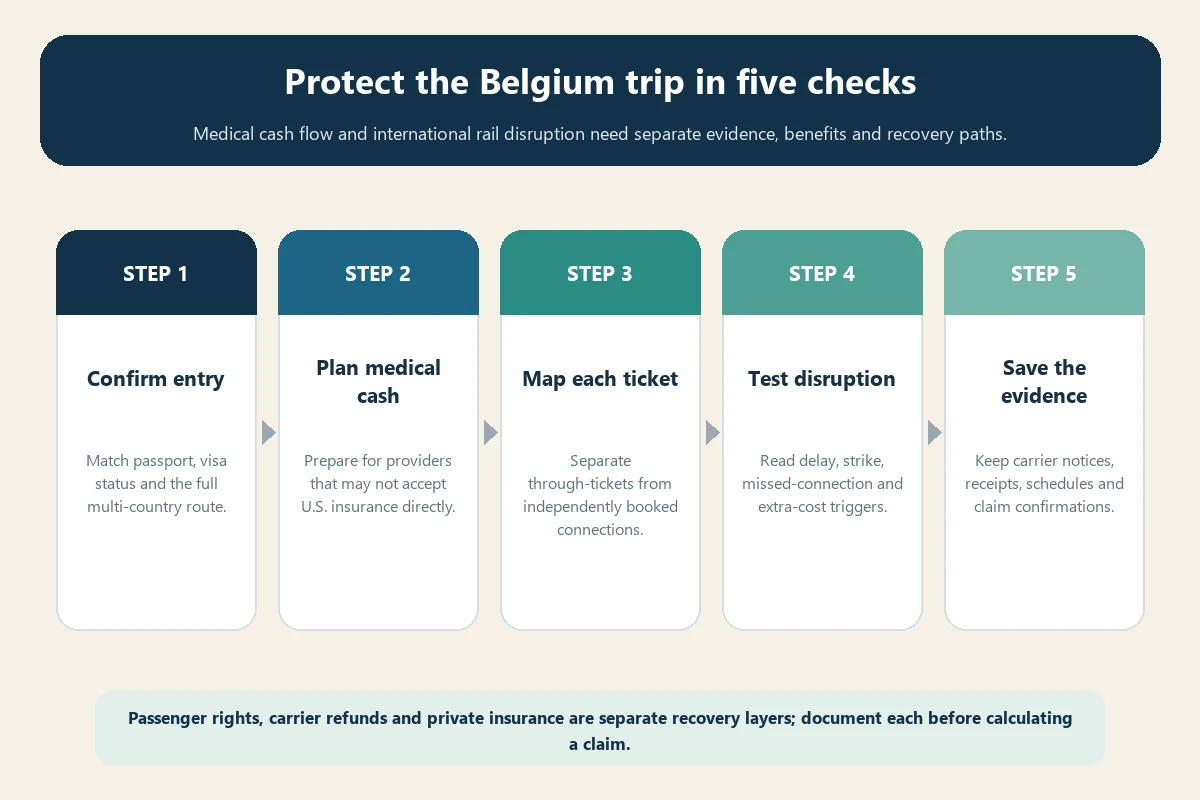
- Assume an overseas provider may request cash, card payment or a deposit unless direct billing is confirmed.
- Separate carrier passenger rights from private trip-delay and missed-connection benefits.
- Record every train, flight, country and overnight date before choosing the policy period and territory.
- Check primary versus secondary medical coverage, evacuation and the assistance process.
- Save carrier notices, unused tickets, replacement receipts and medical documents as events occur.
Planning information reviewed August 16, 2026. Carrier rules, timetables, entry procedures and policy terms can change; verify them for the booked journey.
Build a Belgium trip timeline first
List the journey from the U.S. departure through the return home. Include the overnight flight, first usable hotel night, airport transfer, domestic trains, Eurostar or other international rail, neighboring-country stays and the final airport connection. A Brussels-based trip may still enter through Amsterdam or Paris and include Luxembourg, Germany or the Netherlands.
This timeline determines the appropriate policy dates and exposes self-made connections. If a traveler buys a flight, airport train and international train separately, one carrier may have no contractual duty to protect the next ticket. Private insurance may help only when the event, timing and connection type meet the policy wording.
Use the multi-country Europe insurance guide when Belgium is one part of a wider route.
Entry proof and personal risk protection
A short U.S. tourist visit and a Schengen visa application are not the same process. Many U.S. citizens travel for short tourism without applying for a traditional Schengen visa, subject to current rules. A traveler who does require a visa may need a compliant insurance certificate. Passport, nationality, residence, purpose and length determine which procedure applies.
The Schengen insurance requirements guide covers the formal certificate question. A visa-exempt traveler may still purchase private coverage for medical bills, evacuation, cancellation, delay or baggage. That decision should be based on financial exposure, not on a claim that a policy guarantees entry.
Plan for medical payment in Belgium
The U.S. Department of State’s Belgium country information describes high-quality medical facilities and states that most overseas health-care providers accept cash payments. It also warns that hospitals and doctors abroad do not accept U.S. health insurance in the same way as a domestic provider and recommends adequate insurance, including evacuation coverage.
Belgium’s official health-care costs page explains its reimbursement and patient-contribution system for people covered within that framework. A U.S. visitor should not assume those resident or European-insured arrangements apply. Ask the U.S. health insurer and travel insurer how the actual overseas claim will be handled.
Verify these points in writing:
- Does the existing health plan cover emergency or urgent treatment in Belgium?
- Must the traveler pay the provider first and seek reimbursement?
- Is the travel plan primary or secondary to other collectible insurance?
- Can the assistance service issue a payment guarantee or identify a suitable facility?
- What deductible, coinsurance, exclusions and preauthorization rules apply?
The primary medical coverage guide explains the order in which plans may respond. It does not promise cashless treatment. Carry a usable payment method and a contingency reserve even when coverage appears strong.
Carrier rights and travel insurance do different jobs
European passenger-rights rules can provide assistance, rerouting or reimbursement in qualifying circumstances. The European Union’s official rail passenger-rights guide explains rights for cancellation, delay and missed connections under the applicable conditions. The operating carrier should be the first source for a disrupted journey.
Travel insurance is a separate contract. A trip-delay benefit may reimburse specified reasonable expenses only after a covered reason and minimum delay. A missed-connection benefit may require a delay involving a common carrier and may not cover an itinerary the policy excludes. Trip interruption normally applies only to listed or otherwise defined covered events.
| Protection source | Typical function | Question to ask |
|---|---|---|
| Rail carrier | Operational information, rerouting and applicable passenger rights | Is this one through-ticket or separate contracts? |
| Credit-card benefit | Limited delay or trip protection after eligible card purchase | Was the required fare charged to that card? |
| Travel insurance | Defined delay, connection or interruption reimbursement | What cause, waiting period and limit apply? |
| Traveler’s reserve | Immediate payment for food, hotel or replacement transport | Can the cost be carried until reimbursement? |
The Europe train-travel insurance guide provides a ticket-by-ticket audit for rail-heavy itineraries.
Strikes, timetable changes and foreseeable events
Do not assume every strike produces a claim. The contract may list strike as a covered reason, exclude labor action that was known when the policy was purchased or apply a specific definition and waiting period. Once disruption is announced publicly, buying a policy normally does not turn that known event into an unforeseen loss.
Save the carrier’s dated notice and stated cause. Ask the carrier to reroute or refund the affected service under the applicable rules. If private coverage may respond, call the insurer before purchasing a costly alternative when practical. Record why the replacement was reasonable and keep both used and unused tickets.
A schedule change made weeks before departure may be handled by the carrier rather than a delay benefit designed for an event during travel. Read the policy’s effective date, covered-event definition and claim instructions instead of relying on a general “trip disruption” label.
Test a real Brussels rail connection
Suppose a traveler lands in Brussels and books a train to Bruges, then later travels to Amsterdam on another reservation. Record the scheduled arrival, minimum transfer time, ticket relationship and last practical departure. Now test three scenarios: the inbound flight arrives late; the domestic train is canceled; the cross-border operator changes the schedule.
For each scenario, identify who provides rerouting, which extra costs might remain, and which exact insurance clause could respond. A benefit is useful only when the trigger, waiting period and limit fit the actual loss. A $500 delay maximum does not help if the delay is shorter than the required threshold or the cause is excluded.
Cancellation, interruption and refundable bookings
Calculate only the prepaid, nonrefundable trip cost at risk. Refundable hotels and flexible tickets should not inflate the insured amount. For each major booking, note its cancellation deadline and refund path.
Standard trip cancellation pays only for covered reasons defined in the policy. Fear of travel, a simple change of mind or an event known before purchase is commonly outside standard coverage. “Cancel for any reason,” when offered and purchased correctly, is usually a time-sensitive optional benefit that reimburses only a stated portion and requires cancellation before a defined deadline.
Trip interruption begins after departure and can involve unused prepaid arrangements plus eligible additional transport. It is not the same as a short rail-delay meal benefit. Compare the clauses independently with the Europe policy comparison guide.
Medical evacuation and repatriation
Emergency medical evacuation generally means medically necessary transport arranged or approved under the contract. The destination may be the nearest suitable facility, not automatically a U.S. hospital chosen by the traveler. Repatriation can refer to a later medically necessary return, and transport of remains is another defined service.
Ask who decides medical necessity, whether preauthorization is required and what happens if treatment begins before the insurer can be reached. The State Department notes that medical evacuation can be costly and recommends checking coverage. The repatriation guide helps distinguish these transport functions.
Create an evidence routine
Store the policy, schedule, assistance number, bookings and emergency contacts offline. During a medical event, collect the medical report, itemized invoice, prescription, payment receipt and any insurer authorization. During rail disruption, capture the original schedule, carrier notice, cause and actual arrival time.
For extra expenses, keep itemized receipts and a short note connecting each purchase to the event. Ask for a refund from the carrier or supplier where available; insurance normally reimburses only eligible unrecovered loss. Do not submit the same expense twice without disclosure.
The claim-filing guide organizes evidence by date, provider and benefit.
Belgium insurance comparison checklist
- Complete policy period, including overnight travel and all neighboring countries;
- emergency medical maximum, deductible and existing-condition treatment;
- direct-billing capability, reimbursement process and primary or secondary status;
- medical evacuation, repatriation and assistance authorization;
- trip cancellation and interruption reasons and insured-cost rules;
- rail delay, missed connection and common-carrier definitions;
- baggage, electronics and documentation sublimits;
- claim deadline, evidence requirements and appeal channel.
Compare the issued contract available in the purchaser’s U.S. state. If a sales summary and policy differ, the contract controls. Save the version in force on the purchase date.
Frequently asked questions
Is travel insurance required for every U.S. visitor to Belgium?
Not as a universal private-insurance requirement for every short U.S. tourist. Travelers who need a Schengen visa can face formal insurance-proof rules. Verify the current entry procedure for the specific passport and trip.
Will Belgian hospitals bill a U.S. insurer directly?
Do not assume they will. Ask the insurer about a payment guarantee or network facility and prepare for possible upfront payment and reimbursement.
Does a train strike automatically trigger travel insurance?
No. The policy must cover the cause and satisfy its timing, waiting-period and foreseeability rules. Carrier rights should also be used where applicable.
Are separate train tickets covered as one connection?
Only if the carrier or insurance terms treat them that way. Separate contracts can reduce through-journey protection, so inspect the ticket and missed-connection definitions.
Does EHIC protect a U.S. tourist?
The European Health Insurance Card is tied to eligible European public coverage. A U.S. traveler should not assume access and should verify personal insurance independently.
This article is educational and is not legal, medical or insurance advice. Official authorities, carriers, providers and the issued policy control.
