
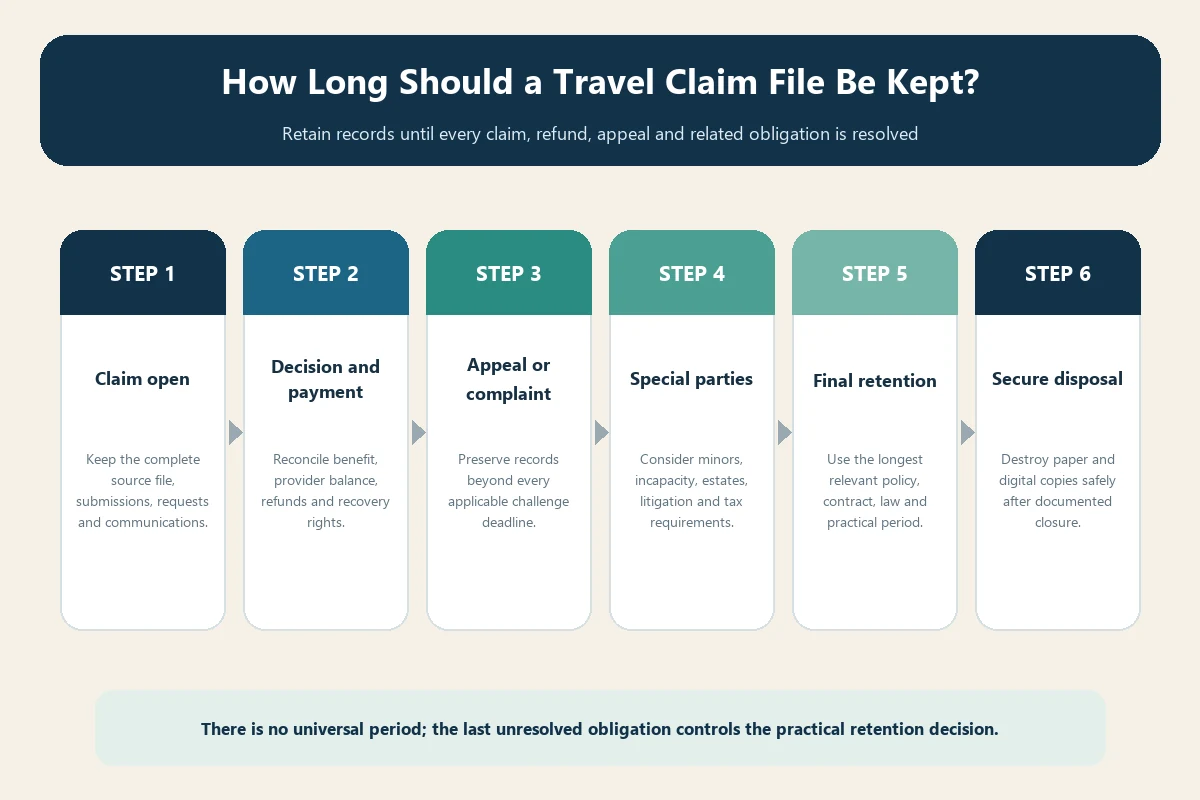
Keep travel insurance claim records until the last open issue closes, not until the payment date. That means holding the file while any benefit is pending or appealed, while any legal-action period is running, and while supplier refunds, provider balances, other insurers, or tax returns still depend on it. The IRS ties its own record periods to the situation, from 3 years in most cases to indefinitely if no return was filed, and travel claims work the same way. Build a trigger-based schedule, store the archive securely, and destroy it only when nothing remains open.
Key facts
- No universal number applies; retention ends when the last open trigger closes, not on the payment date.
- IRS record periods depend on the situation: 3 years in most cases, 6 or 7 for specific issues, indefinitely if no return was filed.
- Medicare claims must be filed within 12 months of the service date, so keep itemized bills at least that long.
- A portal label of closed is not a final decision; get a written line-by-line decision and payment confirmation.
- Insurer portal access can end and systems can migrate, so download your own complete archive while access remains.
- Your state insurance department can answer travel insurance questions and take complaints about an insurer.
Build a trigger-based schedule from the issued policy, decisions, applicable law, tax advice, provider balances, and personal circumstances. Keep sensitive records only as long as needed, protect them while retained, and destroy them securely when every reason to preserve them has expired.
Key takeaways
- Retain the file through final claim, payment, appeal, and legal deadlines.
- Wait for supplier refunds, chargebacks, provider balances, and other insurers to finish.
- Tax, estate, minor, and medical issues can require longer retention.
- Keep a final index and core policy records even after working duplicates are removed.
- Secure disposal is part of privacy protection.
Why there is no single number of years to keep claim records
Policies and state laws use different claim and legal-action periods. Tax record periods depend on the return and issue. Medical providers and health plans have separate records. Minors, estates, fraud, and litigation can extend practical needs. Insurers also have their own retention duties, which do not tell a claimant what is wise.
Do not copy a business record-retention schedule or another insurance line without checking the travel claim. Start with open issues, not a round number.
What to keep: the core claim file and the ten retention triggers
The complete file includes declarations, certificate, endorsements, purchase confirmation, itinerary, claim form, evidence, communications, assistance records, EOBs, provider bills, supplier refunds, decisions, appeal, payment trace, and final reconciliation.
Use stable filenames and a manifest. Our claim documentation guide provides the structure.
Trigger 1: claim status
Keep everything while any benefit is unsubmitted, pending, incomplete, under review, partially paid, denied, appealed, reopened, or awaiting payment. One claim number can contain several benefit statuses.
Obtain a written line-by-line final decision and payment confirmation. A portal label of “closed” is not enough. Use our status follow-up guide.
Trigger 2: appeal and legal action
Retain the issued policy, denial, appeal, evidence, communications, and delivery proof through every internal review, regulator complaint, and applicable legal deadline. Do not discard the file after an appeal decision without checking whether another limitation remains.
Legal-action provisions and law can be complex. Obtain qualified advice before a significant deadline. A regulator complaint does not necessarily pause it.
Trigger 3: payment delivery
Keep the decision, payee, ACH record, check copy, deposit, provider payment, and trace until funds are finally received, deposited, cleared, allocated, and reconciled. A lost check, rejected ACH, or wrong payee can surface after approval.
For direct hospital payment, retain the final provider ledger proving the insurer payment was posted and showing any patient balance or refund.
Trigger 4: supplier refunds and chargebacks
Airlines, cruise lines, hotels, tour operators, and card issuers can issue money or credits after the insurance payment. Keep original bookings, refund requests, final supplier statements, card disputes, and insurance recovery correspondence until every amount is final.
Use our later refund and recovery guide. A provisional card credit is not final closure.
Trigger 5: other insurance
Medicare, Medicare Advantage, employer plans, credit-card benefits, another travel policy, or a responsible third party can reprocess a payment. Keep every original and revised EOB, coordination letter, denial, and reconciliation until all payer decisions and appeals are final.
A revised first-payer decision can change what the travel carrier owes or recovers.
Trigger 6: medical provider balance
A foreign or domestic provider can bill later, post a payment incorrectly, refund a deposit, send a balance to collection, or issue a corrected bill. Retain itemized bills, clinical records relevant to the claim, receipts, EOBs, authorizations, translations, and final ledgers until the account is resolved.
Medical records can have independent health and legal value. Ask providers about access and obtain medical or legal advice for long-term needs.
Trigger 7: taxes
A travel loss, reimbursement, medical expense, business trip, settlement, or foreign transaction can have tax implications depending on facts. If a document supports an amount on a tax return, follow the applicable tax record period and professional advice.
IRS guidance explains that federal tax record retention depends on the action, expense, or event and the relevant limitation period. Do not assume insurance reimbursement is always taxable or nontaxable.
Trigger 8: estate and beneficiary
Claims after death can involve estate authority, beneficiaries, medical bills, repatriation, provider balances, refunds, and tax issues. Retain official death, consular, probate, beneficiary, payment, and expense records according to the estate process and advice.
Follow our deceased traveler claim guide. Do not destroy a power, order, or certified record because one insurer finished.
Trigger 9: minors and incapacity
Claims for minors or incapacitated travelers can involve guardianship, authority, protected funds, medical records, and longer legal periods. Parent or agent authority can change over time. Obtain jurisdiction-specific advice before disposal.
Keep the representative, custody, or court record separate from routine receipts and restrict access.
Trigger 10: investigation or fraud
If a claim involves identity theft, phishing, altered payee instructions, recorded statement, investigation, law enforcement, bank recall, or litigation hold, preserve all relevant evidence. Do not delete messages, logs, device records, or originals to reduce clutter.
Use our claim payment scam guide and follow official preservation instructions.
How to build a retention schedule and close the file
Use columns for record category, file location, sensitivity, claim benefit, open issue, responsible party, controlling deadline, closure evidence, review date, and destruction method. Set the retention end to the latest applicable trigger.
Examples:
- policy and endorsements: through all claim and legal issues;
- supplier refund file: through final cash, credit, or chargeback status;
- medical bills and EOBs: through provider, payer, tax, and legal resolution;
- appeal file: through final decision and applicable review or action period;
- estate records: under estate and legal advice; and
- working duplicates: remove when verified against the final archive.
Final closure checklist
- Every benefit has a written final status.
- Every payment cleared to the correct payee.
- Provider ledgers show correct balances.
- Supplier refunds, vouchers, and disputes are final.
- Other insurers completed processing and appeals.
- No repayment, subrogation, or overpayment issue remains.
- Tax returns and record periods are addressed.
- Estate, minor, incapacity, or legal issues are closed.
- No complaint, appeal, investigation, or lawsuit is pending.
If any answer is uncertain, keep the relevant records and set another review date.
How to store, protect, and dispose of the archive
Keep native PDFs, complete emails, portal exports, original-language records, and physical originals where needed. A screenshot or compressed scan can omit metadata or pages. Use our original document guide.
Before destroying paper, verify the digital copy is complete, readable, backed up, and legally sufficient for remaining purposes.
Secure storage
Separate highly sensitive identity, health, banking, minor, and estate records. Use encryption, strong authentication, limited access, and reliable backups. Do not leave the entire file in an open email folder or public cloud link.
Maintain recovery instructions so an authorized family member can access the archive during incapacity or death without sharing passwords casually.
Version control
Keep final and superseded documents labeled. A corrected provider bill does not make the original irrelevant when the reason for change is disputed. Retain a short change log.
Remove exact working duplicates only after confirming they are not unique submissions with timestamps or annotations.
Secure disposal
Shred paper containing personal, medical, financial, or claim data. Securely erase electronic media and accounts using methods appropriate to the device and sensitivity. Empty trash and cloud recovery locations only after verifying retention is no longer required.
NIST publishes media-sanitization guidance for organizations; consumers can use its principles and device-vendor instructions. Destroying a shortcut or moving a file to trash may not erase the data.
Do not rely on insurer retention
An insurer may retain records under its own rules, but portal access can end and claim systems can migrate. The carrier’s file may not include every original, personal note, supplier record, or delivery confirmation.
Download decisions and submissions while access remains. The claimant’s archive is the independent record.
Keep an archive readme
A future reviewer may not remember the trip or software used. Add a plain-text or PDF readme with traveler, policy, trip dates, claim numbers, benefit status, folder map, encryption or access instructions, and the person authorized to manage the archive.
Do not place passwords inside the same unencrypted folder. Store access recovery separately and update it when a representative changes. Use common, durable file formats for core records and test that the archive can be opened on another trusted device.
Separate retention from routine access
Long-term retention does not mean every family member or caregiver should have continuous access. Move closed sensitive files from daily-use folders into a restricted archive, record who can retrieve them, and log any disclosure.
This reduces phishing and accidental sharing while preserving evidence. When only one issue remains, keep the documents tied to that issue rather than circulating the entire medical or estate file.
Annual review
Review open claim archives at least periodically and after a decision, payment, refund, tax filing, estate event, or legal change. Update the matrix, remove unnecessary duplicates, test backups, and keep the next destruction date conditional on the latest trigger.
FAQ
Can I throw away receipts after payment?
Not until appeal, provider, refund, other-insurance, tax, recovery, and legal issues are resolved.
Is seven years always enough?
No universal number applies. Use the latest applicable contractual, legal, tax, estate, minor, and claim trigger.
Should I keep medical records longer?
They can have value beyond the claim. Obtain health and legal guidance for the relevant records.
Can I trust the portal to store everything?
No. Download a complete independent archive with confirmations and decisions.
Bottom line
Retain travel claim records until the last open trigger—not merely the payment date—has expired. Track claim, appeal, legal, provider, refund, other-insurance, tax, estate, minor, and fraud issues. Keep a secure final archive, review it periodically, and destroy sensitive records only when no valid reason remains.
Sources
- IRS — How Long Should I Keep Records?
- HHS — Your Medical Records Rights
- NIST — Guidelines for Media Sanitization
- FTC — Dispose of Devices Safely
- NAIC — What to Know About Travel Insurance
- NAIC — State Insurance Departments
Reviewed August 17, 2026. This article is general educational information, not legal, tax, medical-record, estate, privacy, or cybersecurity advice.
Sources and further reading
- How long should I keep records? — Federal tax record periods depend on the situation: 3 years in most cases, 6 years for substantial unreported income, 7 years for worthless-securities or bad-debt claims, indefinitely if no return or a fraudulent return was filed (Trigger 7 and key fact).
- Filing a claim | Medicare — Medicare claims must be filed no later than 12 months after the date of service and require the itemized bill, so itemized provider bills must be kept at least that long (Trigger 5 and key fact).
- Insurance Departments — The NAIC directory lets a consumer find their state insurance department and file a complaint against an insurer (Trigger 2 regulator complaint and key fact).
