
A travel insurance claim communication accommodation can help a claimant who is deaf, hard of hearing, blind, has low vision, a speech disability, cognitive or motor limitations, limited English proficiency, or another communication barrier. The practical request should identify the task and an effective format—not disclose an unlimited medical history.
This U.S.-focused guide explains how to request writing, accessible files, relay, captions, interpreter support, extended response time where available, or an authorized communication helper while protecting identity, privacy, evidence, and deadlines. Applicability of disability, language-access, insurance, and state law depends on the organization and facts; obtain qualified guidance for a legal dispute.
Define the communication task first
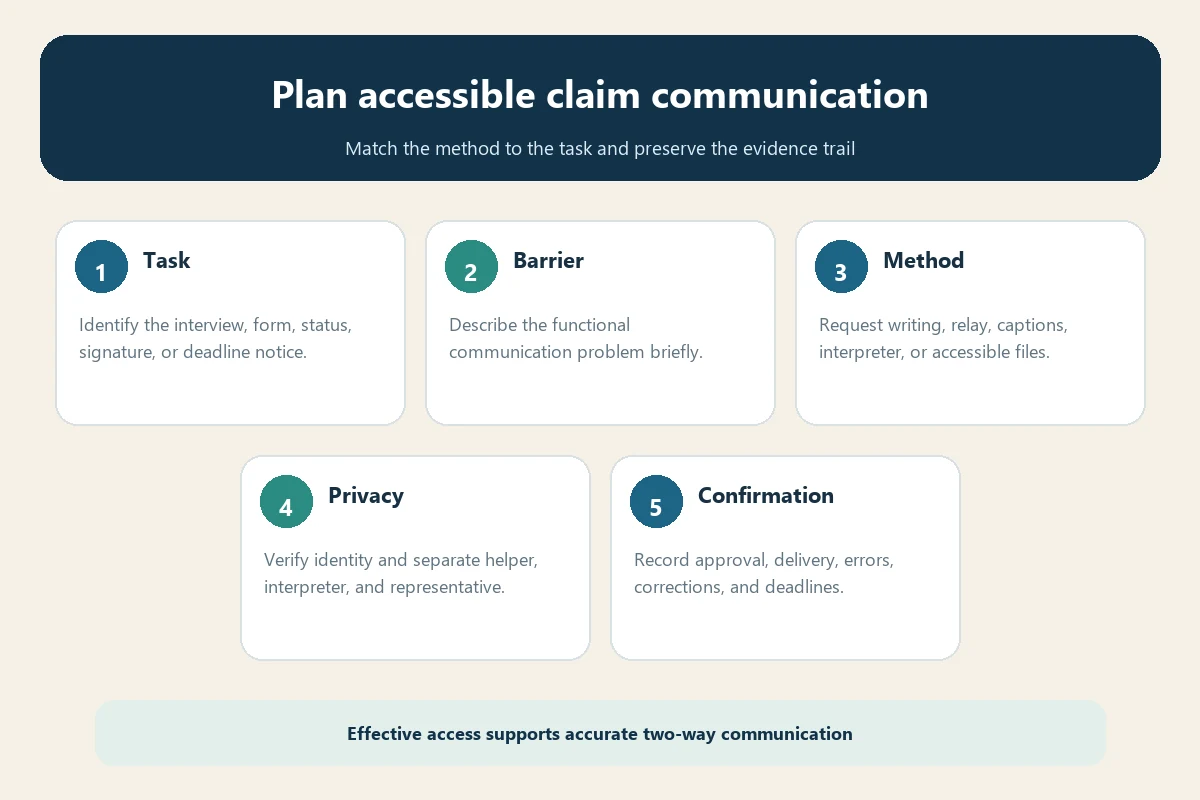
List each claim interaction and the barrier it creates.
| Task | Possible barrier | Possible effective format |
|---|---|---|
| Identity verification | Voice-only call | Secure written or relay-assisted verification |
| Recorded statement | Fast spoken questions | Captioned session, interpreter, breaks, written follow-up |
| Document review | Scanned image PDF or small print | Tagged PDF, large print, accessible digital text |
| Status updates | Automated telephone tree | Portal message, email, text, or relay |
| Signature | Inaccessible form controls | Accessible electronic form or approved alternate method |
| Deadline notice | Single unusable channel | Confirmed accessible delivery plus preserved original date |
Ask for an effective method, not one universal tool
One person may use American Sign Language; another may prefer real-time captions, text relay, speech-to-speech relay, large print, a screen-reader-compatible file, plain language, or written questions. Ask the claimant which method is effective for the task and whether a backup is needed.
ADA.gov’s effective communication guidance lists examples including qualified interpreters, real-time captioning, written materials, and telecommunications relay. It explains that the type of aid depends on the communication’s nature, length, complexity, context, and the person’s usual method. Use it as official general guidance; specific coverage and obligations require a fact-based legal assessment.
Submit a focused written request
Re: Claim [number]. I need an effective communication method for [specific task] because [brief functional barrier]. I request [preferred method], with [backup method] if needed. Please identify the accessibility contact, confirm the approved process and secure channel, and state whether any existing deadline or scheduled interview must be adjusted. I can complete the claim’s identity and evidence requirements through an accessible method.
Include the claim number and task, but avoid attaching medical records unless the administrator reasonably requests support and provides a secure route.
Use telecommunications relay without surrendering identity
The Federal Communications Commission’s TRS guide describes relay services that enable people with hearing or speech disabilities to communicate by telephone. Available modes can include text-based, speech-to-speech, captioned, IP, and video relay services.
Tell the claims team that a relay assistant or interpreter facilitates communication but is not automatically the claimant, representative, payee, or decision-maker. Ask how identity will be verified without requiring the relay professional to answer personal questions on the claimant’s behalf.
Do not share a portal password, one-time code, or full banking credential with an informal helper. Use the organization’s authorized process and secure channels.
Plan a recorded statement accessibly
A recorded interview can involve detailed chronology, policy terms, medical events, expenses, and prior submissions. Request the format before the appointment. Confirm interpreter or caption provider, platform accessibility, breaks, time zone, participants, recording, privacy, and how exhibits will be shared.
The recorded claim statement guide explains how to preserve the request, participants, questions, corrections, and transcript. An accommodation should improve accurate communication, not let someone replace the claimant’s firsthand evidence.
After the interview, request a transcript or written summary if available and promptly correct communication errors. Identify the question, inaccurate text, intended answer, and supporting record without rewriting unfavorable facts.
Keep interpreter and representative roles separate
An interpreter conveys communication between languages or modalities. An authorized representative may receive information, submit documents, or act within granted authority. A family member may provide practical support but does not automatically hold either formal role.
Ask who selected and pays the interpreter, what qualifications and confidentiality apply, and whether the claimant agrees with the arrangement. For complex, consequential communication, avoid relying on a child or conflicted person merely because they are available.
HHS effective-communication guidance discusses auxiliary aids and consultation with the individual in health settings. It is useful context for medical communications but does not by itself decide every private travel-insurance claim obligation.
Do not confuse communication interpretation with document translation
Live interpretation helps people communicate. Document translation creates a written version of a source record. A claimant may need one, both, or neither. Preserve the original foreign-language invoice, medical report, police record, or carrier notice.
The foreign medical bill translation guide explains when to ask whether the administrator translates internally, accepts an informal aid, or requires a professional translation. Do not replace the source document with an unverified summary.
Request accessible claim documents
Identify the unusable feature: image-only PDF, unlabeled fields, inaccessible CAPTCHA, poor heading order, missing alternative text, small print, low contrast, or a signature control that cannot be reached by keyboard. Ask for a tagged PDF, accessible web form, structured Word document, large-print version, or other effective alternative.
Keep both the original issued document and accessible version. Confirm that the content, revision date, fraud notice, authorization language, and signature fields match. An accessibility conversion should not silently change the legal text.
Use a secure alternative when the portal is inaccessible
Document the exact failure: screen-reader label, keyboard trap, CAPTCHA, timeout, unsupported file control, or inaccessible confirmation. Record browser, device, date, error text, and the claim step affected. Do not email sensitive records to a general inbox merely because the portal fails.
Ask the administrator for an approved accessible upload, secure message, encrypted transfer, fax, or postal method and request a delivery receipt. The claim portal upload problems guide explains how to preserve filename, version, page count, destination, and confirmation ID.
If a helper performs the upload, keep the claimant in control, use authorized access where available, and record who submitted each file. Remove temporary copies from shared devices while retaining the secured master and receipt. The accommodation should change access to the channel, not the authenticity or content of the evidence.
Handle signatures and authorizations carefully
A claimant may use assistive technology, an electronic signature, a mark, or another accepted method. Ask what the exact form permits and how a witness or representative should be identified. Do not paste an image of a signature into a different document.
The claim electronic-signature guide maps signer identity, intent, consent, document version, audit trail, and delivery. For medical releases, use the medical records authorization guide to check scope, recipient, expiration, and revocation.
Preserve deadlines while the request is pending
Submit the accommodation request early and record when it was received. Ask whether an interview, document response, appeal, or proof-of-loss deadline will be extended or fulfilled through an alternate channel. Do not assume the request automatically pauses time.
If a deadline arrives first, submit a protective response through any accessible approved method, explain the unresolved barrier, identify the accommodation request and confirmation number, and ask for written instructions. Seek qualified help when a material claim or legal limitation is at risk.
Build an accommodation log
For every interaction, record:
- claim task and scheduled date;
- functional communication barrier;
- requested and backup methods;
- request date, channel, and confirmation;
- accessibility contact and response;
- method provided and provider identity;
- technical or communication failure;
- deadline impact and written extension;
- correction or follow-up needed.
Keep disability information limited to what is needed for the request. Store interpreter notes, transcripts, and medical evidence securely.
Work through a phone-only example
A claimant with a speech disability receives a portal message requiring a telephone interview within seven days. The general call center repeatedly disconnects when a relay service announces itself.
The claimant should send a written request through the authenticated portal, identify the interview and deadline, request acceptance of the relay call or another effective method, and obtain a case number. The claimant should not ask a friend to impersonate them. The claims team can verify identity and schedule a supported interview using an approved channel.
If the seventh day approaches without a response, the claimant should submit a protective written statement documenting the attempts and ask for deadline instructions. After the interview, any relay or caption error should be corrected in writing and linked to the original question.
Escalate an unresolved access barrier
Ask for an accessibility coordinator, supervisor, compliance contact, or complaint channel. Provide the accommodation log and explain how the barrier blocks a specific claim task. Request an effective alternative and deadline protection rather than a general apology.
For insurance claim handling, the NAIC directory links to state insurance departments. For disability-law questions, use appropriate federal, state, or qualified legal resources. Jurisdiction and remedies depend on the entity, service, and facts.
Communication accommodation checklist
- Define the specific task and functional barrier.
- Request the claimant’s effective method and a backup.
- Verify identity without sharing passwords or codes.
- Separate interpreter, helper, and representative roles.
- Match accessible files to the original legal version.
- Plan captions, relay, interpreter, breaks, and exhibits for interviews.
- Correct communication errors in writing.
- Protect deadlines while the request is reviewed.
- Maintain a privacy-conscious accommodation log.
An effective claim communication plan makes the process understandable in both directions: the administrator can ask and verify necessary questions, and the claimant can receive, understand, and answer them accurately. Accessibility should strengthen the evidence trail, not replace it.
