

Europe travel insurance for rail passes can cover an eligible nonrefundable pass loss after a covered cancellation or interruption, but the unused value must be documented. The pass, seat reservations, booking fees and replacement tickets can follow different refund rules. Keep them as separate line items and pursue rail-provider remedies before claiming the remaining loss.
Key takeaways
- A rail pass and a seat reservation are separate costs.
- Activation status can change the pass provider’s refund options.
- Travel insurance needs a covered reason, not simply unused travel days.
- Record used days, refunds, credits and replacement transport.
- Rail passenger rights and policy benefits should be claimed separately.
Know what was purchased
A rail-pass itinerary can contain several products:
- Pass: continuous validity or a fixed number of travel days within a period.
- Seat reservation: a separate booking required or chosen for a specific train.
- Supplement: sleeper berth, premium service or other upgrade.
- Booking fee: a service charge from a pass seller, reservation service or agency.
- Point-to-point ticket: a separate ticket for a train not fully covered by the pass.
Put each item on the trip-cost sheet with its seller, payment date, refund rule and proof. Do not enter “rail pass $1,200” when the total includes a $900 pass and $300 of independently refundable reservations.
The broader Europe train travel insurance guide covers through-tickets, separate contracts, delays and baggage. This page focuses on valuing and documenting a pass.
Before activation: determine the provider refund
If a covered event cancels the trip before departure, first ask the pass seller what can be refunded. The current Eurail refund guidance distinguishes mobile and paper passes and ties eligibility to use, activation status and request deadlines. Promotional products can have different conditions.
Save:
- order confirmation and payment receipt;
- pass type, class and validity period;
- activation status and last activation date;
- refund request and seller response;
- deducted fee or retained amount; and
- separate reservation refund decisions.
The travel-insurance claim normally starts with the eligible amount that remains after refunds or credits. A missed provider deadline can create an avoidable loss that the policy may not pay. Request the provider refund promptly while also notifying the insurer.
After activation: value the unused portion
Once a pass has been activated or partly used, the provider may not issue an ordinary cancellation refund. Travel insurance still does not automatically treat the full purchase price as lost. The certificate’s trip-cost and interruption rules control.
Build an unused-value ledger:
| Record | Evidence | Why it matters |
|---|---|---|
| Original pass cost | Seller invoice and payment | Establishes the maximum starting value |
| Validity type | Pass terms | Continuous and flexible days are not valued identically |
| Days used | Travel diary or app history | Shows the benefit already received |
| Days remaining | Activation and validity record | Defines what became unusable |
| Provider recovery | Refund, credit or denial | Reduces the net insured loss |
| Reason travel stopped | Medical or other event proof | Connects the loss to a covered reason |
Do not choose an allocation method without the insurer. A simple cost-per-day calculation may not match how the certificate values unused travel arrangements. Ask the claims team what documentation and calculation it requires.
The trip interruption guide explains why a covered reason, unused nonrefundable cost and additional transport must be separated.
Seat reservations are separate claims records
A pass can remain valid while a reservation is canceled, missed or no longer usable. Record every reservation separately:
- train number, date, route and operator;
- reservation seller and booking reference;
- seat, berth or cabin charge;
- refund and exchange terms;
- cause of nonuse; and
- operator or seller response.
A traveler who misses a sleeper reservation after an earlier delay may have rail-pass value, reservation value and replacement lodging in the same incident. Each item may go to a different provider or policy benefit. The missed-connection guide helps test whether the insurance wording includes the arriving train and the onward reservation.
Rail passenger rights come before the net insurance claim
EU passenger rights can apply to qualifying delayed or canceled rail services even when travel is made with a pass. The official Your Europe rail-rights guide describes rerouting, reimbursement, assistance and delay compensation, with possible service exemptions.
For recurrent delays during a pass validity period, compensation follows the railway company’s arrangements. The European Commission’s rail passenger rights page links to the governing framework, national exemptions and the common claim form.
Keep carrier compensation separate from an insurance reimbursement. Carrier compensation may address inconvenience or ticket value, while the policy may consider reasonable additional expenses after its own waiting period. Disclose every refund, voucher and payment to prevent duplicate recovery.
Trip delay with a pass
A pass does not remove the need to prove a specific delayed service. Save the planned train, activated travel day, official delay record and actual arrival time. For insurance, verify:
- the train is a covered common carrier;
- the cause is covered;
- the minimum delay is reached;
- meals, lodging and transport are eligible; and
- the expense remains after rail assistance or reimbursement.
The trip-delay reimbursement guide provides a claim ledger for the waiting period, daily cap and itemized expenses.
Cancellation and interruption are different
Cancellation applies before the insured trip begins. The key questions are whether the pass and reservations were prepaid, eligible and nonrefundable after a covered reason.
Interruption applies after the trip begins. The claim can include an insurer-approved value for unused arrangements plus eligible additional transport to return home or rejoin, subject to the certificate.
Delay addresses temporary extra costs. It does not normally convert every future unused pass day into a delay expense.
Use the cancellation, interruption and delay comparison before assigning costs to a benefit.
Lost, stolen or inaccessible passes
When a paper pass, phone or account access is lost, contact the pass provider immediately. The provider may have a replacement or recovery process for the specific product. The current Eurail loss and theft guidance notes that activated pass protection is not automatically supplied by the pass product and directs mobile-pass users to support.
Travel insurance may treat the loss as baggage, travel documents or neither. Check:
- whether tickets and passes are excluded property;
- cash-equivalent or negotiable-document exclusions;
- device and electronics sublimits;
- police-report requirements;
- provider replacement options; and
- reasonable extra transport while access is restored.
The baggage and lost-property guide explains sublimits, custody and proof of ownership.
Multi-country and reservation gaps
A global pass does not guarantee a seat on every train. Some high-speed, international and overnight services require reservations or supplements; availability can be limited. A policy does not turn lack of a reservation into a covered delay.
Map every critical train and identify:
- whether the pass is accepted;
- whether a reservation is mandatory;
- the reservation release date;
- separate ticket or supplement cost;
- connection contract status; and
- the fallback route.
Use the multi-country Europe worksheet to connect rail days with hotels, ferries and flights that would be affected by a disruption.
Use a clean reimbursement order
When one disruption affects several rail products, submit requests in a traceable order. First ask the operating railway for rerouting, assistance and any passenger-rights payment. Then ask the reservation seller about the unused seat or berth. Ask the pass seller about pass-specific compensation, refund or restoration. Finally, give the insurer the complete outcome and claim only the eligible amount that remains.
Do not wait for every provider to finish before notifying the insurer if the policy has a prompt-notice deadline. Open the claim, explain which recoveries are pending and update the file as decisions arrive. Keep a single ledger with the request date, claim number, amount requested, amount received and reason for any denial. This prevents a voucher from being overlooked and shows why the final insurance amount differs from the original pass price.
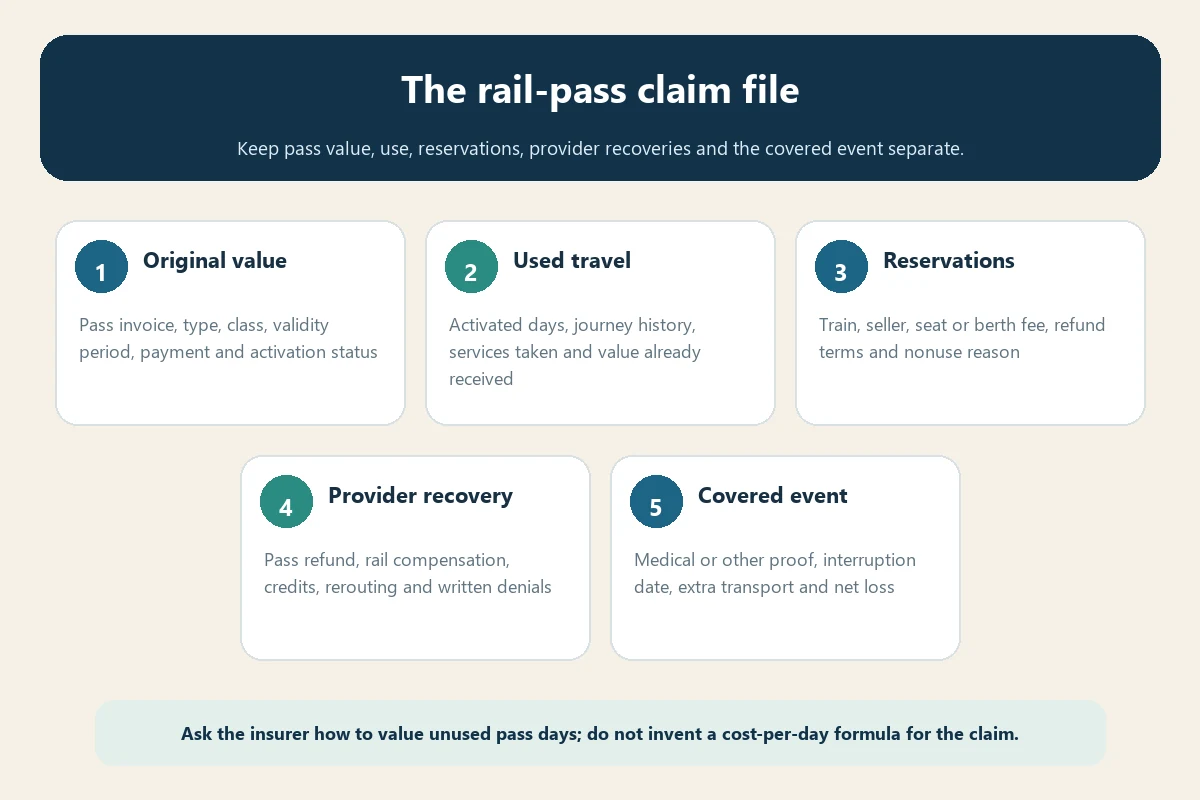
The rail-pass claim file
- Pass invoice and current terms.
- Activation date, validity period and pass type.
- Travel calendar showing used and remaining days.
- Separate reservation and supplement receipts.
- Planned itinerary and actual travel record.
- Delay, cancellation or medical-event proof.
- Pass seller and train operator claim responses.
- Refunds, credits and compensation.
- Replacement ticket, lodging and meal receipts.
- Written insurer instruction on unused-value calculation.
Use the Europe policy comparison worksheet before purchase to record how each plan treats travel passes, reservations, interruption and common-carrier delays.
A rail-pass insurance checklist
- □ Pass type, validity and activation deadline saved.
- □ Refund rules checked before activation.
- □ Pass, reservation, supplement and fee costs separated.
- □ Every critical train’s reservation requirement mapped.
- □ Trip-cost update rules understood.
- □ Cancellation, interruption and delay clauses compared.
- □ Rail passenger rights and pass compensation process saved.
- □ Loss or theft treatment confirmed.
- □ Travel calendar and receipts stored offline.
- □ Claims valuation method will come from the insurer.
Frequently asked questions
Can travel insurance reimburse an unused rail pass?
It can reimburse eligible unused nonrefundable value after a covered cancellation or interruption, subject to the certificate. Provider refunds, used days and recoverable credits must be documented first.
Are seat reservation fees included with the pass claim?
Not automatically. Reservations are separate purchases with their own seller and refund terms. List each one separately and prove why it became unusable.
Does a train delay restore an unused travel day?
The pass provider and railway operator decide their own remedy. Insurance evaluates eligible unreimbursed costs under its delay or interruption wording; it does not control pass activation.
What proof shows the unused portion of a mobile pass?
Save the order invoice, activation and validity details, app travel calendar, journey history, remaining days, provider response and the insurer’s required valuation method.
