

Schengen travel insurance dates should cover every local calendar day of the visa applicant’s intended stay or transit in the Schengen area. Build the window from the actual entry and exit points, not from the number of hotel nights or the US flight-departure date alone. Then decide whether the policy should extend beyond the visa minimum to protect the complete journey.
Key takeaways
- For visa compliance, Article 15 focuses on the entire intended stay or transit in the Schengen area.
- US departure and Schengen arrival can fall on different calendar dates because of overnight flights.
- The final Schengen exit and arrival home can also be different dates.
- A universal 15-day insurance buffer is not stated in Article 15; local instructions and policy needs control.
- After an itinerary change, update both the policy and the insurer-issued certificate.
The legal date rule
Article 15 of the EU Visa Code says travel medical insurance must cover the entire period of the person’s intended stay or transit and remain valid throughout the relevant territory. For a multiple-entry visa application, the applicant proves insurance for the first intended visit and acknowledges the need for insurance on later stays.
The official rule is therefore itinerary-based. It does not say “the number of hotel nights,” “the flight time from the United States” or “the full validity period of whatever visa is later issued.” The European Commission Visa Code handbook specifically explains that insurance need cover the applicant’s stay rather than automatically the entire period of visa validity.
Our Schengen visa insurance requirements guide explains the other elements—amount, territory and required benefits. This page isolates the calendar problem so the correct dates can be calculated and proved.
Use two date windows, not one assumption
A US traveler can have two relevant windows:
| Window | Start point | End point | Why it matters |
|---|---|---|---|
| Schengen visa window | First local date of entry into the Schengen area | Final local date of exit from the Schengen area | Proves cover for the intended stay or transit |
| Complete-trip policy window | Date coverage begins under the policy, often tied to departure or the insured journey | Date coverage ends under the policy, often tied to return | Can protect travel days outside the Schengen stay, subject to the contract |
The complete-trip window may be longer. That can be sensible for medical problems or disruptions during a US departure day, a non-Schengen stop or the return journey. It does not change the visa application’s itinerary. Confirm how the insurer defines trip start, trip end and medical coverage dates rather than assuming every benefit uses the same clock.
How to choose the start date
Step 1: find the first Schengen entry
Read the itinerary segment by segment. Identify the airport, port, rail station or land border where the traveler first enters the Schengen area. Record the local calendar date at that location.
Example: a flight leaves New York on June 3 and lands in Paris on June 4. For the Schengen stay, June 4 is the arrival date. A policy designed to cover the whole trip may begin on June 3. Both facts can be true; the applicant should not confuse the visa window with the broader insurance choice.
Step 2: check connections and transit
A connection can be the first Schengen entry even when the final destination is elsewhere. Airport-transit rules depend on the route, nationality, terminal movement and whether the traveler enters the Schengen territory. Use the official itinerary and visa guidance for the specific connection rather than applying a universal airport rule.
The European Commission’s Schengen visa application page distinguishes short-stay and airport-transit visas and links to the relevant country authorities. When in doubt, ask the competent authority which date and visa route apply.
Step 3: include pre-arrival days only for a reason
Starting the policy before Schengen arrival can cover the outbound journey if the product permits it. Do not add days merely because a blog claims they are legally mandatory. Extra days should reflect the full-trip protection desired, the insurer’s definitions and the responsible consulate’s document instructions.
How to choose the end date
Step 1: find the final Schengen exit
Locate the last itinerary segment that leaves the Schengen area. Use the local date at the exit point. A morning flight from Rome to New York and an evening arrival in New York occur on the same date; an itinerary through a non-Schengen stop or across the International Date Line can create a different result.
Step 2: include the departure calendar day
Coverage should not stop at the beginning of the departure date when the traveler remains in the Schengen area for part of that day. Check the policy’s effective time and time-zone language. A certificate that displays dates without times should span the full calendar dates used in the itinerary.
Step 3: consider the return journey
The visa minimum centers on the Schengen stay or transit, but the travel risk may continue until the traveler reaches home. Review whether an additional return day is appropriate for the complete-trip policy window. Do not assume the medical, delay, interruption and baggage benefits all terminate in the same way.
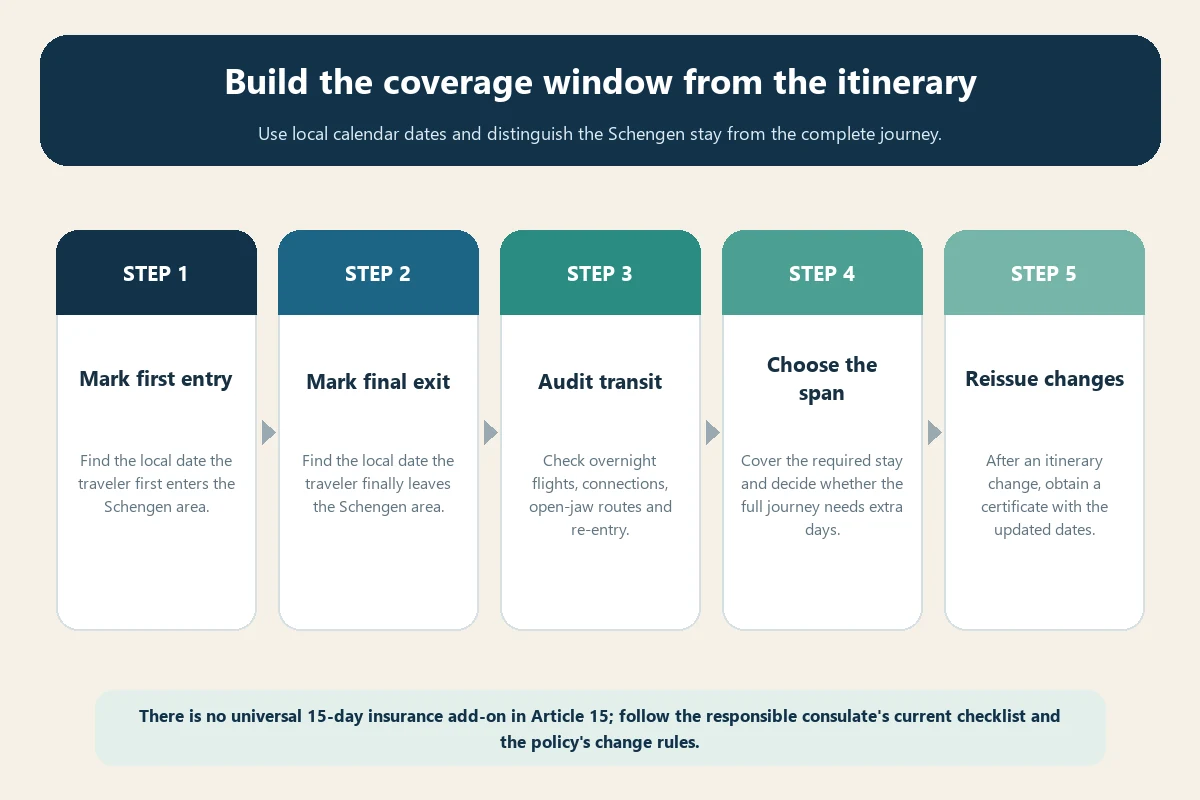
Do you need a 15-day insurance buffer?
Article 15 does not impose a universal rule that every insurance policy must add 15 days. The Commission handbook and its insurance guidance distinguish the intended stay from a longer visa-validity period. Search results that turn visa flexibility into an automatic insurance add-on oversimplify the rule.
A practical buffer can still be useful if the itinerary may shift and the insurer allows unused or extra days at a reasonable cost. Treat that as a planning decision, not a legal constant. Check:
- whether the consulate’s current checklist requests a particular margin;
- whether the certificate can show a broader valid period without contradicting the itinerary;
- whether benefits apply on every extra day or only during a defined trip;
- whether changing dates later is free, limited or unavailable; and
- whether a longer duration changes the premium or eligibility.
The German Missions in the United States insurance sheet, for example, requires the duration of cover to be valid for the entire stay. Use it as a jurisdiction-specific example and check the authority handling the actual application.
Open-jaw and multi-country itineraries
An open-jaw trip enters through one city and leaves from another. The policy window must not stop when the traveler leaves the main destination for a second Schengen country. Record the first Schengen entry and final Schengen exit across the entire route.
Our Europe open-jaw insurance guide addresses missed connections, separate tickets and return-transport issues. For the visa certificate, the central date question remains whether every intended Schengen day is inside the displayed coverage period.
Trips that leave and re-enter Schengen
A traveler may spend several days in the Schengen area, visit a non-Schengen country and then return. Plot every entry and exit. A continuous policy covering the whole journey can be simpler than separate fragments, but the certificate and terms must still prove the required stay or stays.
Do not assume a non-Schengen interlude pauses a policy’s day count. Some plans use consecutive calendar days from the effective date. Others define one insured trip. Read the wording and ask for written confirmation if the schedule is unusual.
What happens when the itinerary changes?
If flights, dates or entry points change before the appointment, update the insurer and obtain a new certificate before submission. If they change after submission, follow the consulate’s instructions for additional documents. Do not edit the PDF or rely on an email that is not connected to the policy record.
After visa issuance, confirm that the actual trip remains insured. A visa-validity window does not automatically extend a shorter insurance contract. Contact the insurer before the current end date if the journey changes; extension availability, waiting periods and coverage continuity are policy-specific.
The Schengen certificate guide gives a document-correction workflow. If an incorrect date has already caused an insurance proof problem, use the status and response steps in the Schengen insurance rejection guide.
Purchase date is not the same as coverage date
Buying insurance today does not necessarily mean every benefit begins today. Cancellation protection, pre-existing-condition provisions and travel medical benefits can use different triggers and deadlines. The certificate’s travel dates are only one layer.
Use the Europe travel insurance timing guide to distinguish purchase deadlines from the insured journey. Save the quote, policy and revised certificate after any date change so the record shows which terms apply.
Date audit before submission
- What is the local date of first entry into the Schengen area?
- What is the local date of final exit?
- Does a connection create an earlier entry or later exit?
- Are overnight flights and time zones reflected correctly?
- Does the certificate include every required calendar day?
- Does the complete-trip policy need a longer outbound or return window?
- Is any buffer based on official instructions or a deliberate planning choice?
- Do all Schengen entries and re-entries fit inside the coverage span?
- After a change, were the policy record and certificate both reissued?
- Does the final certificate match the itinerary in the visa file?
Add this review to the Europe trip insurance checklist so transport, lodging, insurance and traveler details are reconciled in one pass.
General educational information, not legal, visa, medical or insurance advice. Requirements, transit rules and document practices vary and can change. Confirm the current instructions with the consulate or official visa authority responsible for the application and read the issued policy.
Planning repeated visits? Use the multiple-entry Schengen visa insurance guide to separate first-trip proof from the coverage and records needed for every later journey.
Staying longer than planned? Follow the Schengen travel insurance extension workflow before the current policy ends, and treat any visa extension as a separate official process.
